
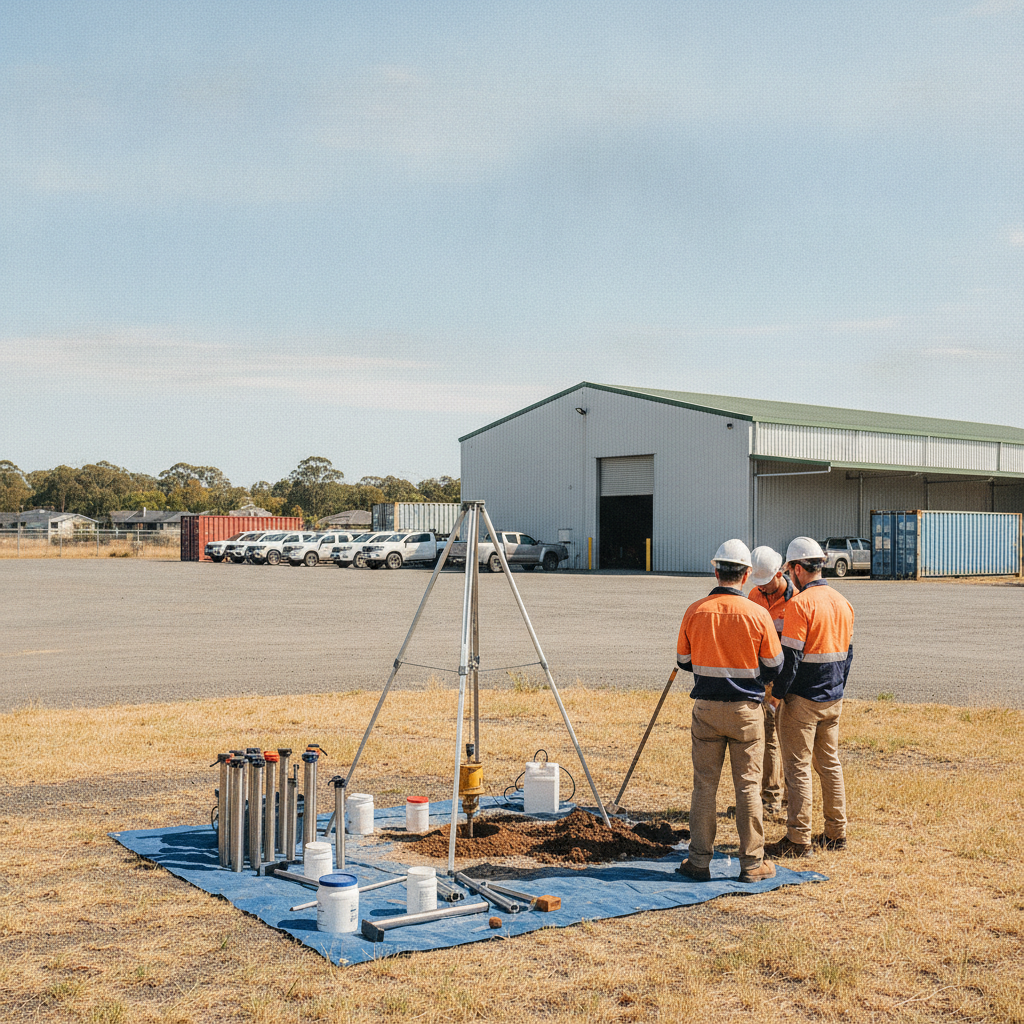
What does a baseline environmental site investigation deliver before an industrial lease?
A documented snapshot of soil and groundwater condition at the start of a tenancy. Soil results are screened against Tier 1 criteria, the standard national assessment criteria for industrial and commercial land use under the ASC NEPM, and groundwater against adopted water quality criteria. Both parties know the starting point and can manage fuel systems and unexpected finds with confidence.
Before an industrial lease changes hands, or a lender asks questions during a refinance, a property’s environmental condition needs to be more than a desktop search. At a roughly 2 ha depot in Archerfield, on Brisbane’s southside, iEnvi completed a baseline environmental site investigation that gave the owner and incoming tenant measured soil and groundwater data, plus practical advice on managing the on-site fuel system.
Why a baseline investigation before an industrial lease
Depots with on-site fuel storage are often recorded on Queensland’s Environmental Management Register (EMR), because petroleum product or oil storage is a notifiable activity under Schedule 3 of the Environmental Protection Act 1994. An EMR listing is not a finding of contamination. It records that a notifiable activity has been carried out on the land, and it prompts an obvious question in any lease, purchase or refinance: what is actually in the ground?
A baseline investigation answers that question with field data. Instead of open-ended liability discussions, the parties get measured concentrations compared against clear criteria, and a defined starting point for the tenancy. It is the foundation of sound contaminated land assessment: evidence first, then decisions.
What the baseline site investigation covered
The site is a roughly 2 ha hardstand and warehouse depot with a combined diesel and AdBlue aboveground storage tank under a canopy. iEnvi began by building a conceptual site model (CSM): a structured picture of potential contamination sources, the pathways they could travel, and the people and environments that could be affected, including nearby fuel facilities as off-site context.
The CSM drove a focused, judgmental sampling design across seven areas of environmental concern plus background locations. Fieldwork in September 2025 collected seventeen primary soil samples and three groundwater samples.
- Soil was analysed for total recoverable hydrocarbons (TRH, C6 to C40), BTEXN (benzene, toluene, ethylbenzene, xylenes and naphthalene), polycyclic aromatic hydrocarbons (PAHs), metals and nutrients, with screening-level asbestos analyses and, where the CSM supported it, screening-level PFAS analyses.
- Groundwater was analysed for TRH, consistent with the fuel storage focus of the CSM.
Groundwater sampling matters at fuel storage sites because hydrocarbons that escape containment can migrate below the surface. You can read more about our approach on our groundwater and water services page.
Results against soil and groundwater criteria
Soil and groundwater were assessed separately, against the criteria appropriate to each.
- All reported soil concentrations sat below the human health investigation levels (HILs) and ecological investigation levels (EILs) adopted for industrial and commercial land use under the ASC NEPM.
- All reported groundwater concentrations sat below the adopted groundwater investigation criteria, drawn from sources such as the ANZG (2018) water quality guidelines and the NEPM groundwater investigation levels as appropriate.
- Hydrocarbon results in the analysed samples were below laboratory reporting limits.
That is the kind of outcome lease negotiations respond well to: evidence, not optimism.
EMR listing and the General Environmental Duty
The investigation also confirmed the planning and register context. The lots are recorded on the EMR for petroleum product or oil storage, consistent with the aboveground tank on site. The General Environmental Duty under Queensland law still applies to day-to-day operations: the operator must take all reasonable and practicable measures to prevent or minimise environmental harm from activities such as refuelling and tank management.
What it means for lease, refinance and operations
Based on the completed scope and results, the site was assessed as suitable for ongoing industrial and commercial use, and no further investigation was recommended at that time. Two practical measures keep that conclusion honest:
- iEnvi recommended maintaining a Fuel System Operation Plan aligned with AS 1940:2017, the Australian standard for the storage and handling of flammable and combustible liquids, for the aboveground tank system.
- Unexpected finds during future works, such as staining, odours or suspect fill, may still need reassessment.
For landlords, tenants and lenders, a baseline investigation turns an EMR listing and on-site fuel storage into a managed story: measured concentrations, clear criteria and practical next steps rather than open-ended liability talk.
Planning a lease, purchase or refinance of an EMR-listed site?
If you are negotiating a lease, buying or refinancing an industrial depot, or dealing with an EMR-listed property in Brisbane or elsewhere in Queensland, a baseline environmental site investigation gives every party the same defensible starting point. Talk to iEnvi about scoping one for your site.
Related services for this project. iEnvi links delivered project work back to the service pathways clients use for similar sites — investigation, remediation, ecology and environmental management.
Contaminated land advice Groundwater services Asbestos in soil advice Ecological assessment Talk to iEnvi