
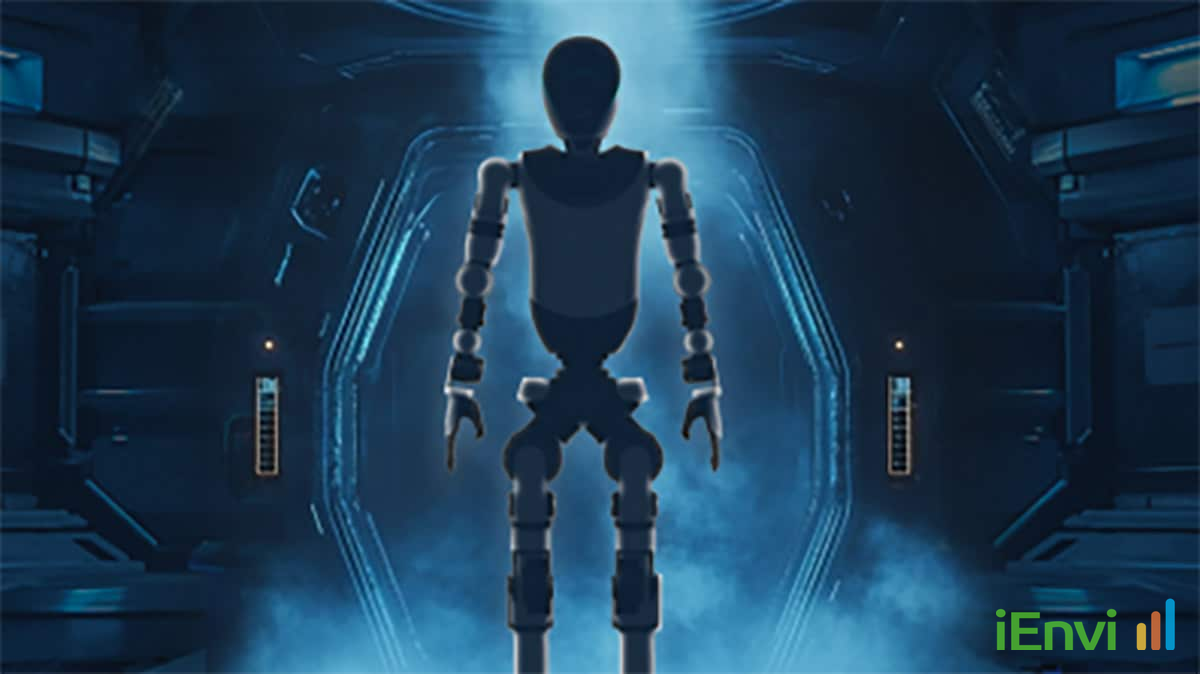
BYD’s Humanoid Robot Debut and the Automaker-to-Robotics Shift
BYD, the world’s largest electric vehicle manufacturer by volume, released a teaser poster in late July 2026 hinting at the public debut of its first humanoid robot in early August 2026. The teaser originated from BYD’s “Di Space” venue in Zhengzhou, China, an interactive science education and brand experience centre operated by the company. While BYD has not formally confirmed final hardware specifications ahead of the event, the interactive and public-facing nature of the Di Space venue has generated substantial industry expectation that the August showcase will feature a fully functional physical prototype rather than a concept rendering or simulation demonstration.
The significance of this announcement extends well beyond a single product launch. BYD’s entry into humanoid robotics represents a structural shift in how physical AI is being developed and brought to market. For decades, robotics was largely the preserve of specialist manufacturers and university research groups. That model is being displaced by automotive conglomerates with vertically integrated supply chains, enormous workforces, and proven capability in high-volume precision manufacturing. BYD joins XPeng and Chery as the third major Chinese automaker to commit publicly to humanoid robotics as a commercial product line, confirming that this is an industry-wide strategic pivot rather than an isolated experiment.
For Australian business leaders, technology strategists, legal advisers, and infrastructure planners, this development carries practical consequences. Humanoid robots are no longer a speculative technology on a 15-year horizon. They are entering commercial deployment now, priced and distributed through existing automotive retail networks. Understanding the trajectory of this transition is directly relevant to workforce planning, facility design, procurement strategy, and regulatory preparedness across multiple Australian industries.
Key details of BYD’s humanoid robot programme and the broader Chinese automaker robotics push
The teaser material published by BYD’s Di Space venue in Zhengzhou on or around 26 July 2026 did not include confirmed technical specifications for the humanoid robot. However, BYD Executive Vice President Stella Li has separately disclosed a concrete commercial deployment plan: BYD intends to place two to three humanoid robots in every one of its dealerships globally. These units are intended to function as sales consultants, walking customers through vehicle features, answering questions, and providing an interactive showroom experience. This strategy is commercially significant because it gives BYD an immediate, large-scale, real-world testbed across a controlled environment without the safety and liability complexity of heavy industrial deployment.
BYD’s competitive position in this space is underpinned by its corporate scale. The company employs more than 570,000 people globally and operates in-house battery manufacturing and semiconductor divisions. These capabilities are directly transferable to humanoid robotics hardware. Battery chemistry, energy density optimisation, electric motor miniaturisation, and power electronics are all foundational requirements for viable humanoid robot platforms. BYD has been engineering solutions to these exact problems at mass-production scale for years through its EV business. The cost reduction potential this creates is substantial: vertically integrated manufacturers can compress the hardware bill of materials far faster than pure-play robotics startups that depend on third-party component supply chains.
BYD is not operating in isolation within the Chinese automotive sector. Chery has already taken its consumer-facing humanoid robot, branded “Aimoga,” to the general market at a retail price of approximately 42,000 USD (roughly 65,000 AUD at mid-2026 exchange rates). XPeng, meanwhile, is scaling production of its “Iron” humanoid robot with a stated target of more than 1,000 units per month, with the XPeng CEO personally taking charge of the robotics business unit to accelerate that programme. These three automakers moving in parallel is not coincidental. Chinese smart EV manufacturers have spent the past decade developing the autonomous driving AI stack, specifically Vision-Language-Action models, that can be adapted into the sensorimotor control systems required for humanoid robots. The crossover from autonomous vehicles to physical AI is technically logical and strategically deliberate.
Tesla CEO Elon Musk has publicly stated that Tesla and Chinese companies will dominate the physical AI market, characterising Western competitors as comparatively weak. BYD’s August 2026 reveal, if it proceeds as signalled, would represent the most direct validation to date of that assessment. The consolidation of humanoid robotics capability around companies with existing battery-powered machine manufacturing at scale is a trend that appears to be accelerating rather than plateauing.

Australian context: what the automaker-to-robotics transition means for Australian business and professional practice
Australia does not currently have a domestic humanoid robotics manufacturing industry, but Australian businesses and government bodies will be among the end-users as these platforms scale globally. The distribution model BYD is piloting through its dealership network is directly relevant here. BYD operates in the Australian market and has been expanding its dealer footprint across Queensland, New South Wales, Victoria, and South Australia. If the global dealership deployment of humanoid robots proceeds as Stella Li described, Australian showrooms could be among the early domestic sites where members of the public interact with commercially deployed humanoid AI in an uncontrolled retail setting. This is not a distant scenario: it is a plausible outcome within the current commercial planning horizon, and one that warrants attention from Australian regulators, procurement decision-makers, and workforce strategists well before the technology arrives at scale.
References and related sources
- Primary source: cnevpost.com
- cleantechnica.com
- cnevpost.com
- cnevpost.com
- cnevpost.com
- NEPM Assessment of Site Contamination
How iEnvi can help
iEnvi integrates technology and data-driven approaches into environmental consulting. We monitor AI and technology developments that affect how environmental professionals deliver services to clients.
This is an iEnvi Machete news summary. Prepared by iEnvi to summarise the source article for environmental professionals tracking AI, data, and technology developments that affect consulting and project delivery.
Published: 27 Jul 2026
Need advice on this topic? Speak to an iEnvi expert at info@ienvi.com.au or 1300 043 684, or contact us online.
Need advice on this issue? iEnvi provides practical, senior-led environmental consulting across contaminated land, remediation, ecology and environmental risk.
Contaminated land advice Remediation services Discuss your site Talk to iEnvi