
Overview
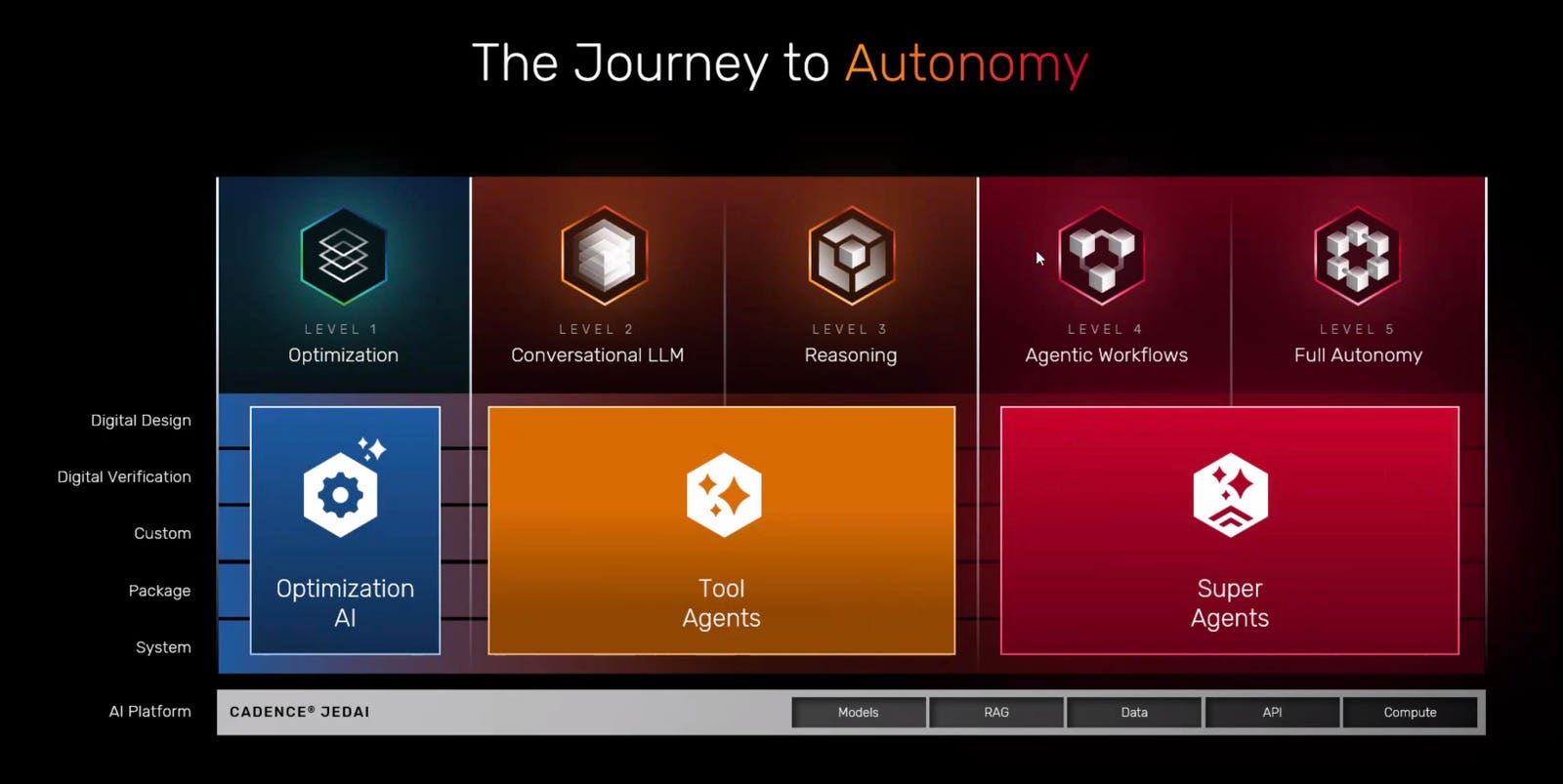
At Computex 2026 in Taipei on 1 June 2026, Cadence Design Systems and NVIDIA jointly announced the transition of the ChipStack AI Super Agent to Level-5 autonomy, marking what the companies describe as the first fully autonomous virtual engineer capable of executing end-to-end semiconductor design and verification workflows without manual prompting. This is not an incremental software update. It represents a structural shift in how complex, high-skill engineering workflows are organised, with an autonomous agent now capable of planning tasks, generating Register-Transfer Level (RTL) code, running simulations, and self-correcting errors across a complete design cycle. The announcement was made alongside NVIDIA Founder and CEO Jensen Huang’s broader remarks at Computex, where he simultaneously argued that AI replacing human jobs is “complete nonsense” while actively deploying ChipStack internally to verify NVIDIA’s own next-generation chips.
For professional services firms, engineering consultancies, and enterprise technology leaders, this development is directly relevant regardless of sector. The semiconductor industry has historically been a leading indicator for how autonomous AI capabilities eventually propagate into other knowledge-intensive fields. When a 40-fold speedup is achievable in one of the most technically demanding engineering disciplines in the world, the question for every professional services leader becomes: which parts of our own workflows are structurally similar to RTL verification, and how far away is autonomous execution in those areas?
For Australian environmental consultancies and their clients, including developers, councils, lawyers, and in-house environmental teams, this development is a signal about the near-term trajectory of agentic AI in complex, regulated professional workflows. The specific technical achievement matters less than what it demonstrates about the maturity of governed, auditable autonomous systems operating in high-stakes, IP-sensitive environments.
Key details: technical specifications and performance benchmarks of ChipStack Level-5 autonomy
The ChipStack AI Super Agent achieves Level-5 autonomy by operating across an entire engineering workflow without requiring manual intervention at each stage. Specifically, the agent autonomously evaluates intermediate results, generates RTL code, plans and executes verification routines, runs simulations, and independently debugs and remediates code failures. The key performance claim from Cadence is a 40-fold speedup in RTL validation, compressing a workflow that typically spans five weeks into less than a single working day. RTL validation is historically one of the most resource-intensive phases of chip development, requiring large engineering teams working extended cycles to identify and resolve logical errors before a design can proceed to physical implementation.
The system’s underlying infrastructure integrates three distinct technology layers. The agent is built on Cadence’s AI-driven electronic design automation (EDA) suite and is powered by NVIDIA Nemotron models. Security and governance are handled by the NVIDIA OpenShell runtime, which provides a sandboxed execution environment with strict policy controls. OpenShell is specifically designed to ensure that sensitive proprietary intellectual property is never exposed to external models or unauthorised tools. This addresses what has been identified as the primary barrier to enterprise adoption of autonomous AI agents: the risk of IP leakage through model interactions.
For verification accuracy, the agent integrates directly with industry-standard tools including Cadence Xcelium Logic Simulation and Jasper Formal Verification. The significance of this integration is that outputs are signoff-accurate, meaning they meet the quality thresholds required for formal engineering sign-off, rather than being indicative or probabilistic outputs that would require separate human validation. This distinction is critical for understanding the practical impact: the agent is not producing drafts for human review; it is producing outputs that meet formal acceptance criteria.
Human oversight is maintained through integration with developer environments including Codex and Claude Code. These integrations give human supervisors full visibility into every decision and action the autonomous agent takes, creating a transparent audit trail. Paul Cunningham, Senior Vice President and General Manager of the System Verification Group at Cadence, described the development as “moving from AI that assists engineers to autonomous virtual engineers that can implement real design and verification work, grounded in our signoff-accurate engines and running in secure, governed environments so teams can innovate faster with confidence.” The governance architecture is therefore not an afterthought; it is structurally embedded in the system design, with auditability treated as a core feature rather than a compliance overlay.
Australian context: agentic AI implications for Australian professional services and environmental consulting workflows
Australia’s professional services sector, including environmental consulting, planning, legal services, and engineering, operates under regulatory frameworks that place significant weight on professional accountability, documented methodology, and traceable decision-making. The Environment Institute of Australia and New Zealand (EIANZ), state EPA licensing frameworks, and professional certification bodies such as the CEnvP scheme all embed the principle that a qualified professional is accountable for the outputs of an assessment, regardless of the tools used to produce them. The emergence of Level-5 autonomous agents raises an immediate and unresolved question: when an AI agent independently executes a multi-stage workflow and produces a signoff-quality output, where does professional accountability sit?
[Article incomplete — remaining content was not supplied for review.]
References and related sources
- Primary source: engtechnica.com
- businesswire.com
- forbes.com
- nvidia.com
- venturebeat.com
How iEnvi can help
iEnvi integrates technology and data-driven approaches into environmental consulting. We monitor AI and technology developments that affect how environmental professionals deliver services to clients.
This is an iEnvi Machete news summary. Prepared by iEnvi to summarise the source article for environmental professionals tracking AI, data, and technology developments that affect consulting and project delivery.
Published: 04 Jun 2026
Need advice on this topic? Speak to an iEnvi expert at info@ienvi.com.au or 1300 043 684, or contact us online.