
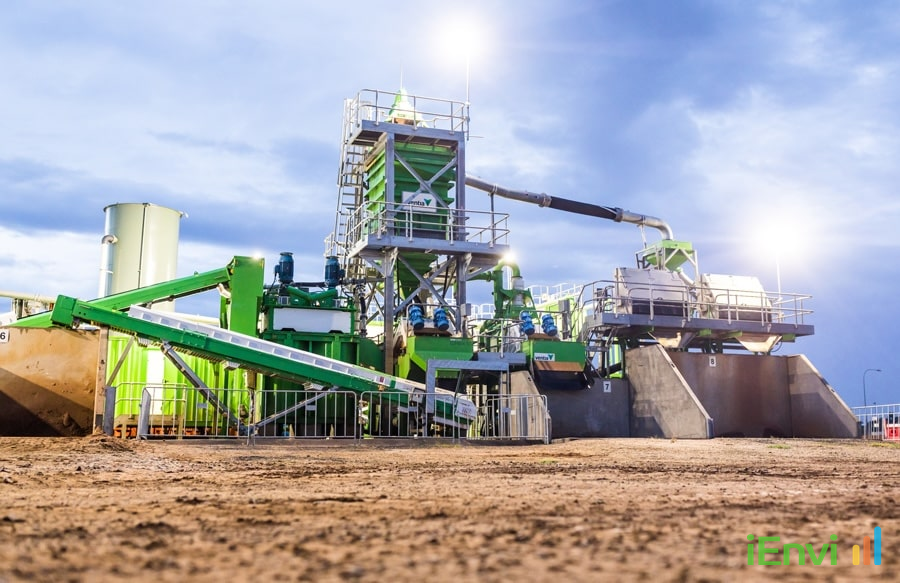
CDE and SOLVE Soil Washing Collaboration in Melbourne
A milestone in Australian PFAS waste management has been achieved at the SOLVE facility in Melbourne, where material processing specialist CDE has integrated advanced wet processing technology capable of treating up to 50,000 tonnes per annum of non-destructive digging (NDD) muds and contaminated soils. The development was highlighted at a recent industry symposium and represents one of the most technically significant closed-loop PFAS treatment configurations to be operational in Australia. SOLVE is recognised as Australia’s largest hazardous waste and contaminated soil treatment plant, and the addition of CDE’s wet separation system positions the facility as a national reference point for how PFAS-impacted soil waste streams should be managed under the current regulatory environment.
The timing of this development is directly relevant to the ongoing transition to PFAS NEMP 3.0, which has introduced tighter controls on the tracking and disposal of PFAS-contaminated materials and explicitly identifies landfills and wastewater treatment facilities as secondary sources of PFAS concern. For environmental consultants, site auditors, developers, and duty holders across Queensland, New South Wales, Victoria, and South Australia, the operational availability of closed-loop soil washing at scale changes the calculus on what constitutes a defensible and legally compliant disposal pathway for PFAS-impacted excavated materials.
The broader significance extends beyond a single facility upgrade. This project demonstrates that the combination of physical separation, on-site water treatment, and downstream thermal processing can divert lower-contaminated soils and NDD muds away from landfill and back into the construction supply chain as secondary materials. That outcome directly supports the waste hierarchy embedded in Victoria’s Environment Protection Act 2017 and signals a shift in what regulators and auditors will expect when evaluating remediation option analyses for PFAS-impacted sites anywhere in Australia.
Key details of the CDE and SOLVE soil washing system for PFAS-contaminated soils
The wet processing system installed at the SOLVE Melbourne facility is engineered to handle up to 50,000 tonnes per annum of NDD muds and drill wastes, which are among the most difficult PFAS-bearing waste streams to manage because of their high moisture content, variable particle size distribution, and the wide range of PFAS compound concentrations they can carry. CDE’s technology separates the incoming material into three distinct fractions: clean aggregate, clean sand, and a clay fraction. The aggregate and sand fractions, once confirmed to meet applicable acceptance criteria, are recycled back into the construction market as secondary materials, directly displacing the use of virgin quarry products.
Contaminated wash water generated during the separation process is treated on-site rather than discharged. The PFAS contaminants are concentrated through the water treatment stage and then diverted to thermal desorption for further processing. It is important to understand what thermal desorption does and does not achieve in this context: it is a separation and concentration process, not a destruction technology. Thermal desorption transfers PFAS compounds from the solid phase into a concentrated liquid or vapour stream. True mineralisation of the carbon-fluorine bond, which is the defining structural feature of PFAS compounds and the source of their environmental persistence, requires high-temperature incineration, supercritical water oxidation, electrochemical oxidation, or equivalent destruction technologies. The system at SOLVE uses thermal desorption as a concentration step that produces a manageable, high-concentration waste stream suitable for subsequent destruction via approved pathways.
From a process engineering perspective, the system is described as compact and highly automated, which has practical implications for its replicability at other sites and for the consistency of its output quality. Automated systems reduce operator-dependent variability in separation efficiency, which is a key consideration when the output materials are being presented to auditors or regulators as meeting clean fill or secondary aggregate standards. The 50,000-tonne-per-annum capacity is a meaningful scale for the Australian market, where large infrastructure projects, defence site remediation programmes, and industrial precinct redevelopments routinely generate PFAS-impacted soil volumes in the tens of thousands of tonnes.
Under the PFAS NEMP 3.0 framework, waste tracking requirements for PFAS-contaminated materials have been strengthened. The framework specifically calls out landfills and wastewater treatment facilities as secondary sources of PFAS contamination, meaning that disposing of PFAS-impacted soils and NDD muds to landfill now carries a regulatory risk profile that did not exist under earlier guidance. Duty holders who can demonstrate that excavated materials have been processed through a closed-loop system, with clean fractions recycled and PFAS concentrated for destruction, are in a materially stronger compliance position than those relying on landfill as the primary pathway.
Australian regulatory context for PFAS soil treatment under PFAS NEMP 3.0 and the Environment Protection Act 2017
Australia’s PFAS National Environmental Management Plan has been the primary national framework for managing PFAS contamination since its first iteration. The transition to PFAS NEMP 3.0 marks the most substantive revision to date. The identification of landfills and wastewater treatment facilities as secondary sources of PFAS is significant because it shifts those disposal pathways from being considered routine management options to being sources of new environmental liability. For practitioners working on sites where PFAS-impacted soils require excavation and off-site management, the availability of a closed-loop treatment facility operating at commercial scale in Melbourne provides a credible, regulatorily defensible alternative to landfill that aligns with both the waste hierarchy principles underpinning Victoria’s Environment Protection Act 2017 and the strengthened tracking and disposal expectations now embedded in the national framework.
References and related sources
- Primary source: wastemanagementreview.com.au
- parkeschampionpost.com.au
- nsw.gov.au
- wastemanagementreview.com.au
- PFAS National Environmental Management Plan (NEMP)
- EPA Victoria
How iEnvi can help
iEnvi provides specialist consulting services relevant to this topic. Our team includes CEnvP Site Contamination Specialists with experience across contaminated land, groundwater, remediation, ecology, and regulatory compliance.
- iEnvi PFAS services
- iEnvi remediation and validation services
- iEnvi expert services and independent review services
This is an iEnvi Machete news summary. Prepared by iEnvi to summarise the source article for contaminated land, groundwater, remediation, approvals and site risk professionals.
Published: 09 Jul 2026
Need advice on this topic? Speak to an iEnvi expert at info@ienvi.com.au or 1300 043 684, or contact us online.
Need advice on this issue? iEnvi provides practical, senior-led environmental consulting across contaminated land, remediation, ecology and environmental risk.
Team credentials Site remediation Environmental management plans Contaminated land advice Talk to iEnvi