
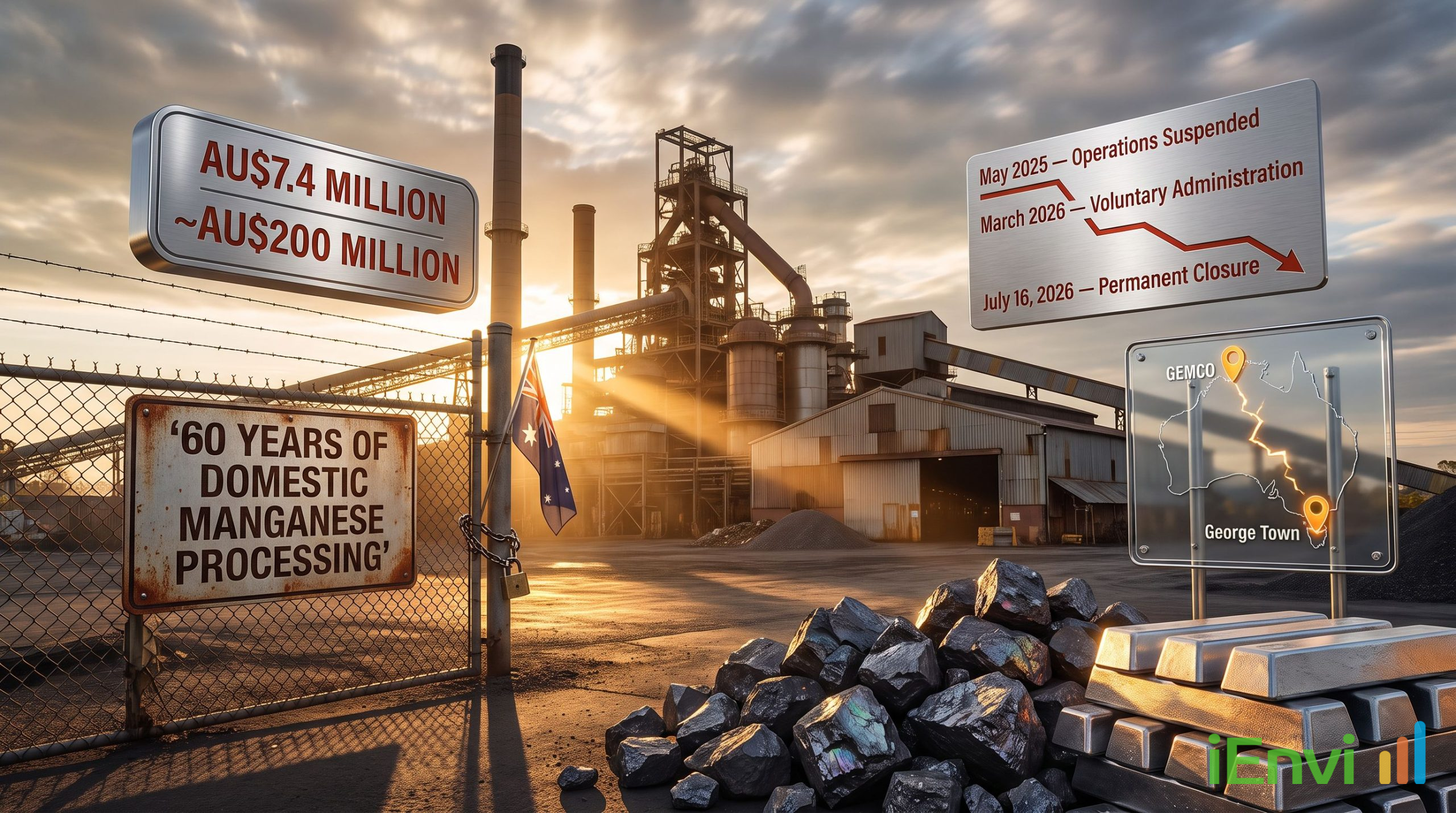
Overview of the Liberty Bell Bay Smelter Closure
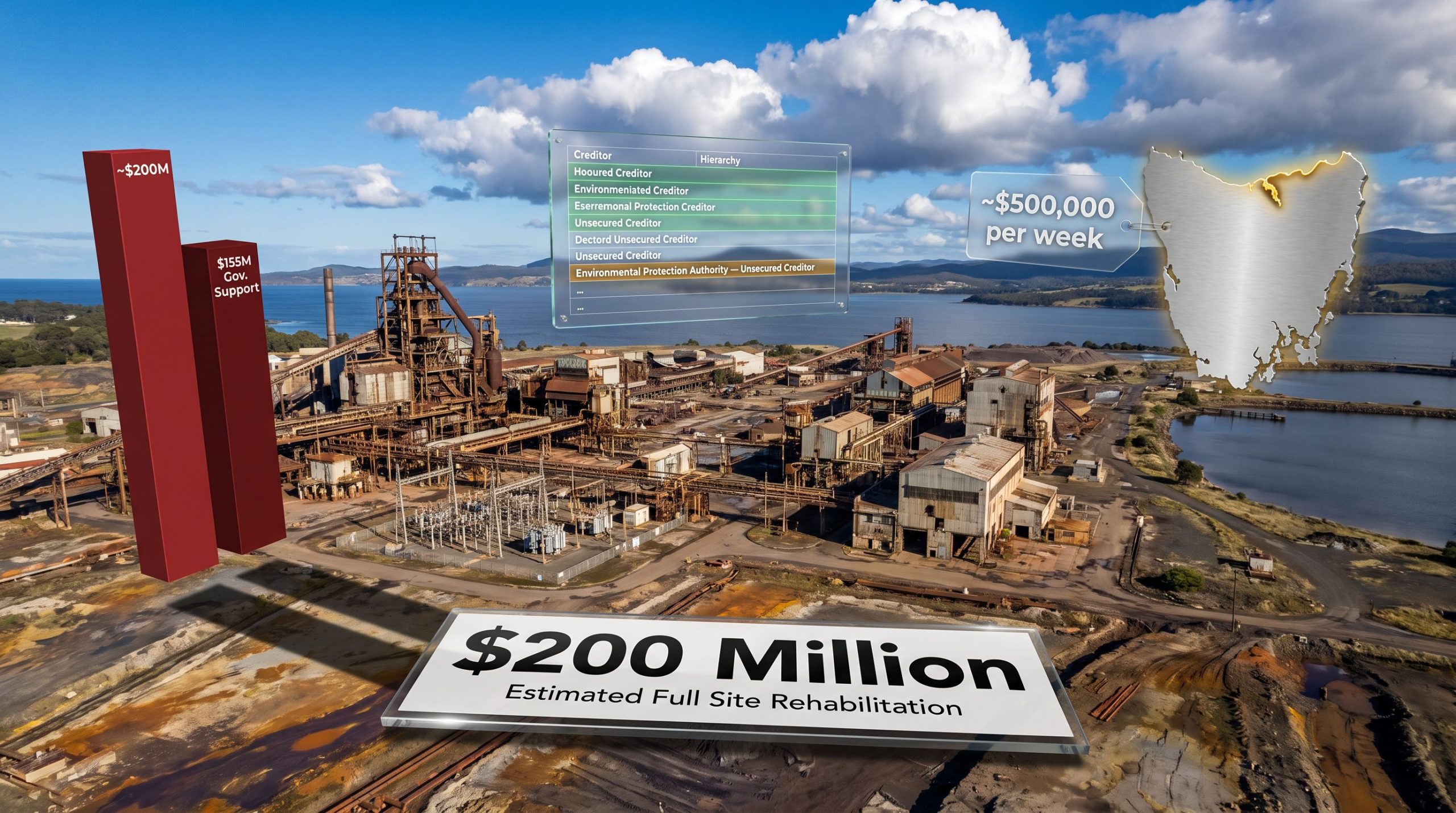
On 16 July 2026, administrators EY Parthenon confirmed the immediate and permanent closure of the Liberty Bell Bay smelter in George Town, northern Tasmania, Australia’s last domestic manganese alloy processing facility. The closure followed the breakdown of exclusive sale negotiations with a buying consortium, leaving more than 200 workers without employment and triggering what is shaping up to be one of the most significant legacy environmental liability events in recent Australian industrial history. Decommissioning and full environmental rehabilitation of the site is estimated to cost approximately $200 million, a figure that places this closure in a different category from the routine industrial site exits that contaminated land practitioners encounter day to day.
The Liberty Bell Bay facility has been in continuous operation since 1962, meaning the site carries more than six decades of accumulated heavy industrial contamination across multiple process areas. The complexity here is not simply a matter of volume. It is the diversity of contamination pathways, infrastructure types, and waste streams that makes this a genuinely difficult decommissioning proposition. The site includes submerged arc furnaces, sinter plant infrastructure, extensive slag stockpiles, fume dams containing concentrated processing byproducts, and a stormwater and leachate management system that must be actively maintained to protect the adjacent Tamar River estuary from acid flush events and heavy metal migration.
For environmental consultants, property lawyers, developers with industrial portfolios, and in-house counsel advising on asset acquisitions, this situation is a sharp reminder that environmental liabilities embedded in heavy industrial land do not simply disappear when the operating entity collapses. The critical question this case forces into focus is straightforward: under the current structure of Australian insolvency law, who actually pays when the bill is $200 million and the operator is insolvent?
Key details of the Liberty Bell Bay smelter closure and $200 million remediation liability
The Liberty Bell Bay facility operated as Australia’s sole domestic manganese alloy processing plant. Manganese alloy smelting is an energy-intensive pyrometallurgical process involving submerged arc furnaces operating at temperatures exceeding 1,600 degrees Celsius. The principal contamination concern from such operations centres on manganese, heavy metals including lead, chromium, and arsenic, polycyclic aromatic hydrocarbons (PAHs) from electrode and refractory materials, and particulate fume deposits that accumulate in both on-site infrastructure and surrounding soils over decades of operation. Fume dams at smelting facilities capture high-concentration byproducts from pollution control systems and typically contain elevated concentrations of manganese, zinc, and other trace metals that require engineered containment solutions rather than simple removal.
The sinter plant component of the Liberty Bell Bay facility is particularly significant from an investigation standpoint. Sintering is an ore pre-processing step in which fine ore particles are agglomerated at high temperature before feeding into the furnace. Sinter plants generate fine dust, sulphur dioxide, and metal-bearing particulates that deposit into soils, building structures, and drainage systems over time. After 60-plus years of operation, embedded contamination in the sinter plant area would be expected to extend into the subsurface at depths requiring systematic investigation under the National Environment Protection (Assessment of Site Contamination) Measure 1999 (as amended in 2013) before any future land use scenario can be evaluated. Soil and groundwater characterisation across such a site would typically involve hundreds of sample locations, multi-level groundwater monitoring, and detailed waste characterisation of stockpiles to support classification under applicable state waste management frameworks.
The slag stockpile management challenge at this scale is a long-term containment and leachate management problem. Manganese smelter slag can exhibit leachable concentrations of heavy metals depending on the ore feed chemistry and process conditions. Without active management of drainage and capping systems, weathering of slag stockpiles creates leachate that can migrate to surface water and groundwater receptors. At George Town, the Tamar River estuary is the critical ecological receptor. The estuary supports commercial and recreational fisheries and has existing sensitivity to industrial inputs given the broader history of the Bell Bay industrial precinct. Maintaining functional containment, stormwater diversion, and leachate collection systems during the period between closure and formal remediation is a non-trivial operational and funding challenge, particularly when the site operator is in administration.
The $200 million remediation estimate, attributed to the administrators’ assessment as reported in the Tasmanian Government’s joint ministerial statement of 16 July 2026, reflects the combined cost of infrastructure decommissioning, waste characterisation, engineered containment upgrades, soil and groundwater remediation, and long-term monitoring commitments. This figure places the Liberty Bell Bay liability in the upper tier of contaminated land remediation costs recorded for any single Australian industrial site.
Australian context: insolvency law, environmental creditor status, and the orphaned contamination problem
The Liberty Bell Bay closure exposes a structural fault line in how Australian law handles environmental remediation obligations when the responsible party becomes insolvent. Under the Corporations Act 2001 (Cth), the priority order for distributing assets in a liquidation places secured creditors at the top of the hierarchy, followed by priority unsecured creditors such as employees, with general unsecured creditors — a category that typically captures environmental regulators holding remediation cost claims — ranked well below. In practice, this means that where a contaminated site operator collapses with insufficient assets to satisfy secured debt, the funds available to meet environmental clean-up obligations may be negligible or non-existent. The result is what practitioners refer to as orphaned contamination: a legacy liability that sits with the land, with no solvent party remaining to fund its remediation, and with the practical burden ultimately falling on regulators, state governments, or future landowners who acquire the site without adequate due diligence.
References and related sources
- Primary source: www.premier.tas.gov.au
- discoveryalert.com.au
- mining-technology.com
- discoveryalert.com.au
- business.tas.gov.au
How iEnvi can help
iEnvi provides specialist consulting services relevant to this topic. Our team includes CEnvP Site Contamination Specialists with experience across contaminated land, groundwater, remediation, ecology, and regulatory compliance.
- iEnvi remediation services
- iEnvi site assessment services
- iEnvi expert services and independent review services
This is an iEnvi Machete news summary. Prepared by iEnvi to summarise the source article for contaminated land, groundwater, remediation, approvals and site risk professionals.
Published: 19 Jul 2026
Need advice on this topic? Speak to an iEnvi expert at info@ienvi.com.au or 1300 043 684, or contact us online.
Need advice on this issue? iEnvi provides practical, senior-led environmental consulting across contaminated land, remediation, ecology and environmental risk.
Team credentials Groundwater remediation Contaminated land services Remediation services Talk to iEnvi