
Overview
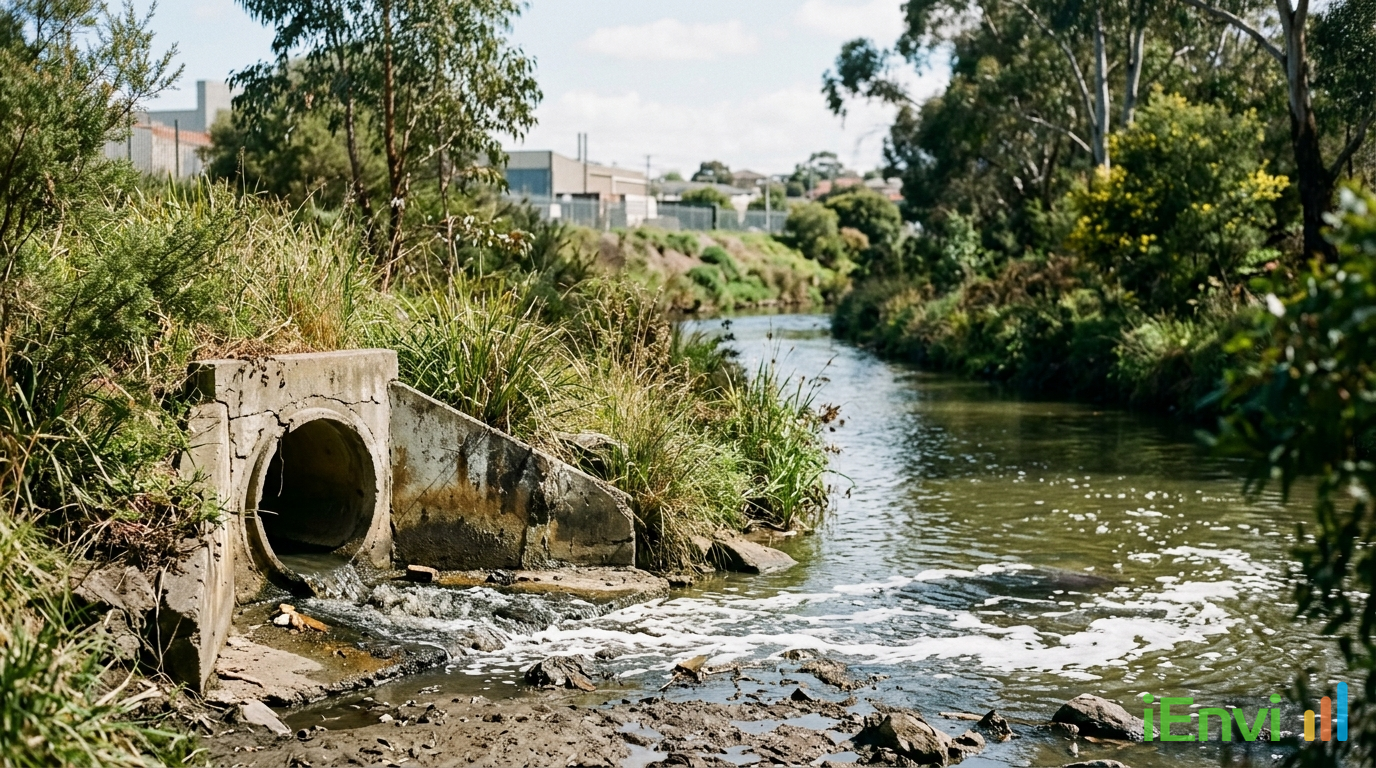
EPA Victoria issued a $4,070 fine to SOR Enterprises Pty Ltd, the operator of Brilliant Car Wash in Northcote, following a pollution incident in which contaminated wastewater discharged continuously into a stormwater drain on Goldsmith Grove and flowed directly into Merri Creek. The incident was published by EPA Victoria on 6 May 2024. The enforcement action was triggered by community reports of a bright green slick visible in the stormwater infrastructure. EPA officers attended the site and conducted a formal inspection. What they found was straightforward and damning: the operator was fully aware of a plumbing blockage that was causing the overflow, had chosen not to engage a plumber to rectify it, and had allowed the contaminated discharge to continue.
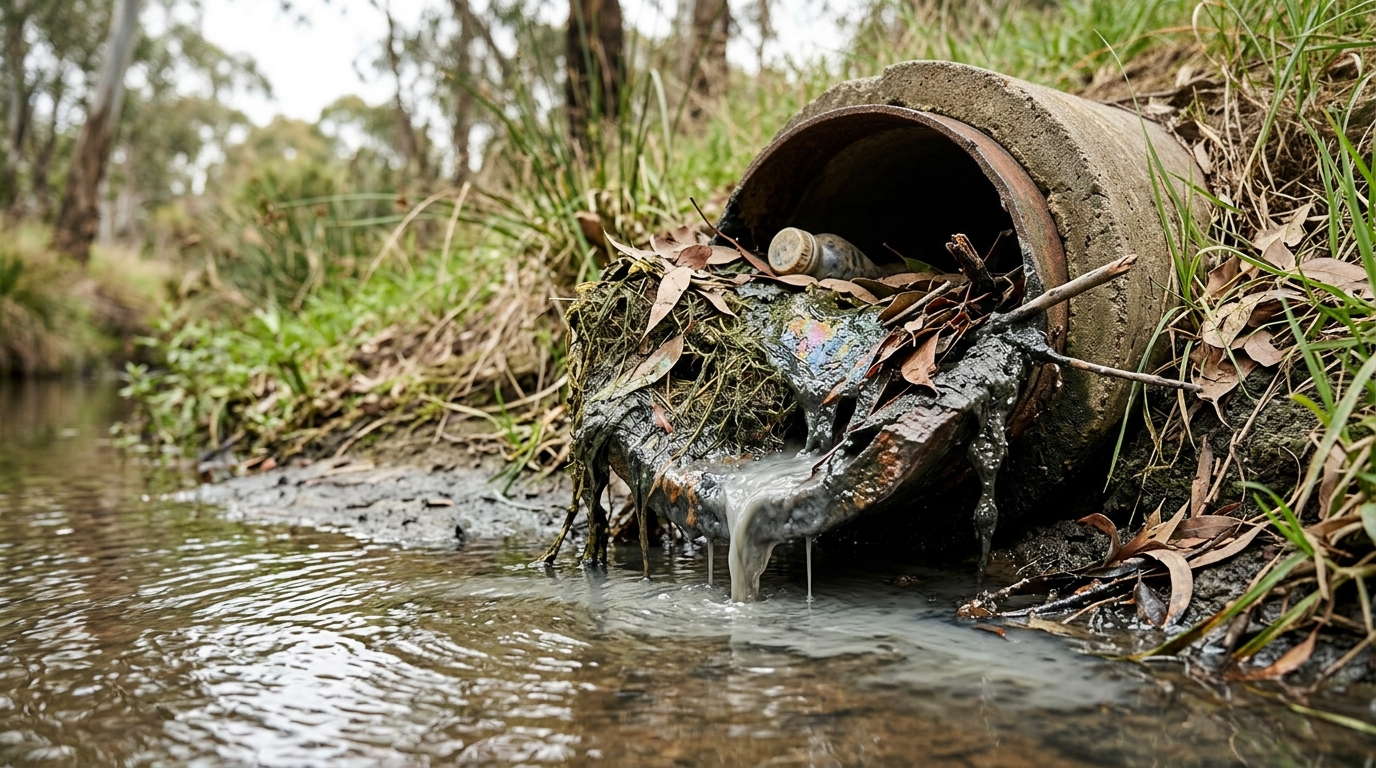
The wastewater in question was not simply soapy water. Commercial car wash effluent routinely carries elevated concentrations of heavy metals including copper, lead, and zinc sourced from brake dust, tyre wear particles, and vehicle bodywork. It also contains aliphatic and aromatic hydrocarbons, emulsified greases, and the complex chemical solvents used in vehicle detailing and high-pressure washing operations. When that cocktail bypasses treatment and enters a stormwater system directly connected to an urban waterway, the aquatic impact is acute. Merri Creek is a significant urban waterway in Melbourne’s north, subject to ongoing restoration and community stewardship efforts, which makes this discharge particularly visible both environmentally and politically.
For environmental practitioners advising commercial property owners, tenants, and facility managers, this case carries a message that goes well beyond a $4,070 penalty. It illustrates precisely how the General Environmental Duty under the Environment Protection Act 2017 (Vic) operates in real operational settings, and it confirms that community-reported incidents in urban areas now routinely escalate into formal regulatory enforcement. The EPA also confirmed the site had been visited previously for similar issues and would be subject to ongoing performance monitoring, which signals that this operator now carries a compliance history that will follow any future assessment of the site.
Key details of the EPA Victoria enforcement action
The formal basis for the fine was a breach of the General Environmental Duty (GED) under Section 25 of the Environment Protection Act 2017 (Vic), which requires any person engaging in an activity that may give rise to risks of harm to human health or the environment to minimise those risks so far as is reasonably practicable. The critical legal point here is the standard of reasonable practicability. EPA officers established that the operator had actual knowledge of the blocked drain causing the discharge. Engaging a licensed plumber to clear a blockage is an action that is self-evidently reasonably practicable. The decision not to do so therefore constitutes a clear failure to meet the GED standard, not a borderline regulatory judgement call.
The penalty issued was $4,070, which reflects the infringement notice pathway rather than a prosecuted offence, but the enforcement significance extends beyond the dollar amount. EPA North Metropolitan Regional Manager Steve Riley publicly noted that the site had been inspected previously for similar issues, which places this incident within a pattern of non-compliance rather than an isolated event. The operator is now subject to ongoing performance monitoring, meaning future inspections are probable and any further incident will be assessed against a background of demonstrated repeat behaviour. Under the Environment Protection Act 2017 (Vic), repeat non-compliance carries escalating regulatory consequences including formal notices, licence conditions, and in serious cases, prosecution under provisions that carry substantially higher penalties than an infringement notice.
The nature of the discharge is technically relevant for practitioners. Car wash wastewater that includes vehicle detailing operations is classified as industrial waste under Victorian environment protection legislation. Its discharge to stormwater infrastructure without authorisation is an unlawful act independent of whether any visible environmental harm results. The Australian Car Wash Association has previously noted that commercial wash water is chemically distinct from domestic wastewater. Concentrations of zinc and copper in commercial wash runoff can exceed aquatic ecosystem guideline values established under the Australian and New Zealand Guidelines for Fresh and Marine Water Quality (ANZG 2018). Copper, for instance, has a freshwater default guideline value of 1.4 micrograms per litre (µg/L) at the 95 percent protection level, a threshold that vehicle washing effluent can exceed by orders of magnitude depending on vehicle type and wash chemistry.
The discharge point was a stormwater drain on Goldsmith Grove, Northcote. Stormwater infrastructure in this area drains to Merri Creek, which is a Class 2 waterway for planning purposes under the Planning and Environment Act 1987 (Vic) and sits within a broader catchment subject to EPA, Melbourne Water, and local government oversight. The visual indicator, a bright green slick consistent with vehicle wax and surfactant chemistry, was the proximate cause of community notification. This highlights the operational reality that chemical discharges with strong visual signatures generate immediate public reporting in urban environments, compressing the window between incident and regulator attendance to hours rather than days.
Australian context: GED obligations, stormwater compliance, and urban waterway protection
The General Environmental Duty under Section 25 of the Environment Protection Act 2017 (Vic) sits at the centre of Victoria’s environment protection framework. Unlike prescriptive licence conditions that apply only to scheduled premises, the GED applies to any person or organisation conducting an activity that may give rise to risks of harm. This means operators of commercial car washes, regardless of size or permit status, carry a positive obligation to identify foreseeable risks and take reasonably practicable steps to eliminate or reduce them. A blocked drain causing wastewater overflow is a foreseeable risk. The failure to act on known infrastructure faults is therefore not a technical oversight — it is a GED breach.
Stormwater compliance is an area of increasing regulatory focus across Australian jurisdictions. Unlike sewerage systems, which are managed under trade waste agreements and subject to pre-treatment requirements, stormwater infrastructure is designed to carry clean rainwater runoff. Industrial or commercial discharges to stormwater are prohibited under environment protection legislation in all Australian states and territories. In Victoria, the Environment Protection Act 2017 (Vic) and its associated regulations establish clear obligations for businesses generating liquid waste to ensure that waste is contained, treated, and disposed of through authorised pathways. The absence of a functioning pre-treatment or containment system does not create a defence — it compounds the liability.
Merri Creek occupies a particular place in Melbourne’s urban environment. The waterway runs through the northern suburbs and has been the subject of significant investment by Melbourne Water, local councils, and community groups including the Merri Creek Management Committee. It supports remnant riparian vegetation, native fish species, and macroinvertebrate communities that are sensitive to chemical contamination. Repeated discharge events — whether from a single operator or from cumulative urban runoff — degrade this ecological baseline in ways that are difficult and costly to reverse. The regulatory response to incidents like the Brilliant Car Wash discharge therefore reflects not just enforcement of individual obligations but the protection of a shared environmental asset.
For facility managers and property owners, the practical implications of this case are direct. Any commercial tenancy generating process wastewater — including car washes, mechanical workshops, food production facilities, and laundries — must have a functioning wastewater management system that prevents discharge to stormwater. Lease agreements should clearly allocate responsibility for maintaining pre-treatment infrastructure. Where a blockage, equipment failure, or infrastructure deficiency is identified, it must be rectified promptly. Documentation of the fault, the response taken, and the timeline of repairs provides evidence of GED compliance if a regulatory inquiry follows. Operators who identify a problem and fail to act on it, as occurred here, face the worst regulatory outcome: demonstrable knowledge of the risk combined with a failure to respond.
References and related sources
- Primary source: www.epa.vic.gov.au
- EPA Victoria
How iEnvi can help
iEnvi provides specialist consulting services relevant to this topic. Our team includes CEnvP Site Contamination Specialists with experience across contaminated land, groundwater, remediation, ecology, and regulatory compliance.
- iEnvi contaminated land investigation services
- iEnvi remediation and validation services
- iEnvi expert services and independent review services
This is an iEnvi Machete news summary. Prepared by iEnvi to summarise the source article for contaminated land, groundwater, remediation, approvals and site risk professionals.
Published: 08 May 2026
Need advice on this topic? Speak to an iEnvi expert at info@ienvi.com.au or 1300 043 684, or contact us online.
Need advice on this issue? iEnvi provides practical, senior-led environmental consulting across contaminated land, remediation, ecology and environmental risk.
Contaminated land services Remediation services Groundwater services Ecological assessment Talk to iEnvi