
Overview
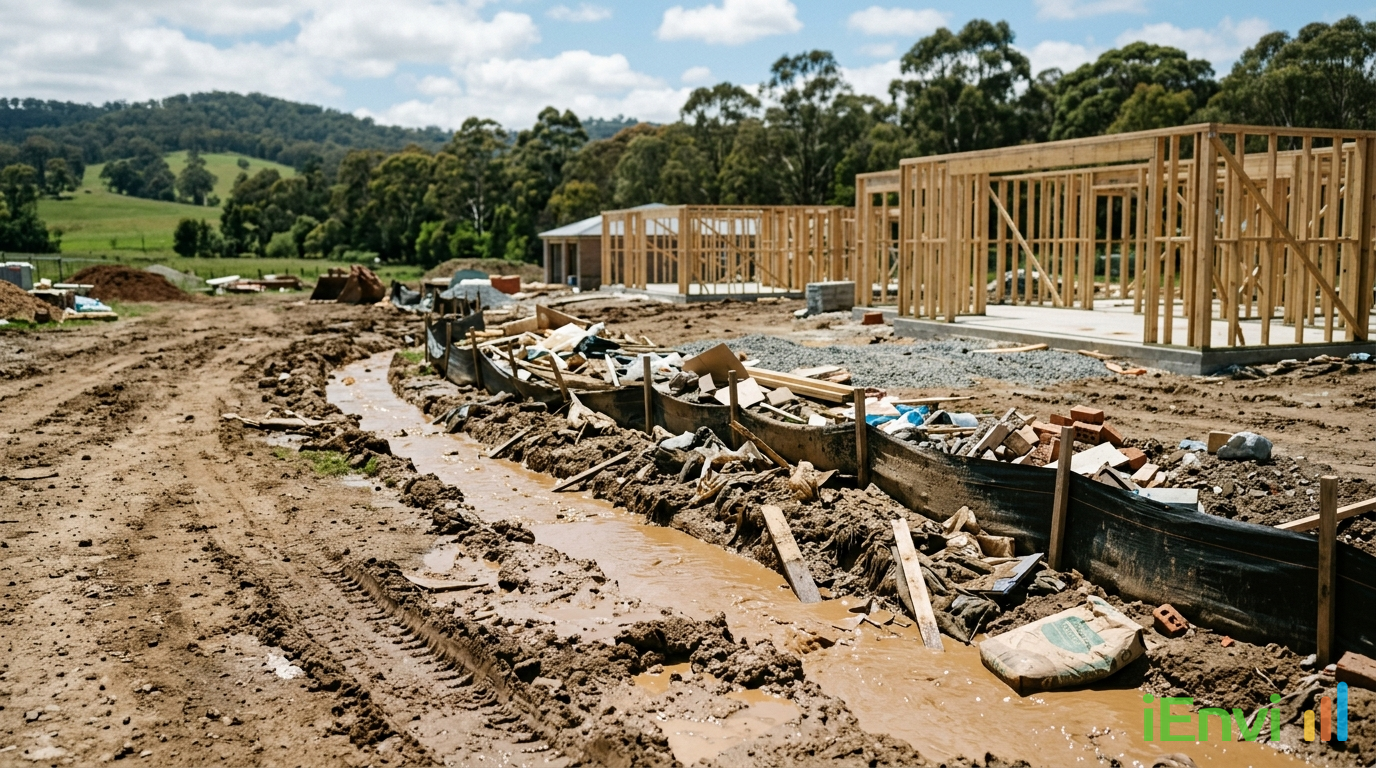
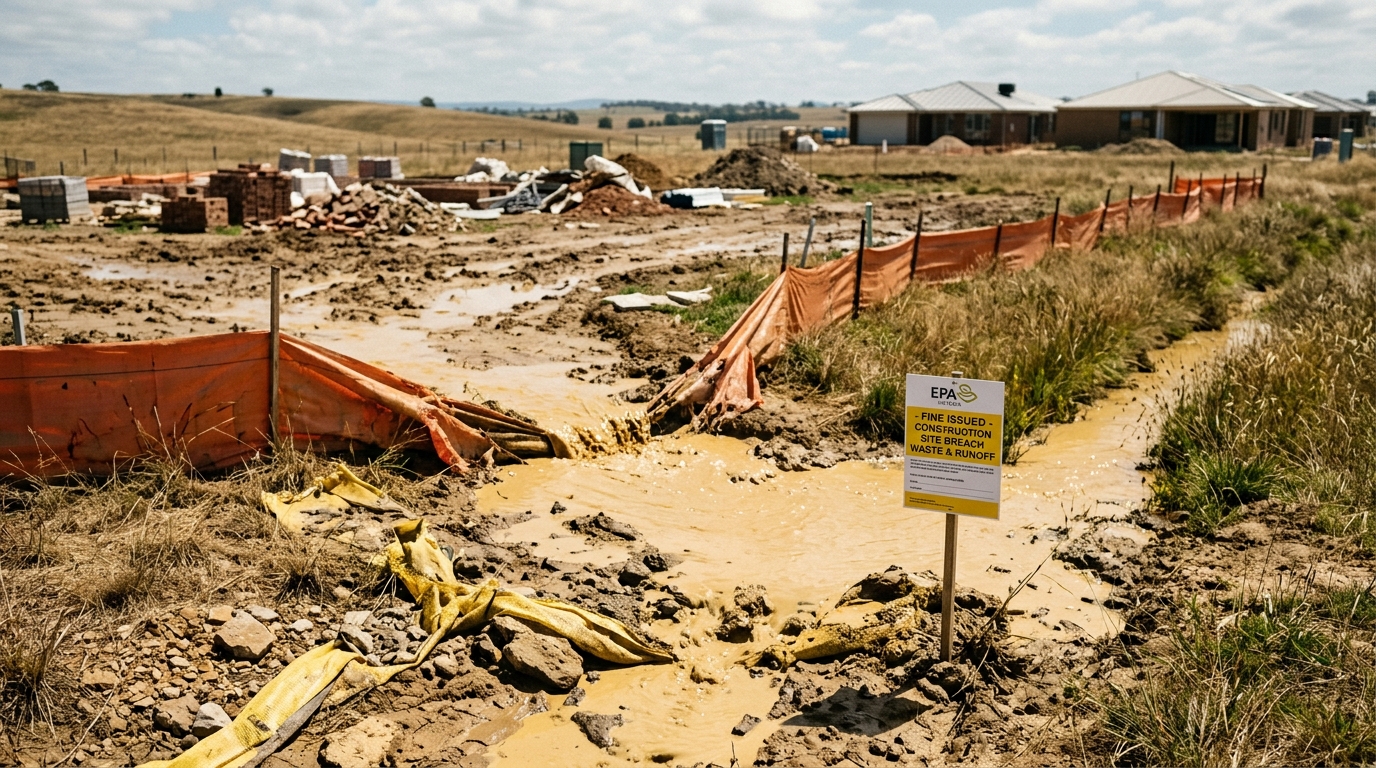
On 7 April 2026, EPA Victoria announced infringement notices totalling $2,032 each against three residential builders following a targeted compliance blitz across 20 building sites in the growth corridor suburbs of Lara and Armstrong Creek. The builders cited were Luxton Homes, Aplace, and Boutique Homes. Authorised Officers identified unsecured building waste escaping from skip bins, materials scattered across nature strips, sediment tracked onto public streets, and concrete washout residue entering local gutters and stormwater drainage infrastructure. The enforcement action is noteworthy not because the fines are large, but because of what it indicates: residential construction sites are now a primary compliance target for EPA Victoria, not a secondary consideration behind heavy industry and major infrastructure.
EPA Southwest Regional Manager Martha-Rose Loughnane was unambiguous in her assessment of builder responsibilities following the blitz. Her statement that sediment, paint, wastewater, and other liquids entering gutters and drains “will wind up in rivers, wetlands and the ocean” reflects a regulatory posture that treats diffuse runoff from residential subdivisions with the same seriousness as point-source discharges from industrial facilities. For environmental consultants, construction auditors, and principal contractors advising developer clients in greenfield and infill residential markets, this action reinforces that Construction Environmental Management Plans must translate into verifiable, on-the-ground controls rather than desktop documents filed at the start of a project.
This enforcement outcome is also a timely prompt for developers and their legal advisers. The General Environmental Duty under section 9 of the Environment Protection Act 2017 (Vic) applies continuously and proactively. Infringement notices can be issued under the Infringements Act 2006 (Vic) as strict liability instruments, meaning the absence of intent is not a defence. Both mechanisms were engaged in this action, and both are now being actively applied at the suburban residential scale across Victoria.
Key details of the EPA Victoria residential construction blitz
The compliance blitz targeted 20 residential building sites across Lara and Armstrong Creek, two high-growth suburban areas on the Geelong fringe where large-scale land releases have produced dense concentrations of active construction worksites operating in close proximity to each other and to established drainage infrastructure. Authorised Officers from EPA Victoria’s South West Region conducted the inspections and identified a consistent pattern of non-compliance across multiple sites rather than isolated incidents at a single operator. Three builders received infringement notices of $2,032 each for industrial littering offences under the Infringements Act 2006 (Vic).
The specific issues identified fell into three broad categories. The first was unsecured building waste, particularly lightweight packaging materials such as polystyrene insulation offcuts and plastic wrapping that had escaped skip bins and migrated onto nature strips and adjacent public land. The second was sediment track-out, where construction vehicles had carried soil and aggregate material from the building footprint onto sealed public roads, from where rainfall mobilised the sediment into kerb-and-channel drainage systems. The third was concrete washout residue, a highly alkaline waste stream generated when concrete trucks and mixers are rinsed down on or near the site, with the washwater entering gutters and ultimately the stormwater network. Each of these issues is addressed in the EPA Civil Construction, Building and Demolition Guide, which sets out the practical control measures builders are expected to implement.
The infringement notices were issued as strict liability instruments. Under the Infringements Act 2006 (Vic), proof of intent is not required for an infringement notice to be valid. A builder does not need to have knowingly allowed waste to escape or sediment to enter the stormwater system. If the physical conditions observed on site demonstrate that the offence has occurred, the notice can be issued. This is a materially different enforcement mechanism from the criminal prosecution pathway under the Environment Protection Act 2017 (Vic), which requires a higher evidentiary threshold but carries substantially greater penalties for serious or wilful environmental harm. The $2,032 penalty per builder represents the administrative infringement level, not the ceiling of potential liability under the broader Act.
The General Environmental Duty under section 9 of the Environment Protection Act 2017 (Vic) requires all persons conducting activities that may pose risks to human health or the environment to understand those risks and take reasonably practicable measures to minimise them. This duty is continuous and applies independently of whether an infringement notice has been issued. A builder who has received and paid an infringement notice is not thereby absolved of the General Environmental Duty in respect of ongoing site conditions. EPA Victoria’s framing of this blitz as a broader compliance signal to the sector suggests that follow-up inspections, improvement notices, or prohibition notices remain available tools if conditions on previously inspected sites do not improve.
Australian regulatory context for residential construction site compliance
Victoria’s Environment Protection Act 2017 is one of the most substantively reformed environmental protection statutes in Australia, having replaced the long-standing Environment Protection Act 1970 with a preventative, duty-based framework. The General Environmental Duty introduced under section 9 represents a philosophical shift from a prescriptive permit-based system to one where all persons conducting potentially harmful activities bear a standing obligation to identify and manage environmental risks before harm occurs.
References and related sources
- Primary source: www.epa.vic.gov.au
- EPA Victoria
How iEnvi can help
iEnvi provides specialist consulting services relevant to this topic. Our team includes CEnvP Site Contamination Specialists with experience across contaminated land, groundwater, remediation, ecology, and regulatory compliance.
- iEnvi contaminated land investigation services
- iEnvi remediation and validation services
- iEnvi expert services and independent review services
This is an iEnvi Machete news summary. Prepared by iEnvi to summarise the source article for contaminated land, groundwater, remediation, approvals and site risk professionals.
Published: 13 Apr 2026
Need advice on this topic? Speak to an iEnvi expert at info@ienvi.com.au or 1300 043 684, or contact us online.
Need advice on this issue? iEnvi provides practical, senior-led environmental consulting across contaminated land, remediation, ecology and environmental risk.
Team credentials Environmental management plans Contaminated land services Remediation services Talk to iEnvi