

EPA Victoria Enforcement Action at Campbellfield Demolition Facility
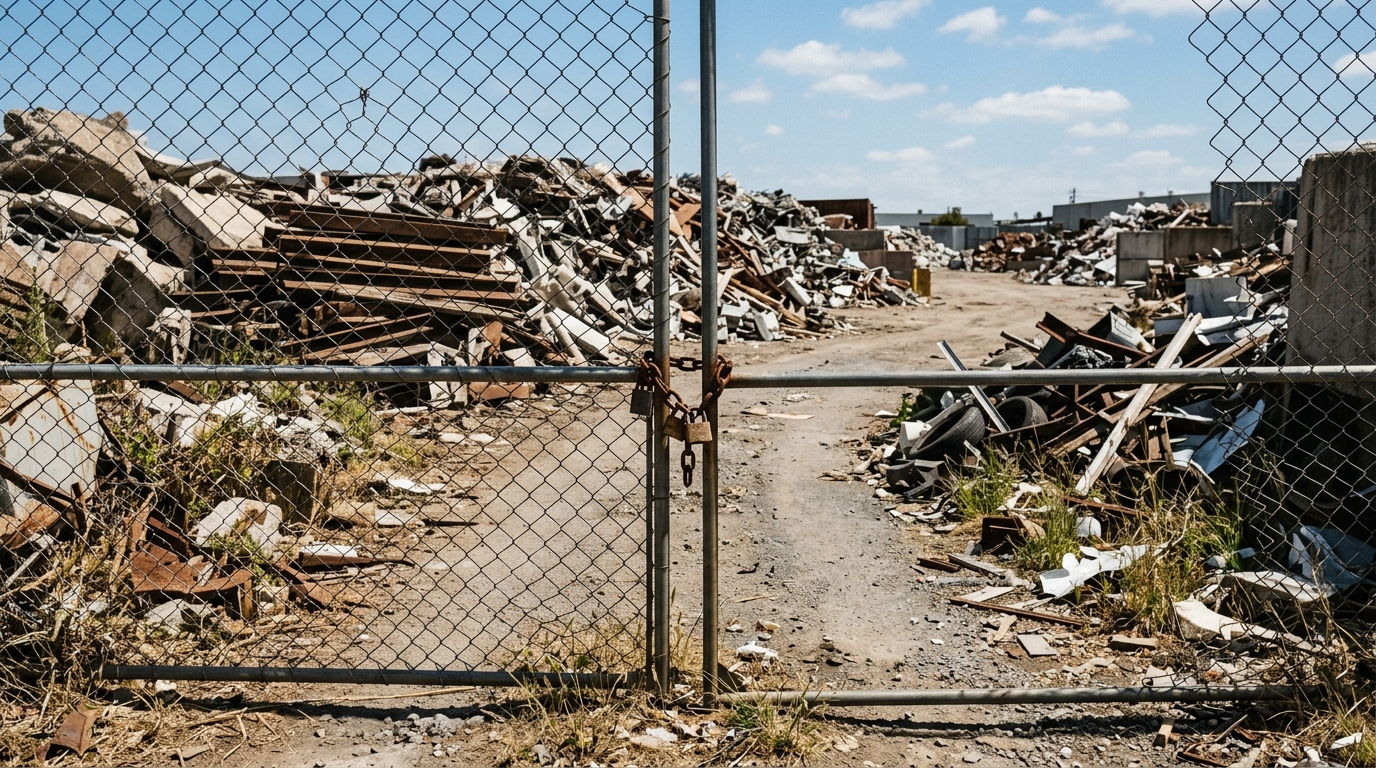
On 9 April 2026, EPA Victoria issued a prohibition notice to Monash Demolition Aust Pty Ltd, a demolition and resource recovery yard located in Campbellfield in Melbourne’s northern industrial corridor. The notice took immediate effect, legally prohibiting the facility from accepting any further combustible waste until specific conditions are met. The enforcement action followed an inspection by EPA Victoria officers who identified a stockpile of mixed combustible waste measuring 50 metres long, 30 metres wide, and 6 metres high that was restricting emergency vehicle access across the site. This is not a marginal compliance issue. A stockpile of those dimensions represents approximately 9,000 cubic metres of mixed timber, cardboard, fabric, and plastic, creating a direct and foreseeable fire hazard at a scale that would overwhelm local emergency response capacity.
For environmental professionals, auditors, and facility operators, this enforcement action clarifies what operational compliance means in a post-Environment Protection Act 2017 (Vic) regulatory environment. The General Environmental Duty, which sits at the centre of that Act, requires operators to proactively identify and manage risks of harm to human health and the environment. EPA Victoria’s decision to issue an immediate prohibition notice confirms that physical site management failures, including stockpile dimensions and emergency access routes, are treated as direct breaches of that duty. The EPA has made clear that operators cannot manage combustible waste accumulation retrospectively once a problem has grown to this scale.
The wider significance for environmental practitioners and their clients extends well beyond fire safety as a standalone concept. A large-scale fire at a facility handling mixed demolition waste generates hazardous air pollutants and produces significant volumes of contaminated firewater runoff. That runoff carries dissolved metals, hydrocarbons, oils, and concentrated leachates into stormwater systems and local waterways, creating an acute urban water contamination event. Waste facility fires are a recognised cause of precisely this type of secondary environmental harm, and preventing them is a legitimate environmental protection objective, not merely a workplace health and safety concern.
Key details of the EPA Victoria prohibition notice
The prohibition notice issued to Monash Demolition Aust Pty Ltd on 9 April 2026 carries specific legal weight under the Environment Protection Act 2017 (Vic). A prohibition notice is among the strongest enforcement tools available to EPA Victoria. Unlike a compliance notice, which sets a timeframe for corrective action while allowing operations to continue, a prohibition notice imposes an immediate cessation of the specified activity. In this case, the facility is legally banned from accepting further combustible waste until two conditions are satisfied: the stockpile is reduced to safe levels, and adequate emergency vehicle access is restored and maintained across the site.
The stockpile identified during the EPA inspection measured 50 metres by 30 metres by 6 metres, equating to a volume of approximately 9,000 cubic metres. The waste composition included timber, cardboard, fabric, and plastic, all of which are high-calorific combustible materials commonly encountered in demolition and mixed waste streams. At that volume and with that material profile, the stockpile represented a severe fire risk in its own right. The additional factor that triggered the prohibition notice was the restriction this stockpile placed on emergency vehicle access across the site. Fire appliances require minimum clearance widths and turning circles to operate effectively, and a stockpile of this footprint, occupying a 1,500 square metre ground area, was assessed as critically compromising that access.
EPA Victoria guidelines for the storage of combustible recyclable materials and waste set specific parameters for stockpile dimensions, separation distances between stockpiles, and fire break requirements. These guidelines exist precisely to prevent accumulations reaching the scale identified at Campbellfield. Maximum stockpile heights, perimeter setbacks from boundaries and drainage infrastructure, and minimum separation distances between individual stockpiles are all defined within those guidelines. Where a facility’s actual site configuration deviates materially from those parameters, the operator is in breach of its General Environmental Duty obligations, regardless of whether a fire has occurred. The Campbellfield notice demonstrates that EPA officers are assessing these physical parameters directly during inspections and acting on what they find.
The secondary environmental risk associated with a fire of this scale is contaminated firewater runoff. In a large combustible waste fire, the volume of water applied by firefighting crews can be substantial, and that water picks up oils, leachates, dissolved metals, hydrocarbons, and other pollutants from the burning and smouldering waste mass. Stormwater drainage systems at industrial facilities are typically not designed to contain or treat firewater at that volume. The result is that contaminated firewater runoff can enter local drainage catchments, waterways, and potentially groundwater systems in a short timeframe, creating an acute pollution event that may require emergency response from multiple agencies and triggers separate notification obligations under Victorian environment protection legislation.
Australian context: GED enforcement and waste facility compliance obligations
The Environment Protection Act 2017 (Vic), which came into full effect in July 2021, fundamentally changed the compliance framework for waste facility operators in Victoria. The General Environmental Duty established by that Act requires any person conducting an activity that may give rise to risks of harm to human health or the environment to understand those risks and take reasonably practicable steps to minimise them. For waste and resource recovery facilities, this duty applies continuously and is not limited to prescribed activities or licensed operations. It covers site layout, operational practices, stockpile management, and emergency access provisions as a matter of course. The Campbellfield enforcement action demonstrates that EPA Victoria is prepared to use its strongest available powers where site conditions indicate that an operator has failed to meet that standard.
References and related sources
- Primary source: www.epa.vic.gov.au
- EPA Victoria
How iEnvi can help
iEnvi provides specialist consulting services relevant to this topic. Our team includes CEnvP Site Contamination Specialists with experience across contaminated land, groundwater, remediation, ecology, and regulatory compliance.
- iEnvi contaminated land services
- iEnvi remediation and validation services
- iEnvi expert services and independent review services
This is an iEnvi Machete news summary. Prepared by iEnvi to summarise the source article for contaminated land, groundwater, remediation, approvals and site risk professionals.
Published: 12 Apr 2026
Need advice on this topic? Speak to an iEnvi expert at info@ienvi.com.au or 1300 043 684, or contact us online.
Need advice on this issue? iEnvi provides practical, senior-led environmental consulting across contaminated land, remediation, ecology and environmental risk.
Team credentials Contaminated land services Remediation services Groundwater services Talk to iEnvi