
Overview
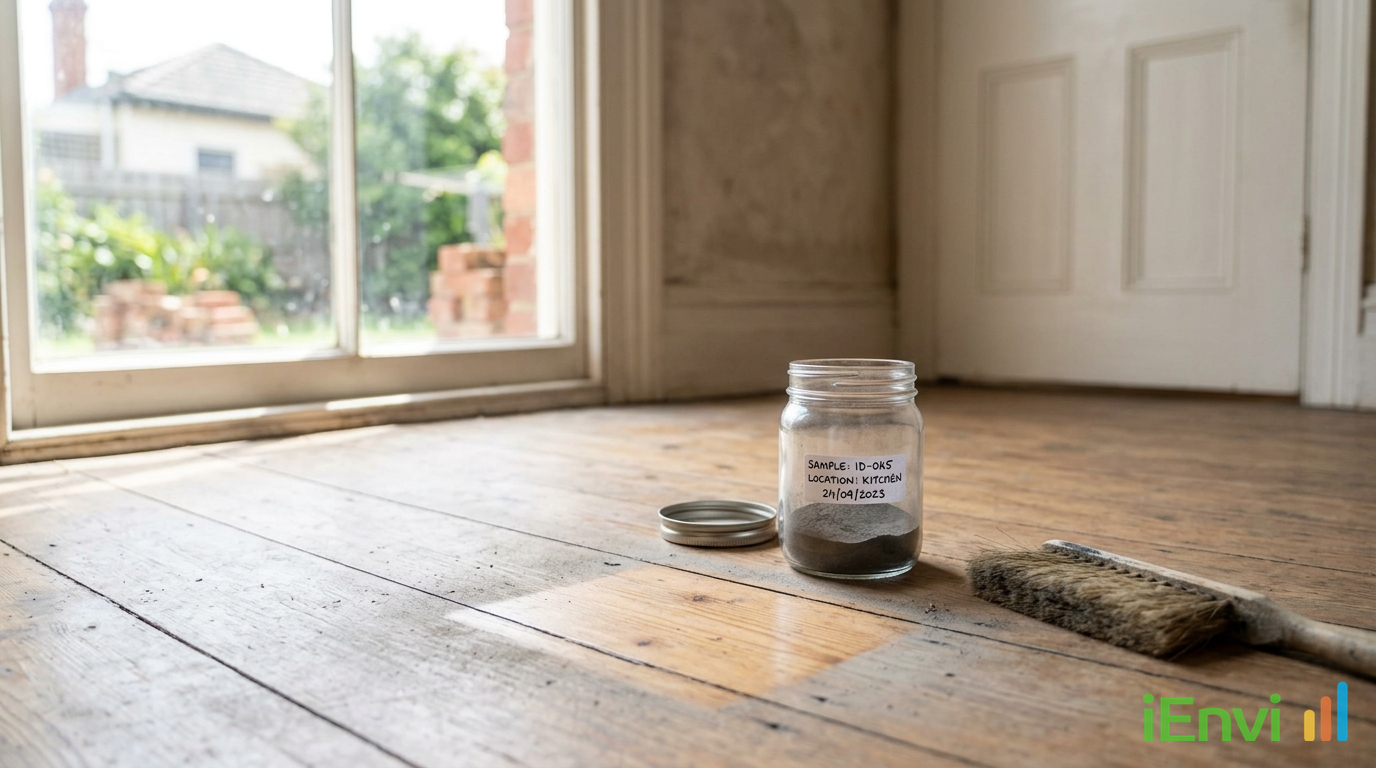
Environment Protection Authority Victoria has published a peer-reviewed study in Environment International confirming that indoor dust and soil across 44 Victorian homes contain remarkably low levels of both legacy and emerging contaminants, with 99.5 percent of all detected chemical concentrations sitting below health-protective screening thresholds. The research, drawn from samples collected through EPA Victoria’s GardenSafe citizen science programme, screened for 184 individual chemicals spanning PFAS, household pesticides, hydrocarbons, pharmaceuticals, personal care products and trace metals such as lead and arsenic.
This matters to Australian environmental professionals because it is one of the largest published datasets of its kind linking real residential indoor dust chemistry to current health screening frameworks. For consultants preparing human health risk assessments (HHRAs), conceptual site models (CSMs) and due diligence reports, the study offers empirical baseline data rather than modelled assumptions about what typical Australian homes actually contain in household dust.
For developers, councils, lawyers and site owners managing contaminated land liabilities, the findings reinforce a point that is often lost in public and media commentary about PFAS and modern chemicals: legacy lead paint, not emerging contaminants, remains the dominant acute exposure pathway in older residential housing stock. Only one of the 44 sampled properties returned a dust result exceeding health screening thresholds, and that exceedance was directly attributed to historical lead-based paint.
Key details
The GardenSafe programme collected paired indoor dust and garden soil samples from 44 Victorian residences, with laboratory analysis targeting 184 discrete chemical parameters. This included per- and polyfluoroalkyl substances (PFAS), organochlorine and pyrethroid pesticides, polycyclic aromatic hydrocarbons (PAHs), pharmaceuticals and personal care product residues, and a suite of trace metals including lead, arsenic, cadmium and chromium.
Of the full dataset, 99.5 percent of detected concentrations fell below applicable health-based screening values. Concentrations of PFAS compounds and contemporary household pesticides in indoor dust were consistently low across the sample set and did not present an actionable human health risk when assessed against current guidance. This is a significant methodological finding because indoor dust ingestion is frequently modelled as a conservative exposure pathway in residential HHRAs, particularly for young children exhibiting hand-to-mouth behaviour.
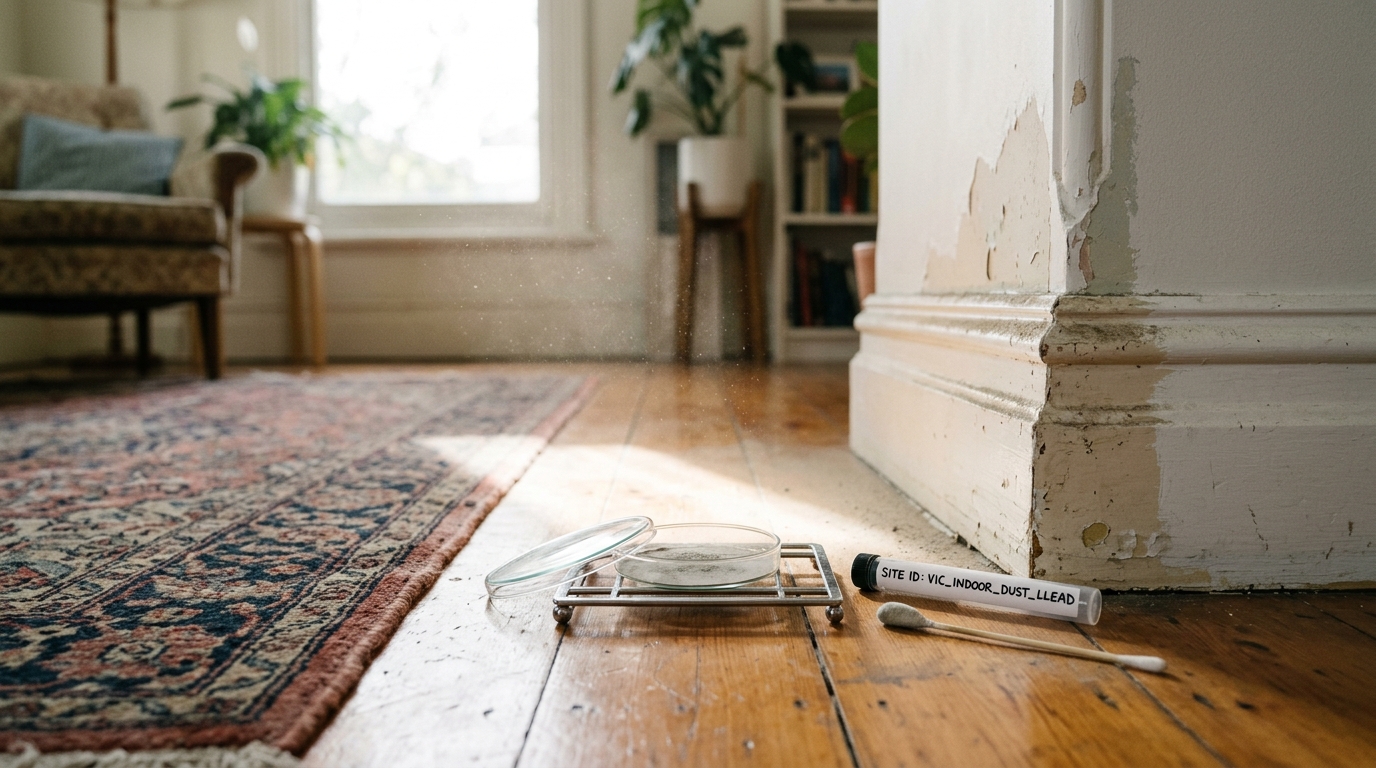
The single exceedance recorded across the entire study was attributed to legacy lead-based paint, consistent with Australia’s well-documented history of lead paint use in residential construction prior to the phase-down of lead additives in domestic paints during the 1990s and 1997 mandatory standard changes. This single result aligns with decades of Australian and international literature identifying deteriorating lead paint, and lead-contaminated soil around older dwellings, as the primary source of elevated indoor lead dust.
Results were benchmarked against established Australian screening frameworks, including the National Environment Protection (Assessment of Site Contamination) Measure 2013 Health Investigation Levels for residential land use (HIL A) and Health Screening Levels (HSLs), enHealth’s Environmental Health Risk Assessment guidance, and health-based guidance values under the PFAS National Environmental Management Plan (PFAS NEMP). Applying these frameworks in combination allowed researchers to evaluate both soil-to-dust transfer pathways and direct indoor dust ingestion and inhalation exposure routes within a single conceptual model.

Australian context
These findings sit directly within Victoria’s contaminated land regulatory framework under the Environment Protection Act 2017, which imposes a General Environmental Duty (GED) on any person managing an activity that gives rise to risk of harm to human health or the environment. The GED requires duty holders to apply proportionate risk management, meaning remediation and management controls should be directed at genuine, verified exposure pathways rather than applied uniformly across every chemical class regardless of measured risk. This study provides duty holders and their consultants with quantitative support for that proportionality principle.
Nationally, the study’s use of NEPM 2013 HIL A residential thresholds and PFAS NEMP guidance values means the results are directly transferable to site assessment practice in New South Wales, Queensland, South Australia and other jurisdictions that adopt the same national framework for residential land use assessment. Consultants working under state EPA guidelines in these jurisdictions can reasonably reference this dataset when justifying background concentration assumptions for indoor dust exposure pathways in CSMs, particularly where PFAS is a nominated contaminant of potential concern but no clear source area has been identified on site.
The findings also carry weight for legacy lead assessment practice, an area that receives comparatively less regulatory and media attention than PFAS despite carrying a well-established toxicological profile and lower tolerable exposure margins for young children. Practitioners assessing older residential subdivisions, particularly pre-1970s housing stock common in inner suburban Melbourne, Sydney, Adelaide and Brisbane, should treat this study as a reminder that lead paint condition surveys and soil lead sampling around building perimeters remain a core, non-negotiable component of residential redevelopment assessments.
Practical implications
Site assessors scoping Preliminary Site Investigations (PSIs) and Detailed Site Investigations (DSIs) on residential land can use this dataset to calibrate their sampling design and CSM assumptions. Where a desktop review identifies no credible PFAS source, this study strengthens the case for treating indoor dust as a low-priority pathway, freeing budget for higher-value lines of evidence such as perimeter soil lead sampling and paint condition surveys on pre-1970s dwellings.
For HHRA practitioners, the results provide measured Australian background concentrations for indoor dust that can replace conservative modelled defaults, potentially reducing over-estimation of exposure in residential risk assessments. Lawyers and site owners negotiating remediation scope can also point to the study when arguing that management effort should be proportionate to demonstrated risk, consistent with the GED under Victoria’s Environment Protection Act 2017.
The clearest practical message, however, concerns lead. With the study’s only exceedance traced to legacy lead paint, consultants, councils and developers dealing with older housing stock should keep lead front and centre in scoping decisions, community engagement and renovation advice, even as PFAS continues to dominate public discussion of contamination risk.
References and related sources
- Primary source: www.epa.vic.gov.au
- holdingredlich.com
- https://www.epa.vic.gov.au/about-us/news-media-and-updates/media-releases-and-ne
- PFAS National Environmental Management Plan (NEMP)
- NEPM Assessment of Site Contamination
- EPA Victoria
How iEnvi can help
iEnvi provides specialist consulting services relevant to this topic. Our team includes CEnvP Site Contamination Specialists with experience across contaminated land, groundwater, remediation, ecology, and regulatory compliance.
- iEnvi site investigation services
- iEnvi remediation and validation services
- iEnvi expert services and independent review services
This is an iEnvi Machete news summary. Prepared by iEnvi to summarise the source article for contaminated land, groundwater, remediation, approvals and site risk professionals.
Published: 21 Aug 2026
Need advice on this topic? Speak to an iEnvi expert at info@ienvi.com.au or 1300 043 684, or contact us online.
Need advice on this issue? iEnvi provides practical, senior-led environmental consulting across contaminated land, remediation, ecology and environmental risk.
PSI services DSI services Team credentials Contamination risk assessment Talk to iEnvi