

Overview
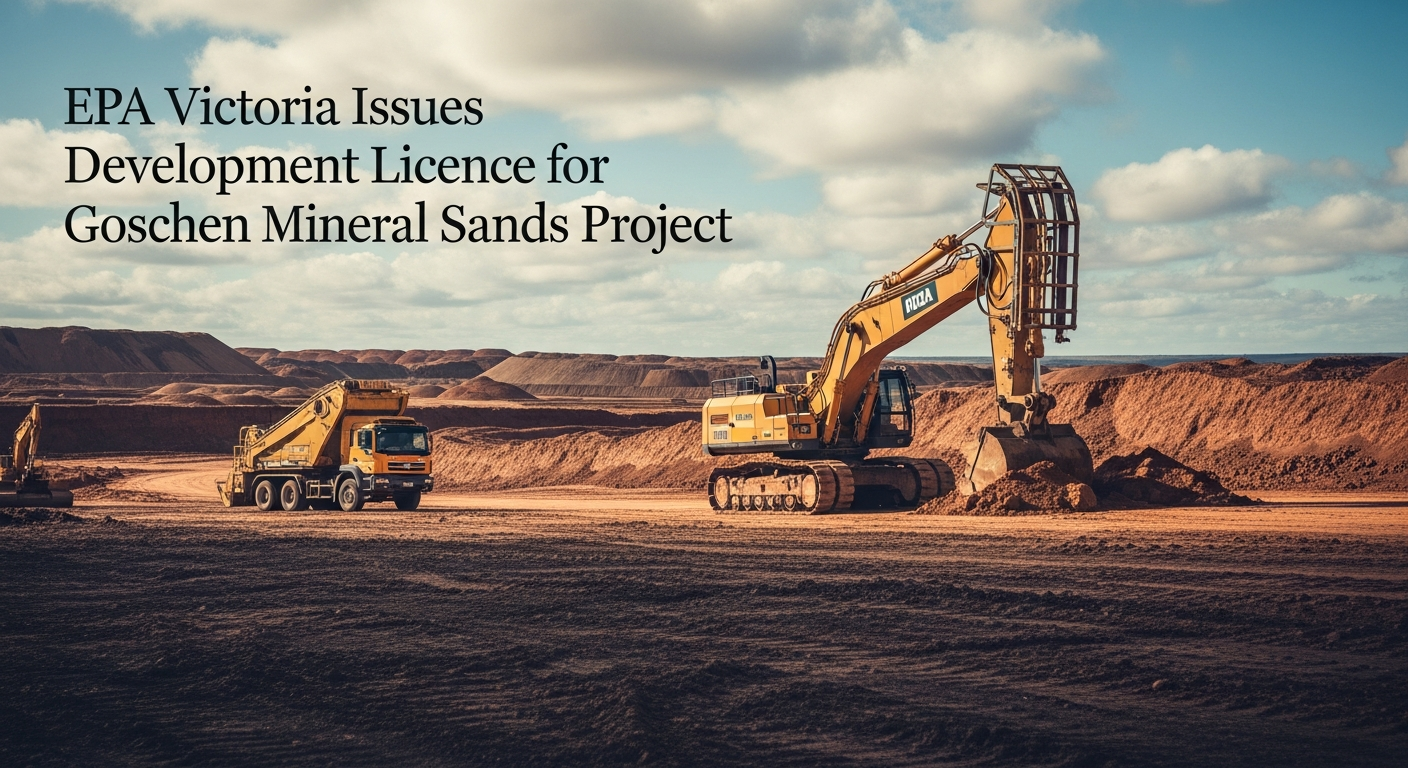
EPA Victoria officially issued Development Licence DL000300088 to VHM Limited on 20 July 2024, with the EPA’s project portal updated on 23 July 2024. The licence covers the design and construction of onsite power generation and domestic wastewater treatment systems at the Goschen Mineral Sands and Rare Earths Project, located approximately 35 kilometres south of Swan Hill in northwest Victoria. This approval represents one of the more technically complex development licence determinations EPA Victoria has issued under the modernised Environment Protection Act 2017 (Vic), and it carries direct lessons for environmental practitioners, resource developers, and transaction advisers working across the critical minerals sector.
The Goschen project sits across a 1,534-hectare tenement and is targeting production of heavy mineral sands alongside a suite of rare earth elements including neodymium, praseodymium, dysprosium, and terbium. These are classified as critical minerals under Australian federal policy, meaning the project intersects both state environmental regulation and national strategic supply chain objectives. For environmental professionals, the significance of this licence extends beyond the individual project: it demonstrates how the General Environmental Duty (GED) under the Environment Protection Act 2017 (Vic) operates in practice for large-scale resource developments, and how concurrent multi-agency assessment pathways can be structured to support commercial delivery without regulatory shortcuts.
The approval follows the conclusion of a comprehensive Environment Effects Statement (EES) process in late 2024, which was jointly evaluated alongside a draft Planning Scheme Amendment and the EPA development licence application itself. That concurrency is not incidental. It reflects a deliberate project management strategy to align regulatory workstreams and avoid the sequential bottlenecks that have historically delayed major resource projects in Victoria. For developers, lawyers, and councils dealing with comparably scaled proposals, the Goschen trajectory provides a working template for how front-end environmental investment translates into regulatory and commercial outcomes.
Key details of Development Licence DL000300088 and the Goschen regulatory pathway
Development Licence DL000300088 was issued under Section 69 of the Environment Protection Act 2017 (Vic), which governs the assessment and granting of development licences for activities that carry a risk of harm to human health or the environment. Under that provision, an applicant must demonstrate that the design and construction of the proposed works will apply reasonably practicable measures to fulfil the General Environmental Duty. For the Goschen project, the licence specifically authorises the onsite power generation system and the domestic wastewater treatment system. These are discrete infrastructure elements, but their approval under a development licence signals that EPA Victoria assessed them as activities with environmental risk profiles requiring formal regulatory authorisation rather than lower-tier approvals.
The Goschen project’s EES process, which concluded in late 2024, was evaluated jointly by the Minister for Planning and EPA Victoria. Joint evaluation of an EES alongside a planning scheme amendment and a development licence application is a relatively uncommon procedural configuration in Victoria. It is typically reserved for projects where the environmental and land use planning implications are sufficiently integrated that separate sequential assessments would produce an inefficient or inconsistent outcome. The EES assessment framework under the Environment Effects Act 1978 (Vic) requires an independent assessment and ministerial assessment to precede planning approvals, and VHM Limited structured its regulatory programme to allow all three workstreams to progress in parallel. This compressed what could have been a five-to-seven year sequential approval pathway into a more commercially viable timeframe.
Beyond the EPA development licence, the Goschen project requires a suite of secondary approvals that carry their own assessment timelines and agency interfaces. These include radiation management licences under the Radiation Act 2005 (Vic), which are mandatory for projects processing naturally occurring radioactive material (NORM) in heavy mineral sands. The mineral sands deposits at Goschen contain radioactive minerals including monazite, which is a significant carrier of thorium and uranium. Water management approvals and in-pit tailings deposition consents are also required, each governed by separate regulatory instruments and assessment criteria. The interaction between these approval streams and the EPA development licence creates a complex dependency matrix that project teams must map explicitly at the programme planning stage.
On the commercial side, VHM Limited executed a strategic partnership and 18-year binding offtake agreement with Iluka Resources on 2 July 2024, approximately three weeks before the EPA development licence was issued. That agreement commits VHM to supply 146,000 tonnes of rare earth concentrate to Iluka’s Eneabba refinery in Western Australia, which is being developed as Australia’s first fully integrated rare earths refinery. The sequencing of the Iluka offtake agreement immediately preceding the EPA licence issuance reflects the reality that major project financing and offtake structures are typically negotiated against a regulatory risk profile, with development licence approval functioning as a key derisking milestone for prospective counterparties and financiers.
Australian context: critical minerals projects and Victoria’s Environment Protection Act 2017 framework
Victoria’s Environment Protection Act 2017 (Vic), which commenced operation in July 2021, introduced a substantially modernised regulatory framework that replaced the longstanding Environment Protection Act 1970 (Vic). The 2017 Act restructured the licensing regime around risk-based principles, with the General Environmental Duty sitting at the centre of the framework as an overarching obligation applicable to all persons whose activities may pose risks of harm to human health or the environment. Development licences under Section 69 of the Act represent the primary mechanism through which EPA Victoria exercises pre-construction oversight of high-risk infrastructure, requiring applicants to demonstrate that proposed designs and construction methods meet the GED standard before works commence.
References and related sources
- Primary source: www.epa.vic.gov.au
- chemanalyst.com
- marketindex.com.au
- epa.vic.gov.au
- epa.vic.gov.au
- EPA Victoria
How iEnvi can help
iEnvi provides specialist consulting services relevant to this topic. Our team includes CEnvP Site Contamination Specialists with experience across contaminated land, groundwater, remediation, ecology, and regulatory compliance.
- iEnvi contaminated land investigation services
- iEnvi remediation and validation services
- iEnvi expert services and independent review services
This is an iEnvi Machete news summary. Prepared by iEnvi to summarise the source article for contaminated land, groundwater, remediation, approvals and site risk professionals.
Published: 24 Jul 2026
Need advice on this topic? Speak to an iEnvi expert at info@ienvi.com.au or 1300 043 684, or contact us online.
Need advice on this issue? iEnvi provides practical, senior-led environmental consulting across contaminated land, remediation, ecology and environmental risk.
Team credentials Contaminated land services Remediation services Groundwater services Talk to iEnvi