
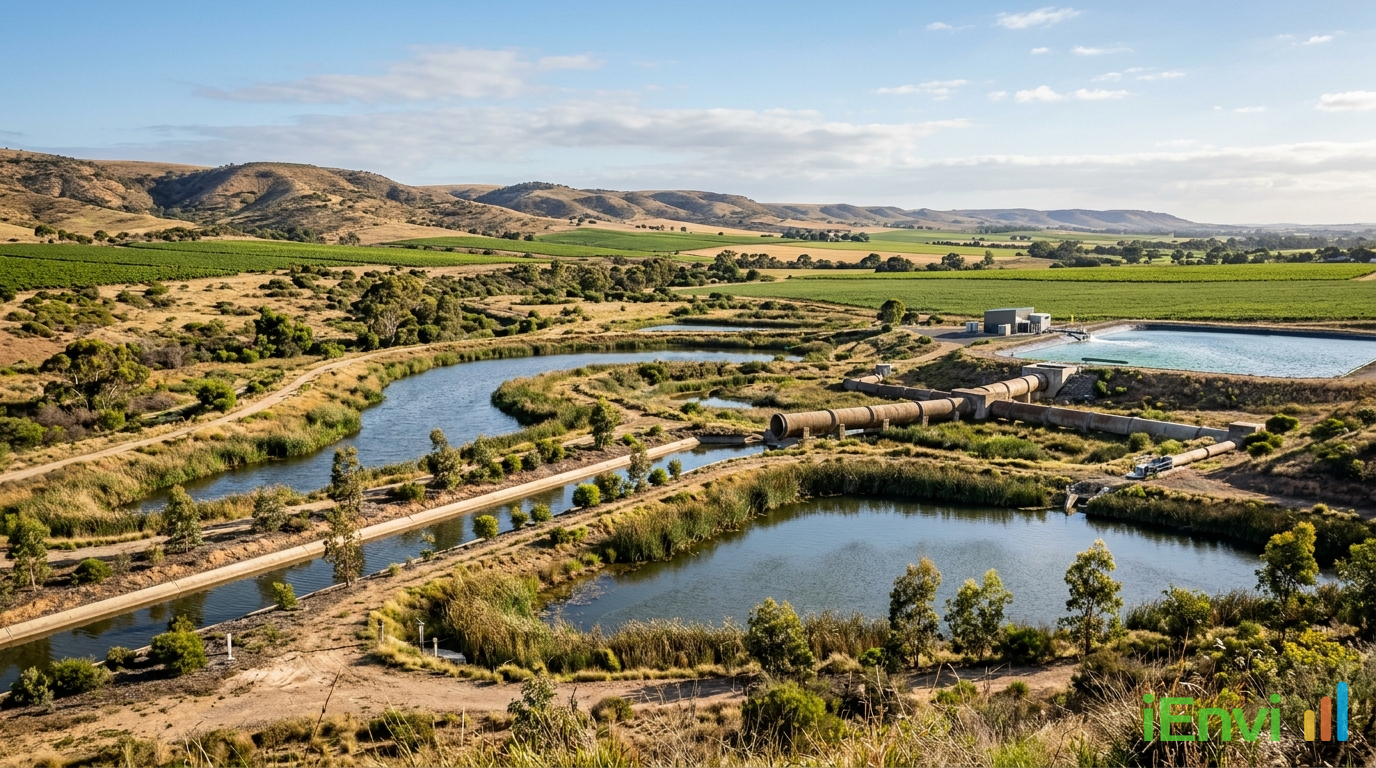
Federal and SA Government Funding for Stormwater Harvesting
On 17 August 2026, Federal Minister for the Environment and Water Murray Watt and South Australian Minister for Climate, Environment and Water Emily Bourke announced $32 million in joint funding for six South Australian local government water projects under the SA Alternative Water Supply Efficiency Measures (AWSEM) Program. The funding targets stormwater harvesting and recycled water infrastructure across metropolitan Adelaide, with construction due for completion by the end of 2027.
The announcement matters well beyond South Australia because it demonstrates a working mechanism for converting urban water infrastructure spend into measurable Basin Plan compliance. Rather than funding stormwater harvesting purely as a sustainability initiative, the AWSEM program is structured so that potable water offsets translate directly into transferable River Murray entitlements. That distinction should interest every environmental practitioner working on water security, integrated urban water management, or Murray-Darling Basin compliance, because it establishes a template that other states and councils are likely to reference.
For developers, councils and legal advisers working on Basin-connected projects, this is a signal that alternative water infrastructure is no longer a discretionary environmental add-on. It is becoming a recognised pathway for meeting regulatory water recovery obligations, and the projects funded here will generate real hydrogeological, water quality and compliance workloads over the next 18 months.
Key details
The $32 million AWSEM allocation is split across six recipients: the City of Salisbury, City of Charles Sturt, City of Playford, City of Marion, City of Onkaparinga, and Eastern Region Alliance Water, a joint venture representing the councils of Burnside, Norwood Payneham & St Peters, and Walkerville. Works will include new stormwater harvesting infrastructure, expanded water capture basins, and upgraded recycled water distribution networks, with completion targeted for late 2027.
The program is projected to generate 1,890 megalitres (ML) of alternative water savings annually. This water will substitute for potable supply currently used to irrigate public open spaces, sports ovals and industrial sites across the participating council areas. The mechanism is straightforward in principle: every megalitre of potable water displaced by harvested stormwater or recycled water reduces the corresponding draw on River Murray allocations, freeing up entitlement volume that can be formally transferred.
Under the scheme, 1,769 ML of South Australian River Murray High Security entitlements will be transferred to the Commonwealth Environment Water Holder. This transfer counts directly toward the 450 gigalitre (GL) environmental water recovery target established under the Murray-Darling Basin Plan, which operates under the Water Act 2007 (Cth). The 450 GL target relates to additional environmental water recovery above the original 2,750 GL Basin Plan baseline, and has historically been the hardest component of the Basin Plan to deliver, given the requirement that recovery occur through efficiency measures with neutral or positive socioeconomic outcomes rather than simple buybacks.
The AWSEM program sits within the broader Resilient Rivers Program funding architecture. While the media release does not specify per-project cost breakdowns or the individual ML contribution of each of the six councils, it confirms the aggregate 1,890 ML annual savings figure and the 1,769 ML entitlement transfer figure, which implies a recovery efficiency of roughly 94 percent between water saved and entitlement volume transferred. This gap is consistent with typical allowances for conveyance losses, seasonal variability in stormwater yield, and administrative buffers built into efficiency measure calculations.
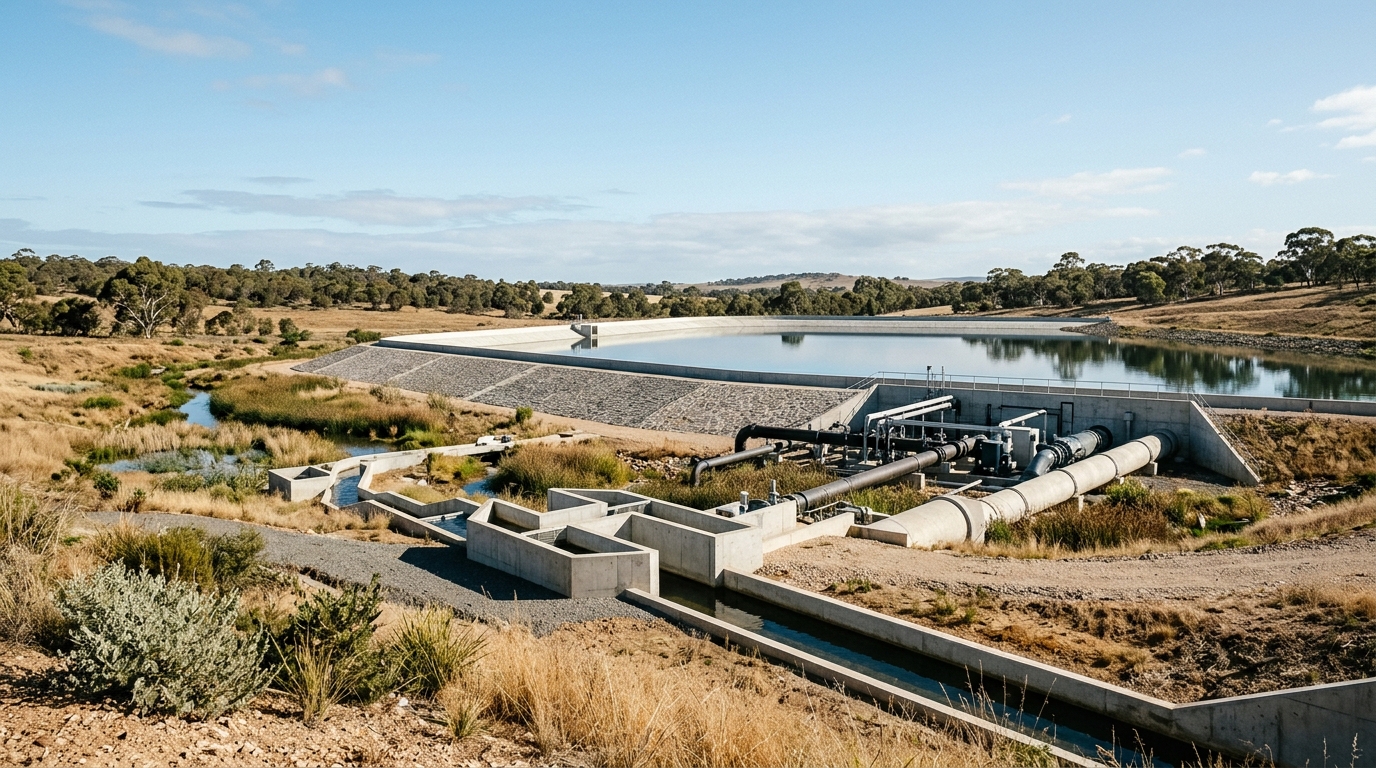
Australian context: stormwater harvesting and the 450 GL Basin Plan target
For practitioners working in the Murray-Darling Basin states, this announcement is a concrete example of how efficiency measures under the Basin Plan are being operationalised at council scale. The 450 GL target has faced persistent delivery challenges since it was legislated, and stormwater harvesting schemes like this one offer a lower-friction alternative to the water buyback approaches that have generated significant socioeconomic pushback in irrigation communities. Practitioners advising Basin state governments or water utilities on efficiency measure proposals should treat this AWSEM tranche as a live case study in how ML savings are calculated, verified and converted into transferable entitlements.
The technical work behind these six projects will draw heavily on frameworks already familiar to Australian contaminated land and water quality practitioners. Water quality management for harvested stormwater destined for open space irrigation or recycled distribution typically requires assessment against the Australian and New Zealand Guidelines for Fresh and Marine Water Quality (ANZG 2018), alongside state-specific health and reuse frameworks such as SA Health’s guidelines for recycled water schemes. Where stormwater capture involves aquifer storage or injection, Managed Aquifer Recharge (MAR) feasibility work will need to address infiltration rates, receiving aquifer geochemistry, and compatibility testing to avoid clogging, mobilisation of aquifer minerals, or contamination of groundwater resources.
This program is South Australian, but the funding architecture and entitlement conversion logic are directly transferable to New South Wales and Victorian councils operating within the Basin footprint. Any jurisdiction with existing potable substitution infrastructure and access to Basin entitlements could, in principle, pursue a similar efficiency measure pathway. Practitioners in Victoria and NSW should expect councils and state agencies in those jurisdictions to examine the AWSEM model closely, and should be prepared to advise on feasibility assessments, water quality compliance and entitlement transfer arrangements if similar programs emerge in the Basin footprint over the coming years.
References and related sources
- Primary source: minister.dcceew.gov.au
- ANZG Water Quality Guidelines
- SA EPA
How iEnvi can help
iEnvi provides specialist consulting services relevant to this topic. Our team includes CEnvP Site Contamination Specialists with experience across contaminated land, groundwater, remediation, ecology, and regulatory compliance.
- iEnvi contaminated land investigation services
- iEnvi remediation and validation services
- iEnvi expert services and independent review services
This is an iEnvi Machete news summary. Prepared by iEnvi to summarise the source article for contaminated land, groundwater, remediation, approvals and site risk professionals.
Published: 19 Aug 2026
Need advice on this topic? Speak to an iEnvi expert at info@ienvi.com.au or 1300 043 684, or contact us online.
Need advice on this issue? iEnvi provides practical, senior-led environmental consulting across contaminated land, remediation, ecology and environmental risk.
Team credentials Contaminated land services Remediation services Groundwater services Talk to iEnvi