
Does a new council depot on a vegetated lot automatically need a BDAR?
Not automatically. Under Part 5 of the EP&A Act the operative test is the Five-Part Test of significance, not Biodiversity Values Map overlap. iEnvi’s flora and fauna assessment for a Mid North Coast NSW council depot found the works were not likely to significantly affect threatened species or ecological communities, supporting a REF with no BDAR and no EPBC referral warranted on the assessment, subject to the determining authority’s decision.
Councils need modern works depots, and the land available often carries native vegetation, threatened flora and mapped biodiversity values. The question for the project team is whether the depot can proceed under a Review of Environmental Factors without a Biodiversity Development Assessment Report (BDAR) being forced into the approval path. For a council works depot on the Mid North Coast of NSW, iEnvi’s flora and fauna assessment answered that question with targeted field survey and the tests the legislation actually applies.
Why a council depot REF needed a flora and fauna assessment
The proposal covered a vegetated multi-hectare lot, with roughly a third proposed for the depot and the balance retained for conservation and environmental management. As a public authority activity, the project is assessed under Part 5 of the Environmental Planning and Assessment Act 1979 through a Review of Environmental Factors (REF).
The REF needed an ecology evidence base: desktop review and field survey to test whether clearing for the depot would significantly affect threatened species or ecological communities under NSW and Commonwealth law, and whether a BDAR would be required for the approval.
Field survey findings: vegetation communities and threatened flora
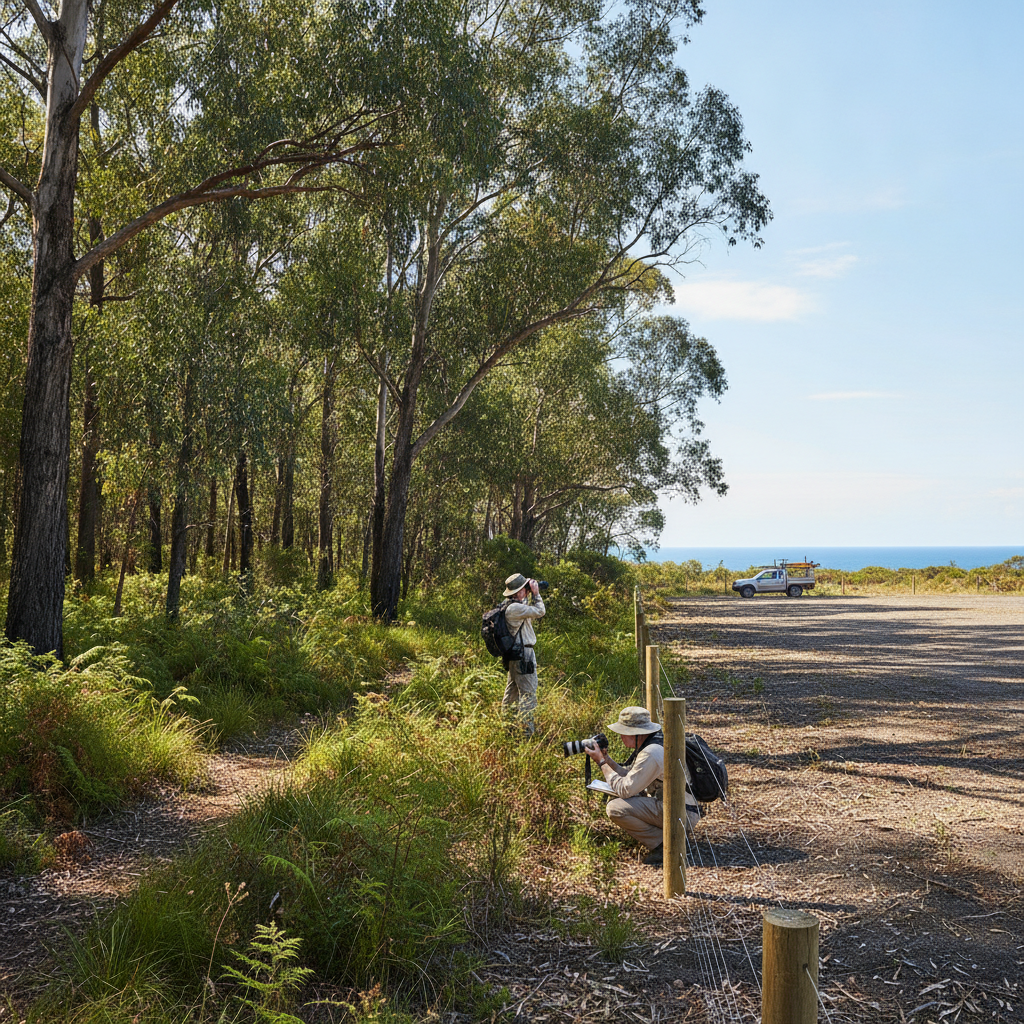
iEnvi completed a desktop assessment and two autumn 2026 field survey campaigns, four survey days in total, across the lot. The vegetation comprised:
- Mid North Lowland Flooded Gum-Palm Wet Forest
- Northern Paperbark-Swamp Mahogany Saw-sedge Forest
- Cleared and disturbed areas
Two threatened plants were confirmed on the lot: the critically endangered Scrub Turpentine (Rhodamnia rubescens) and the vulnerable Biconvex Paperbark (Melaleuca biconvexa). Both were concentrated in the vegetation proposed for retention.
Avoidance by design: ecology retained outside the works footprint
The depot layout keeps the works footprint on already disturbed ground and retains the eastern and northern ecological areas outside it, with no clearing or earthworks extending into those retained zones. That is avoidance, the first step in the mitigation hierarchy, not offsetting under the Biodiversity Offsets Scheme. The high-value bushland stays on the lot as conservation and environmental management land, and the threatened flora records sit within it.
Five-Part Test, EPBC and the BDAR question under Part 5
iEnvi applied the Five-Part Test of significance under section 7.3 of the Biodiversity Conservation Act 2016 and concluded the activity was not likely to significantly affect threatened species, populations or ecological communities. A separate significant impact assessment under the Commonwealth EPBC Act concluded a referral was not warranted on the assessment findings.
A point that catches many project teams out: for a Part 5 activity, overlap with the Biodiversity Values Map does not by itself trigger the Biodiversity Offsets Scheme. The operative test remains section 7.3 significance. On the assessment findings a BDAR was not required, and the flora and fauna assessment supports the REF with management recommendations for the determination. The outcome remains subject to the determining authority’s decision on the REF.
Ecology and contaminated land in one REF package
Depot sites usually raise more than ecology. Fill, fuel storage and past operational use bring contamination questions into the same REF, and the assessment is stronger when both disciplines are scoped together from the start.
iEnvi delivers flora and fauna assessments and contaminated land assessment as a single REF package for councils and public authorities across NSW. To scope ecology and contaminated land for your next REF, contact iEnvi or call 1300 043 684.
Need advice on this issue? iEnvi provides practical, senior-led environmental consulting across contaminated land, remediation, ecology and environmental risk.
Flora and fauna assessment Contaminated land services Environmental management Talk to iEnvi