
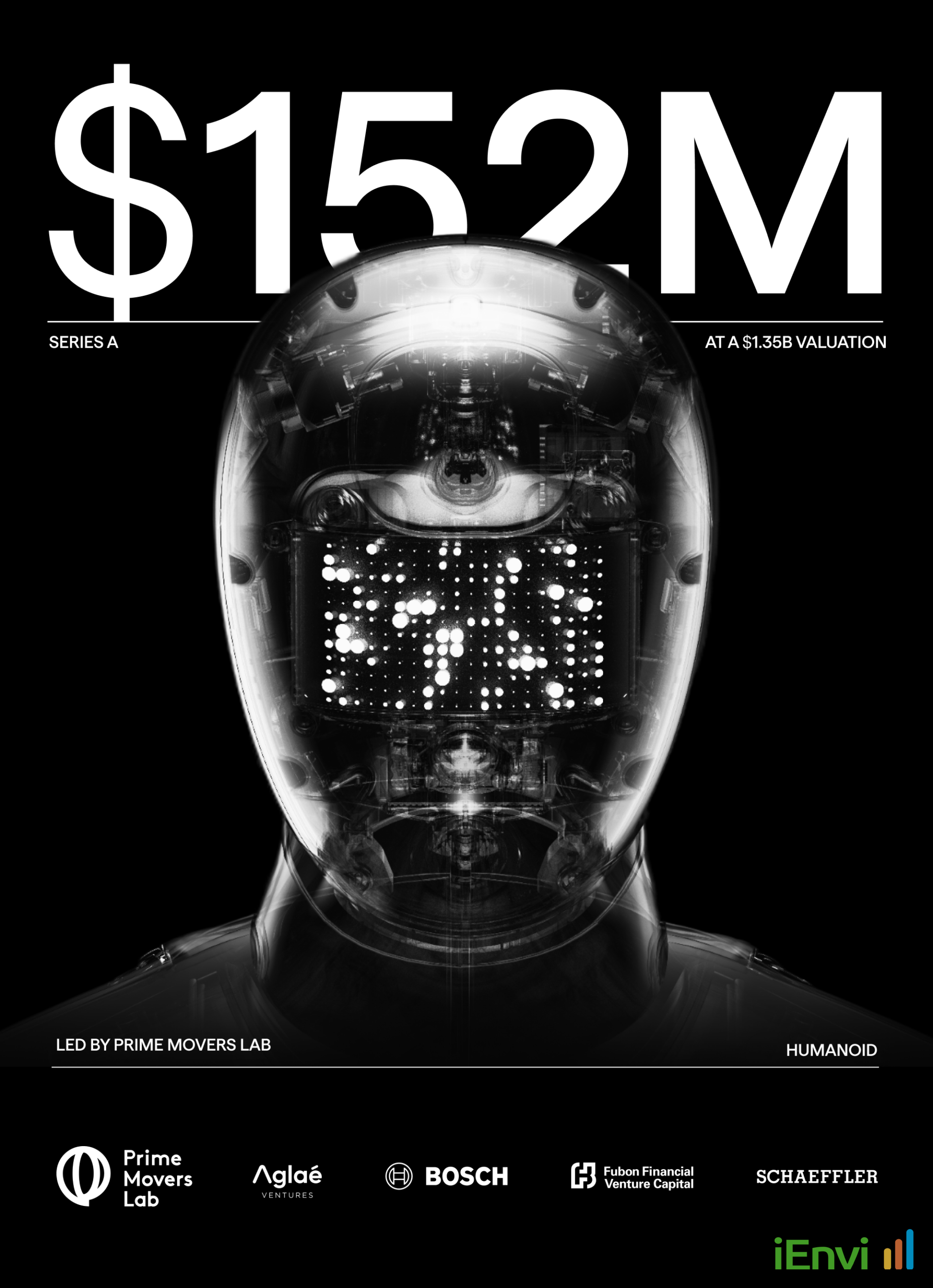
Humanoid Raises USD $152 Million Series A, Becoming Europe’s First Humanoid Robotics Unicorn
London-based artificial intelligence and robotics firm SKL Robotics Ltd., trading as Humanoid, has closed a USD $152 million (approximately AUD $232 million) Series A funding round at a post-money valuation of USD $1.35 billion (approximately AUD $2.06 billion), making it Europe’s first pure-play humanoid robotics unicorn. The round was led by Prime Movers Lab and includes strategic investment from global engineering conglomerates Bosch and Schaeffler, alongside Fubon Financial Holding Venture Capital and Aglaé Ventures. The announcement marks a significant shift in the global industrial robotics landscape, which has until now been dominated almost entirely by United States firms such as Tesla Optimus, Figure, and Apptronik, and Chinese manufacturers including Unitree and AgiBot.
What makes this raise particularly significant is not simply the capital amount, but the speed at which it has been achieved. Humanoid was founded in 2024, meaning the company reached unicorn status within approximately two years of inception. Artem Sokolov, the company’s founder and CEO, has described the trajectory as something that “would typically take a decade,” attributing the accelerated timeline to advances in physical AI, simulated training environments, and pre-trained world models that allow hardware development cycles to compress dramatically. For professionals and enterprise leaders across manufacturing, logistics, and industrial services, this signals a transition from robotics as a long-term aspiration to a near-term procurement and workforce planning reality.
For Australian business leaders, technology strategists, and the professional services firms that advise them, the Humanoid raise is a leading indicator of where physical AI deployment is heading at an industrial scale. While the immediate commercial activity is centred in Europe, the contractual commitments already in place with Bosch and Schaeffler, two companies with substantial Australian operations and supply chain relationships, suggest that decisions made in European factories today will influence procurement, operations, and workforce strategy in Australian facilities within the next five to seven years.
Key details of the Humanoid Series A raise and deployment architecture
The USD $152 million Series A round positions Humanoid at a post-money valuation of USD $1.35 billion. The round’s lead investor, Prime Movers Lab, is a US-based deep technology venture fund with a track record in physical sciences and frontier hardware. The strategic investors, Bosch and Schaeffler, are not passive financial participants. Bosch has been confirmed as Humanoid’s contract manufacturing partner, taking on responsibility for hardware design, supply chain management, and production scaling. The stated production target is 100,000 units over a five-year period, which, if achieved, would represent one of the largest single-company humanoid robot production commitments in the world to date.
Schaeffler, a German precision engineering group with manufacturing and distribution operations across multiple continents, has reportedly signed a binding commercial agreement to deploy between 1,000 and 2,000 wheeled humanoid units across its facilities by 2032. This is not a memorandum of understanding or a pilot programme agreement. It is described as a binding commercial rollout, a distinction that matters when assessing the credibility of the company’s commercial pipeline. These figures originate from the company’s own announcement and have not been independently verified by third parties, but the involvement of Schaeffler as both an investor and a named deployment customer lends the claims a degree of commercial substance that purely financial raises often lack.
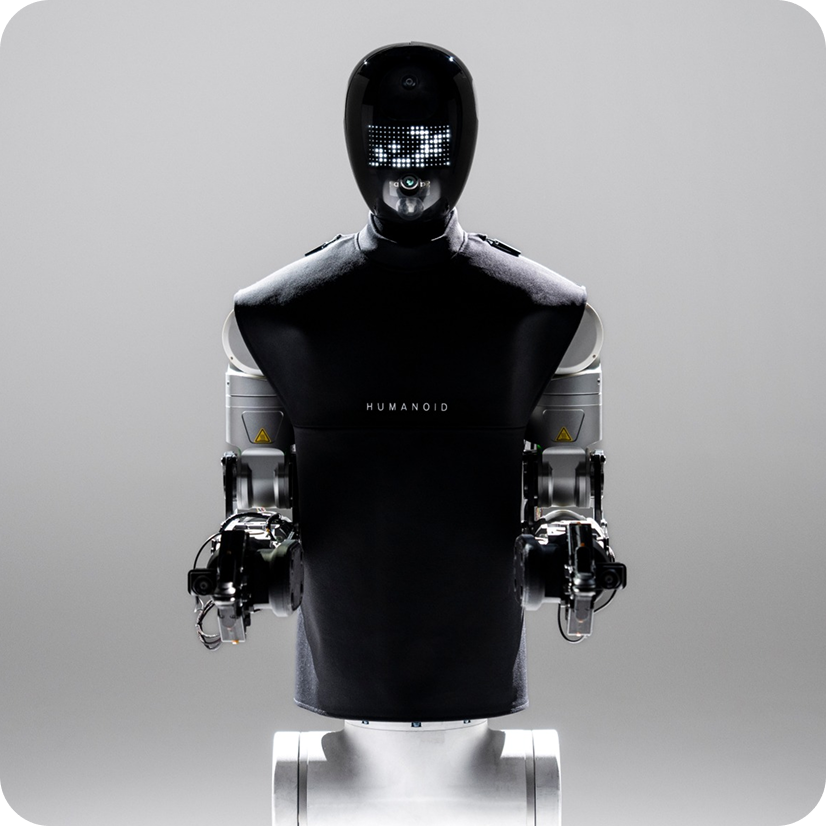
The company’s product platform, known as the HMND-01 Alpha family, includes both wheeled and bipedal humanoid models. The wheeled variant is designed for heavy industrial logistics, component sorting, and materials handling. Its wheeled base allows the platform to pursue CE certification under existing Autonomous Mobile Robot frameworks and collaborative-robot regulatory standards, which are already well-established in European industrial settings. The company is targeting CE certification for the wheeled model within the next year. The bipedal variant, which is intended for confined-quarters industrial environments where a wheeled base is impractical, remains in research and development and faces a more complex and lengthy regulatory pathway.
Central to the company’s technical proposition is KinetIQ, a proprietary AI intelligence framework that functions as a shared operational brain across a fleet of robots. Rather than each robot operating as an isolated unit responding only to its own sensor inputs, KinetIQ enables multiple robots to communicate in real time, hand off tasks between units, and dynamically coordinate to complete larger operational objectives on the factory floor. This fleet-level orchestration capability is architecturally different from conventional industrial robot programming, where individual units follow fixed, pre-programmed routines. The talent pipeline supporting this capability includes over 50 engineers recruited from Boston Dynamics, Sanctuary AI, Apptronik, and 1X, all of which are regarded as among the most technically advanced humanoid robotics organisations in the world.
Australian context: physical AI deployment and its implications for Australian industry and professional services
Australia does not currently have a domestic humanoid robotics manufacturer of comparable scale, and the country’s regulatory framework for autonomous mobile robots in industrial settings is still maturing. Safe Work Australia’s model Work Health and Safety laws govern the introduction of new plant and machinery in Australian workplaces, and any deployment of autonomous mobile robots in Australia would need to satisfy those obligations alongside applicable state and territory work health and safety legislation. For Australian manufacturers, logistics operators, and the engineering and consulting firms that support them, the Humanoid raise is a prompt to begin assessing how physical AI systems will interact with existing compliance frameworks, workforce structures, and capital planning cycles well before these platforms reach local shores.
References and related sources
- Primary source: thehumanoid.ai
- siliconangle.com
- forbes.com
- youtube.com
- pymnts.com
- NEPM Assessment of Site Contamination
How iEnvi can help
iEnvi integrates technology and data-driven approaches into environmental consulting. We monitor AI and technology developments that affect how environmental professionals deliver services to clients.
This is an iEnvi Machete news summary. Prepared by iEnvi to summarise the source article for environmental professionals tracking AI, data, and technology developments that affect consulting and project delivery.
Published: 22 Jul 2026
Need advice on this topic? Speak to an iEnvi expert at info@ienvi.com.au or 1300 043 684, or contact us online.
Need advice on this issue? iEnvi provides practical, senior-led environmental consulting across contaminated land, remediation, ecology and environmental risk.
Contaminated land advice Remediation services Discuss your site Talk to iEnvi