
Humanoid raises USD $152 million Series A, becoming Europe’s first humanoid robotics unicorn
London-based robotics startup Humanoid, operating legally as SKL Robotics Ltd., announced a USD $152 million Series A funding round in July 2026, reaching a post-money valuation of USD $1.35 billion. The raise positions Humanoid as Europe’s first pure-play humanoid robotics unicorn and marks a significant inflection point in the global race to commercialise physical AI at industrial scale. The round was led by Prime Movers Lab and backed by industrial heavyweights Bosch and Schaeffler, alongside Taiwan’s Fubon Financial Holding Venture Capital and Aglaé Ventures, the family investment vehicle of LVMH chairman Bernard Arnault. Founded in 2024 by CEO Artem Sokolov, the company has now raised a total of USD $270 million across its short two-year history.
What distinguishes this raise from the steady stream of robotics funding announcements is the combination of strategic industrial partners, a clear manufacturing pathway, and a commercial order book that substantially exceeds anything the company has yet delivered. With 34,000 pre-orders valued at USD $2.4 billion and not a single commercial unit shipped, Humanoid is betting heavily on execution. The involvement of Bosch as a contract manufacturing partner, with a stated target of up to 100,000 units produced over five years, suggests the ambition is grounded in genuine industrial capacity rather than speculative hype.
For business and professional services sectors in Australia, including engineering, environmental consulting, logistics, and industrial operations, this development signals that physical AI is transitioning from a research curiosity to a procurement decision. The timeline for beta deployments in logistics, manufacturing, and retail is set for the fourth quarter of 2026, meaning the first real-world performance data will be available within the next eighteen months. Australian industry professionals who have been monitoring the humanoid robotics space as a long-range trend should now be treating it as a near-term operational consideration.
Key details of the Humanoid Series A raise and HMND 01 technical platform
The Series A round of USD $152 million closed at a post-money valuation of USD $1.35 billion, making Humanoid the first European startup in the pure-play humanoid robotics category to reach unicorn status. Prime Movers Lab led the round, with Bosch and Schaeffler participating as strategic industrial investors alongside Fubon Financial Holding Venture Capital and Aglaé Ventures. Total capital raised since the company’s founding in 2024 now stands at USD $270 million. Beta deployments across logistics, manufacturing, and retail verticals are scheduled for Q4 2026, with the Schaeffler partnership specifically targeting deployment of thousands of units across that company’s global manufacturing plants.
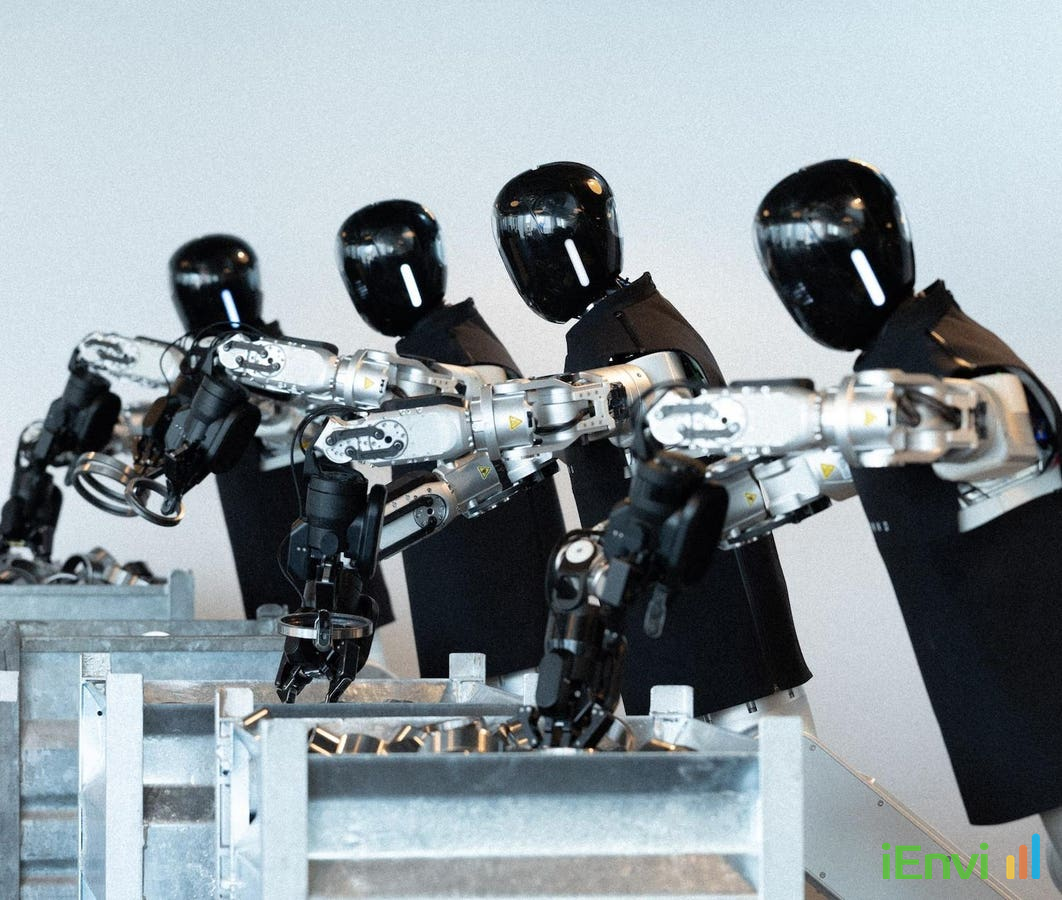
Rather than pursuing the bipedal locomotion strategy adopted by competitors such as Tesla, Figure, and Chinese manufacturer Agibot, Humanoid has adopted a dual-platform approach. The flagship near-term product is the HMND 01 Alpha Wheeled, a bimanual mobile manipulator mounted on a wheeled base. This design decision is explicitly strategic: wheeled robots operating on flat industrial floors avoid the safety certification and regulatory complexity that accompanies bipedal systems under European CE marking requirements. Bipedal development continues in parallel but is classified as a longer-term research and development programme, not a near-term commercial product. This distinction is important for assessing deployment timelines, since wheeled systems face a materially shorter path to regulatory clearance in European and comparable international markets.
The software architecture underpinning the HMND 01 is called KinetIQ, a proprietary four-layer physical AI framework incorporating a Vision-Language-Action model. This system allows the robot to observe its environment, reason about task requirements, and execute precise pick-and-place operations autonomously in unstructured, variable industrial settings. An extension of the framework, called KinetIQ Ascend, enables learning through trial and error, with the company reporting that the system can achieve approximately 80 per cent of human speed in factory tasks. The ability to function in unstructured environments, rather than only in purpose-built, highly controlled automation cells, is a key differentiator from earlier generations of industrial robotics.
Bosch will serve as Humanoid’s primary contract manufacturing partner, providing hardware design, supply chain management, and production capability. The stated manufacturing ambition is up to 100,000 units over the next five years. The scale of this partnership is notable because Bosch brings established automotive and industrial supply chain infrastructure, quality assurance systems, and global distribution networks that a two-year-old startup could not independently replicate. Schaeffler’s role is both as an investor and as an anchor customer, with a commitment to deploy units across its own manufacturing operations. These two relationships collectively de-risk the commercial pipeline in a way that distinguishes Humanoid from many pre-revenue deeptech companies at a similar stage.
Australian business and professional services implications of physical AI commercialisation
Australia does not yet have a specific national regulatory framework governing the deployment of autonomous mobile robots in commercial and industrial workplaces. The primary legislative instruments governing workplace robotics and automation remain the Work Health and Safety Act 2011 (Commonwealth) and its state equivalents, alongside Safe Work Australia guidance on workplace automation and machinery safety. The Australian Signals Directorate and the Department of Industry, Science and Resources have both published AI ethics frameworks and voluntary standards guidance, though neither constitutes binding regulation specific to physical AI systems operating alongside workers in industrial environments.
References and related sources
- Primary source: www.forbes.com
- businesswire.com
- siliconrepublic.com
- finsmes.com
- therobotreport.com
- NEPM Assessment of Site Contamination
How iEnvi can help
iEnvi integrates technology and data-driven approaches into environmental consulting. We monitor AI and technology developments that affect how environmental professionals deliver services to clients.
This is an iEnvi Machete news summary. Prepared by iEnvi to summarise the source article for environmental professionals tracking AI, data, and technology developments that affect consulting and project delivery.
Published: 24 Jul 2026
Need advice on this topic? Speak to an iEnvi expert at info@ienvi.com.au or 1300 043 684, or contact us online.
Need advice on this issue? iEnvi provides practical, senior-led environmental consulting across contaminated land, remediation, ecology and environmental risk.
Contaminated land advice Remediation services Discuss your site Talk to iEnvi