

First Successful Humanoid Robotic Surgery
A peer-reviewed study published in Nature on 8 July 2026, titled “In vivo feasibility study of humanoid robots in surgery,” has documented the world’s first successful live, minimally invasive surgeries performed using teleoperated humanoid robots. The research was conducted by a collaborative team of engineers and surgeons at the University of California San Diego (UCSD). The preclinical trials involved laparoscopic gallbladder removals (cholecystectomies) carried out on live porcine models, using a system the team called “Surgie,” which was built by adapting general-purpose humanoid hardware to operate standard hospital laparoscopic instruments. The study’s lead authors include Michael Yip, Associate Professor of Electrical and Computer Engineering at UCSD, who described the system’s potential to “amplify access to critical surgeries to which patients would otherwise not have access.”
The significance of this milestone extends well beyond the operating theatre. For decades, robotic surgery has been dominated by purpose-built, prohibitively expensive platforms that require dedicated infrastructure and large specialist teams. This study demonstrates for the first time that a compact, general-purpose humanoid robot, weighing approximately 27 kilograms (60 pounds), can achieve the millimetre-level precision and tissue-safe compliance required to perform live surgery on a biological subject. That proof of concept fundamentally changes the calculus around where, how, and at what cost robotic surgical capability can be deployed.
For technology, engineering, and professional services firms operating in Australia, this development is a meaningful signal about the pace at which physical artificial intelligence is maturing. The transition from AI systems that process information to AI systems that perform skilled, dexterous, physical tasks in unstructured environments is accelerating. Understanding that trajectory is increasingly relevant for businesses and institutions planning infrastructure, workforce models, and service delivery strategies over a five-to-fifteen year horizon.
Key details of the UCSD humanoid surgery study
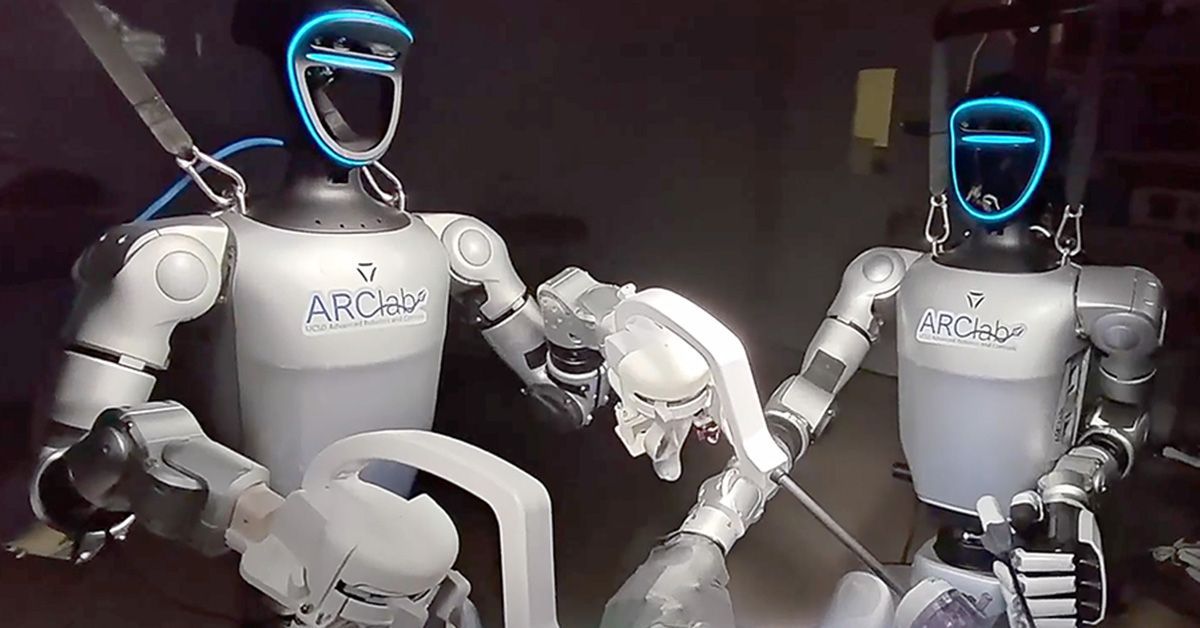
The hardware platform at the centre of the study is a modified Unitree G1 humanoid robot. The G1 stands approximately 1.52 metres (5 feet) tall and weighs 27 kilograms (60 pounds), making it dramatically more compact and mobile than established surgical robotic systems. For comparison, Intuitive Surgical’s da Vinci system weighs approximately 816 kilograms (1,800 pounds), costs several million dollars per unit, and requires a purpose-retrofitted operating suite. The contrast in physical footprint and infrastructure dependency is the central engineering argument the UCSD study is making.
To achieve the precision required for live-tissue surgery, the research team engineered custom tool-grasping adaptors that allowed the G1 to grip standard laparoscopic instruments without slippage or alignment loss. The control architecture integrated a bi-manual teleoperation interface featuring high-fidelity pose tracking combined with an active impedance controller. The impedance controller is a critical safety component: it governs how the robot responds to physical resistance from tissue and organs, ensuring compliant interaction rather than the application of potentially damaging force. This is not a trivial engineering achievement. Impedance control in a surgical context must account for the variable, non-linear mechanical properties of living tissue under real-time conditions.
The preclinical trials demonstrated two distinct operational configurations. The first was a human-robot team, where the humanoid robot worked alongside a human surgeon assistant. The second was a robot-robot team, where two humanoid robots operated side-by-side without a human assistant in the operative field. Both configurations successfully completed the cholecystectomy procedure on the porcine models. The ability to demonstrate the robot-robot configuration is particularly notable, as it suggests a pathway toward fully automated or remotely supervised surgical workflows that do not require on-site specialist staff.
The study also clearly identifies the primary engineering bottlenecks that remain before any progression to human clinical trials would be feasible. System latency, the delay between a remote operator’s input and the robot’s physical response, was identified as a persistent challenge. Frequent physical recalibrations were also required during the procedures, extending operative time considerably beyond what is achievable with mature, single-purpose surgical platforms. These are not minor limitations. In a clinical context, operative time directly affects anaesthetic risk, tissue trauma, and patient outcomes. Resolving latency and calibration stability will be prerequisites for any regulatory pathway to human use.
Australian context: physical AI and professional services in a remote-access nation
Australia’s geography makes the implications of this research particularly pointed. Approximately 7.3 million Australians live in regional, rural, or remote areas, and access to specialist surgical care in those communities is a well-documented and persistent challenge. The UCSD study’s authors explicitly frame remotely deployed humanoid surgical robots as a potential response to healthcare access inequality, not only in the United States but globally. Australia, with its vast distances and concentration of specialist services in capital cities, is exactly the kind of geography where a compact, mobile, general-purpose surgical robot could have meaningful impact, if the technology reaches clinical maturity.
From a regulatory and professional services standpoint, Australia does not yet have a specific framework governing humanoid robotic surgery. The Therapeutic Goods Administration (TGA) regulates medical devices and would be the primary regulatory body through which any such system would need to be assessed and approved before use in human patients. Existing frameworks covering software as a medical device and active implantable devices offer partial analogues, but a humanoid robotic surgical platform presents genuinely novel questions around liability, remote operation, and real-time oversight that current TGA guidance does not fully address. Professional bodies including the Royal Australasian College of Surgeons would similarly face questions about credentialling, supervision standards, and scope of practice as the technology matures.
References and related sources
- Primary source: today.ucsd.edu
- indiatimes.com
- github.io
- popsci.com
- github.io
How iEnvi can help
iEnvi integrates technology and data-driven approaches into environmental consulting. We monitor AI and technology developments that affect how environmental professionals deliver services to clients.
This is an iEnvi Machete news summary. Prepared by iEnvi to summarise the source article for environmental professionals tracking AI, data, and technology developments that affect consulting and project delivery.
Published: 10 Jul 2026
Need advice on this topic? Speak to an iEnvi expert at info@ienvi.com.au or 1300 043 684, or contact us online.
Need advice on this issue? iEnvi provides practical, senior-led environmental consulting across contaminated land, remediation, ecology and environmental risk.
Contaminated land advice Remediation services Discuss your site Talk to iEnvi