
Humanoid raises $152 million Series A, becomes Europe’s first humanoid robotics unicorn
London-based robotics startup Humanoid has closed a $152 million (USD) Series A funding round at a post-money valuation of $1.35 billion (USD), making it Europe’s first pure-play humanoid robotics unicorn. The round was led by Prime Movers Lab, an early backer of Figure AI, with strategic participation from industrial manufacturers Bosch and Schaeffler, alongside Aglaé Ventures (the venture capital arm of LVMH chairman Bernard Arnault) and Taiwan’s Fubon Financial Holding Venture Capital. Founded in 2024, the company has now raised a total of $270 million (USD) in just two years, a pace that would be extraordinary even in software, let alone in capital-intensive physical robotics hardware.
What separates this announcement from typical venture capital milestones is the industrial commitment attached to it. Robert Bosch Robotics has signed on as Humanoid’s contract manufacturer with a mandate to produce up to 100,000 units over five years, and Schaeffler has committed to deploying thousands of these robots across its own manufacturing facilities. These are not letters of intent or pilot programme agreements. They represent anchor demand and a manufacturing pathway that most hardware startups spend a decade trying to secure. For technology consultants, operations managers, and logistics professionals evaluating physical AI adoption, this development warrants close attention.
The broader significance is geopolitical as much as commercial. The humanoid robotics race has, until now, been dominated by United States and Chinese capital, with companies such as Figure AI, 1X Technologies, and Tesla’s Optimus programme absorbing the bulk of global investment and media attention. Humanoid’s emergence as a well-capitalised, industrially backed European competitor signals that the physical AI sector is entering a genuinely competitive, multi-polar phase. For Australian businesses that procure industrial automation equipment, engage in advanced manufacturing, or advise on technology infrastructure, this shift in the competitive landscape is directly relevant.
Key details of the HMND 01 Alpha platform and the Humanoid funding round
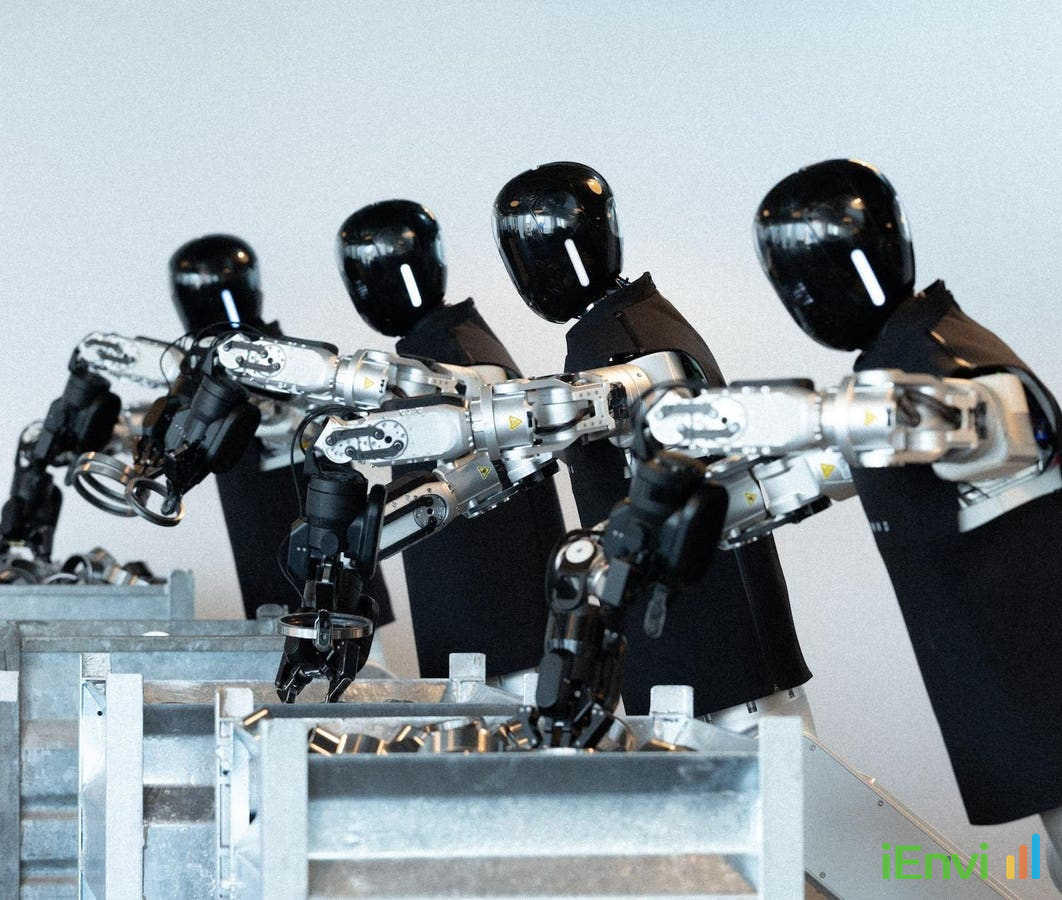
The robot at the centre of this announcement is the HMND 01 Alpha, a wheeled humanoid manipulator rather than a bipedal walking robot. The platform stands 220 centimetres tall and is capable of moving at speeds up to 7.2 kilometres per hour on an omnidirectional wheeled base. It features 29 degrees of freedom, excluding end effectors, a payload capacity of 15 kilograms, and a battery life of up to four hours per charge. These specifications place it firmly in the category of industrial workhorse rather than research demonstrator, which is consistent with Humanoid’s stated commercial focus on manufacturing and logistics environments.
The compute architecture is built around NVIDIA’s Jetson Thor platform, which delivers approximately 800 TOPS (tera-operations per second) of AI inference capacity. This level of onboard processing is designed to allow the robot to make real-time decisions locally, without depending on continuous cloud connectivity. For industrial environments where network reliability, data sovereignty, and latency all matter, local inference capability is a meaningful technical differentiator. The software layer running on top of this hardware is Humanoid’s proprietary four-layer AI platform, called KinetIQ. Within that stack, the KinetIQ Ascend framework uses reinforcement learning to allow the robot to learn and refine complex industrial tasks through iterative trial and error, rather than requiring exhaustive manual programming for each new task type.
The decision to use a wheeled base rather than bipedal legs is a deliberate engineering trade-off with significant downstream consequences. Bipedal locomotion requires continuous computational resources and battery capacity to maintain balance, resources that a wheeled platform can redirect entirely to manipulation tasks and AI inference. According to the company’s disclosures, this design choice also simplifies the regulatory pathway to achieving European CE safety certification, which Humanoid is targeting by 2027. CE certification is the prerequisite for commercial deployment across European Union member states, and achieving it for a wheeled platform is substantially less complex than for a dynamically balancing biped, where failure modes are harder to bound and predict.
The manufacturing and supply chain arrangement deserves particular attention. Schaeffler is performing a dual role: it is simultaneously an anchor customer committing to deploy thousands of units across its facilities, and a key component supplier providing high-precision actuators for the robots themselves. Bosch, through its Robert Bosch Robotics division, is handling assembly and supply chain management under the contract manufacturing agreement. This structure means Humanoid enters commercial production with two of Europe’s most sophisticated industrial manufacturers embedded in both its demand side and its supply side, dramatically reducing the execution risk that typically kills hardware startups at the scaling stage. As CEO Artem Sokolov noted, the company has accomplished in two years what would typically require a decade.
Australian context: physical AI adoption, advanced manufacturing, and professional services implications
Australia does not yet have a domestic humanoid robotics industry of comparable scale, but Australian businesses are active buyers of industrial automation technology, and the conditions that are driving European manufacturers toward physical AI deployment apply equally in this market. Australia’s manufacturing sector faces persistent labour shortages, rising wage costs, and growing pressure to improve productivity without proportional headcount increases. The logistics and warehousing sector faces similar pressures, with e-commerce growth and tightening margins making the economics of robotic automation increasingly compelling relative to expanding human workforces. Developments of this nature in the global robotics market are therefore worth monitoring for procurement teams, operations planners, and advisers working across these sectors in Australia.
References and related sources
- Primary source: www.forbes.com
- businesswire.com
- valueaddvc.com
- thenextweb.com
- euronext.com
How iEnvi can help
iEnvi integrates technology and data-driven approaches into environmental consulting. We monitor AI and technology developments that affect how environmental professionals deliver services to clients.
This is an iEnvi Machete news summary. Prepared by iEnvi to summarise the source article for environmental professionals tracking AI, data, and technology developments that affect consulting and project delivery.
Published: 28 Jul 2026
Need advice on this topic? Speak to an iEnvi expert at info@ienvi.com.au or 1300 043 684, or contact us online.
Need advice on this issue? iEnvi provides practical, senior-led environmental consulting across contaminated land, remediation, ecology and environmental risk.
Contaminated land advice Remediation services Discuss your site Talk to iEnvi