
Summary
Groundwater modelling is often time-consuming. However, a new interpretable AI framework may soon replace months of traditional calibration with rapid, accurate predictions.
When assessing multiple overlapping pollution sources, traditional contaminant transport models become computationally intensive and difficult to calibrate. Researchers have published a spatiotemporal deep learning model designed to predict complex groundwater contamination patterns in a fraction of the time.
The primary hurdle for AI in environmental consulting has been the black box problem. Regulators and site auditors require transparency in the methodology.
This new framework is designed to be explainable. For practitioners and developers, these models are necessary for gaining regulatory approval when developing Conceptual Site Models.
Could explainable AI assist with your next complex groundwater risk assessment?
This is an iEnvi Machete news summary. Full summary and source references are available at the link below.
Further detail
The technical details behind this predictive framework show a significant improvement in how we manage hydrochemical data.
Traditional deterministic models like MODFLOW and MT3DMS often struggle with the non-linear realities of multiple, overlapping industrial and atmospheric pollution sources. These models require extensive parameterisation and calibration.
This new framework integrates a Spatial-Temporal-Assisted Deep Belief Network with metaheuristic optimisation, specifically a hybrid Whale Optimisation and Tiki-Taka Algorithm.
To manage large historical datasets without computational bloat, it utilises an Addax Optimisation Algorithm. This filters out redundant data, selecting only the most relevant attributes for forecasting Groundwater Quality Indices.
For practitioners working under NEPM 2013 (Assessment of Site Contamination) Schedule B2, the interpretable nature of this model is beneficial. Explainable AI allows us to justify our predictive methodology to EPA site auditors, rather than relying on a black-box approach when signing off on long-term groundwater management strategies.
Background and context
Headline: New Interpretable AI Framework Optimizes Groundwater Contamination Predictions Using Deep Learning
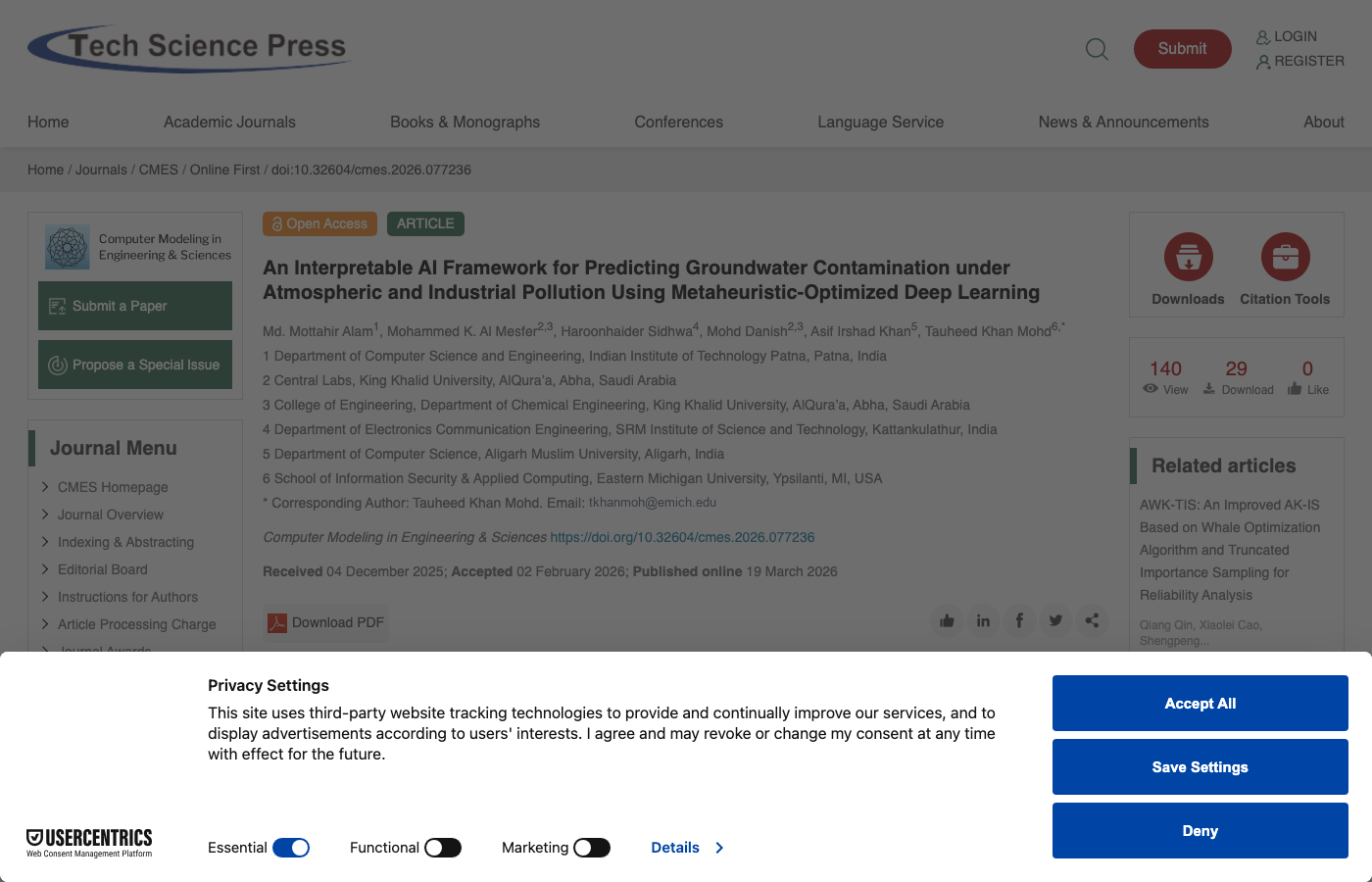
On 19 March 2026, researchers published a peer-reviewed breakthrough in Computer Modeling in Engineering & Sciences, detailing a new spatiotemporal deep learning model designed to accurately predict groundwater contamination influenced by complex industrial and atmospheric pollution sources. The framework integrates a Spatial-Temporal-Assisted Deep Belief Network (StaDBN) with metaheuristic optimization (a hybrid Whale Optimization and Tiki-Taka Algorithm) to model intricate, non-linear contamination patterns. To process massive historical hydrochemical datasets, the model utilizes an Addax Optimization Algorithm (AOA) to filter out redundant data and select only the most relevant attributes, allowing for highly efficient and accurate forecasting of Groundwater Quality Indices (GQI).
Why it Matters for Environmental Professionals and Their Clients
Traditional groundwater contaminant transport modelling (such as MODFLOW/MT3DMS) is notoriously time-intensive, computationally heavy, and difficult to calibrate when dealing with multiple, overlapping pollution sources. This research demonstrates how machine learning can streamline the prediction of complex groundwater contamination plumes, saving significant consulting hours and client costs.
Crucially, the framework was specifically designed to be "interpretable"—directly overcoming the "black box" limitation that often prevents AI methodologies from being utilized in regulatory compliance. For Australian practitioners, transparent and explainable predictive models are absolutely essential for gaining approval from state EPA site auditors when developing Conceptual Site Models (CSMs), conducting risk assessments, and designing long-term groundwater management strategies.
While this is a technological methodology paper, interpretable predictive modelling has direct implications for site characterisation and conceptual site models (CSMs) conducted under the NEPM 2013 (Assessment of Site Contamination) — specifically Schedule B2 (Guideline on Site Characterisation) — as well as state-based EPA groundwater risk assessment and auditor guidelines where predictive methodology transparency is mandated.
References and related sources
- Primary source: www.techscience.com
How iEnvi can help
iEnvi provides specialist consulting services relevant to this topic. Our team includes CEnvP Site Contamination Specialists with experience across contaminated land, groundwater, remediation, ecology, and regulatory compliance.
- iEnvi groundwater services
- iEnvi remediation and validation services
- iEnvi expert services and independent review services
This is an iEnvi Machete news summary. Prepared by iEnvi to summarise the source article for contaminated land, groundwater, remediation, approvals and site risk professionals.
Published: 23 Mar 2026
Need advice on this topic? Speak to an iEnvi expert at info@ienvi.com.au or 1300 043 684, or contact us online.
Need advice on this issue? iEnvi provides practical, senior-led environmental consulting across contaminated land, remediation, ecology and environmental risk.
Team credentials Contaminated land services Remediation services Groundwater services Talk to iEnvi