
Overview
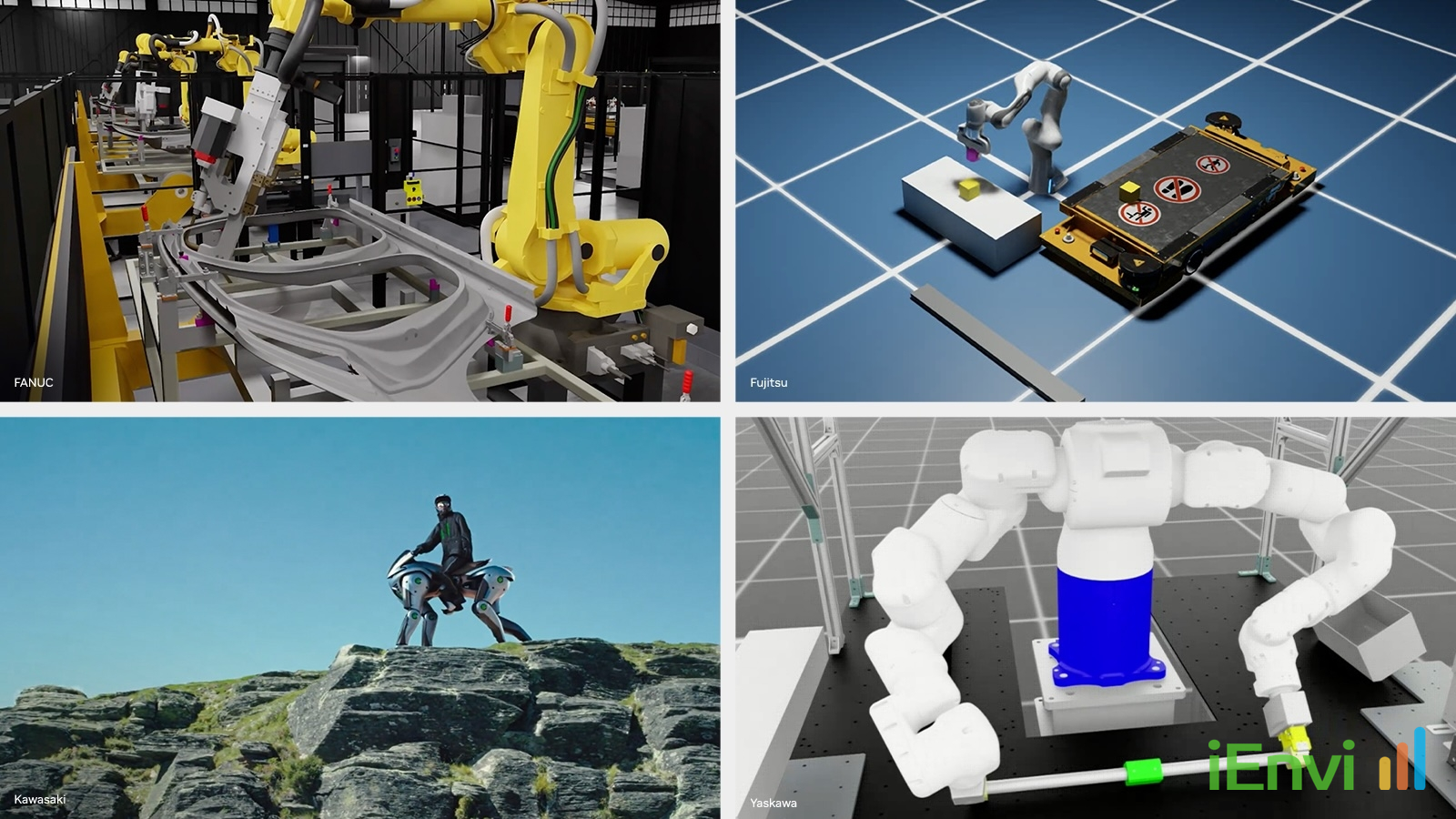
On 15 July 2026, NVIDIA announced the release of Cosmos 3 Edge, a 4-billion-parameter on-device world model built on the Nemotron architecture, designed specifically for real-time robot perception, physical reasoning, and action generation at the edge. The announcement was made during a two-day visit to Japan by NVIDIA CEO Jensen Huang and was accompanied by a major expansion of the NVIDIA Cosmos Coalition, with twenty-two of Japan’s largest robotics and manufacturing companies formally committing to the initiative. The coalition now includes FANUC, Yaskawa Electric, Kawasaki Heavy Industries, Sony Group Corporation, SoftBank Corp., Honda R&D, Hitachi, and Fujitsu, among others.
The significance of this announcement extends well beyond the robotics sector. The shift from cloud-dependent AI inference to localised, on-device processing represents a structural change in how intelligent systems interact with the physical world. For industries that operate in environments with latency constraints, connectivity limitations, or data sovereignty requirements, including field-based engineering, environmental monitoring, infrastructure inspection, and resource extraction, this development marks a meaningful inflection point. Machines can now perceive, reason, and generate motor policies in real time without relying on a round-trip to a remote data centre.
Jensen Huang described the partnership with Japan’s industrial sector in terms that signal long-term strategic intent: “Japan invented modern manufacturing. Now, it has the opportunity to reinvent it for the age of intelligent industries. By combining its world-leading heritage in manufacturing, precision engineering and robotics with NVIDIA Cosmos, Isaac, Metropolis and Jetson, Japan’s innovators are building the next generation of intelligent machines.” For Australian consulting and engineering professionals, the practical consequences of this shift in physical AI capability are beginning to arrive faster than many workflow and procurement systems are prepared to handle.
Key details of the NVIDIA Cosmos 3 Edge release and coalition expansion
Cosmos 3 Edge is a 4-billion-parameter dense model trained entirely from scratch on NVIDIA’s Nemotron architecture. This is a technically important distinction from the Cosmos 3 Super and Cosmos 3 Nano models, which were released in May 2026 and were initialised from pre-trained weights. Training from scratch on a purpose-built architecture allows the model to be optimised specifically for the demands of edge inference, including constrained compute budgets, sensor diversity, and the real-time decision cycles required in industrial robotics and autonomous systems.
The model is designed to run locally on NVIDIA’s edge computing hardware ecosystem, which includes RTX GPUs, DGX systems, and the newly announced Jetson T2000 and T3000 modules. The Jetson platform has an established presence in field robotics and autonomous inspection applications, and the addition of a world model capable of physical reasoning at this scale represents a substantial capability uplift for devices already deployed in industrial settings. Critically, running the model on-device eliminates the latency and connectivity dependencies that have historically limited cloud-based AI in remote, time-sensitive, or safety-critical environments.
Alongside Cosmos 3 Edge, NVIDIA released updated NVIDIA Metropolis libraries. These libraries are designed to let developers use coding agents to build, train, and deploy video intelligence systems up to six times faster than conventional development workflows, according to NVIDIA. This acceleration in the development cycle is material for organisations seeking to customise base models for specialised sensor arrays or unique operating contexts. NVIDIA has indicated that enterprise teams can adapt the Cosmos framework to specialised robots and environments in approximately one day, which dramatically compresses the timeline between prototype and operational deployment.
Within the coalition, the work is already being divided according to each member’s industrial strengths. Fujitsu is exploring a collaborative control platform for physical AI systems. FANUC, Yaskawa Electric, and Kawasaki Heavy Industries are directly integrating Cosmos and NVIDIA’s Isaac GR00T humanoid robot foundation model into their industrial robot control pipelines. These are not peripheral technology experiments. FANUC, Yaskawa, and Kawasaki collectively supply a significant proportion of the world’s industrial robotic arms, meaning that physical AI integration at this level will have widespread downstream effects on how automated systems are deployed across manufacturing, logistics, and field operations globally.
Australian business and professional services context for physical AI at the edge
Australia’s professional services and consulting sector, including environmental, engineering, and infrastructure disciplines, operates in conditions that make edge AI particularly relevant. Remote project sites across Queensland, Western Australia, the Northern Territory, and regional New South Wales frequently have unreliable or absent mobile data connectivity. Field operations in these environments currently face a hard ceiling on the sophistication of AI tools that can be deployed in real time. The availability of a capable 4-billion-parameter world model that runs entirely on local hardware removes that ceiling for projects equipped with compatible edge computing devices.
From a data sovereignty and regulatory compliance standpoint, Australian organisations handling sensitive project data, including contamination assessment records, infrastructure condition data, or safety-critical monitoring outputs, face increasing scrutiny over where data is processed and stored. Cloud-based AI inference involves transmitting data to remote servers, introducing jurisdictional and security considerations that on-device processing avoids entirely.
References and related sources
- Primary source: nvidianews.nvidia.com
- adtmag.com
- windowsforum.com
- iconnect007.com
- pureai.com
How iEnvi can help
iEnvi integrates technology and data-driven approaches into environmental consulting. We monitor AI and technology developments that affect how environmental professionals deliver services to clients.
This is an iEnvi Machete news summary. Prepared by iEnvi to summarise the source article for environmental professionals tracking AI, data, and technology developments that affect consulting and project delivery.
Published: 20 Jul 2026
Need advice on this topic? Speak to an iEnvi expert at info@ienvi.com.au or 1300 043 684, or contact us online.
Need advice on this issue? iEnvi provides practical, senior-led environmental consulting across contaminated land, remediation, ecology and environmental risk.
Contaminated land advice Remediation services Discuss your site Talk to iEnvi