
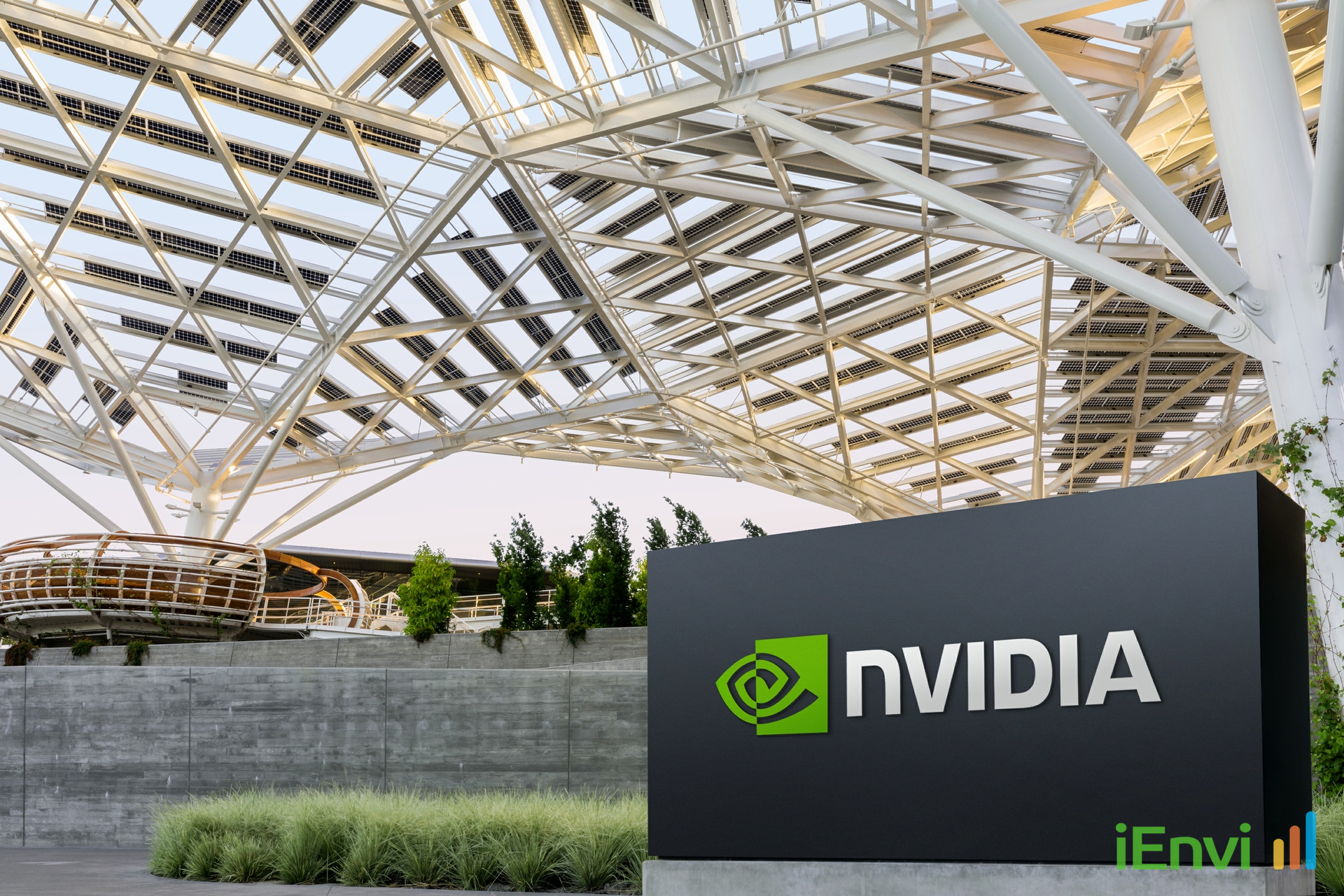
NVIDIA’s $500 billion AI compute infrastructure financing deal
On 10 August 2026, NVIDIA announced a landmark set of memorandums of understanding with six of the world’s largest asset managers and financial institutions, Apollo, BlackRock, Blackstone, Brookfield, Goldman Sachs and KKR, to establish independent financing platforms targeting over $500 billion in third-party private capital for global AI compute infrastructure. This is not a chip sale announcement. It is a financial engineering announcement that converts GPU clusters, data centre shells and the power infrastructure behind them into a standardised, investable asset class, the kind of thing institutional capital already treats toll roads, transmission grids and logistics parks as.
For Australian environmental professionals this matters because the physical assets sitting underneath this capital, data centres, substations, transmission corridors and cooling infrastructure, still need land, water and power, and someone still has to assess the ground they sit on. When institutional capital at this scale is chasing “AI factory” projects, the pace and volume of data centre and energy infrastructure development proposals reaching planning authorities, developers and environmental consultants in Australia is likely to accelerate. Environmental due diligence, site assessment and planning advice sit directly in the path of that capital deployment, whether the ultimate client is a hyperscaler, a private equity sponsor or a state government partnering on a sovereign compute initiative.
NVIDIA founder and CEO Jensen Huang framed the shift plainly: “In AI, compute is revenue.” That single sentence is the commercial logic behind the whole structure. Compute clusters backed by long-term usage contracts now generate predictable cash flow, which is exactly what private credit and infrastructure debt markets require to underwrite billion-dollar financing facilities without demanding equity-style returns.
Key details of the six-institution financing platforms
The six partner institutions, Apollo, BlackRock, Blackstone, Brookfield, Goldman Sachs and KKR, are each establishing dedicated financing platforms under signed memorandums of understanding with NVIDIA. The stated ambition is to mobilise more than $500 billion in third-party private capital directed at the physical construction, power procurement and chip supply chains required for what NVIDIA calls “AI factories.” This figure sits well beyond the scale of most individual hyperscaler capital expenditure programmes and instead resembles utility-sector or transport infrastructure financing rounds.
The mechanism relies on NVIDIA’s full-stack compute offering, including Blackwell-generation GPU architecture and the CUDA-X software platform, being packaged into chip-backed, yield-generating assets suitable for private credit and infrastructure debt instruments. Long-duration usage contracts from frontier AI labs, cloud providers and enterprise clients supply the predictable revenue stream that institutional lenders need to price and underwrite debt against a physical asset rather than a corporate balance sheet.
Practically, this resolves a capital expenditure bottleneck that has been building since 2023 as cloud providers and AI developers negotiated bespoke, multi-billion-dollar leases and financing arrangements individually for each new data centre campus. The new platforms replace ad hoc negotiation with pre-structured institutional debt facilities that tier-2 AI clouds, enterprise consortia and sovereign AI initiatives can draw down against, extending access to lower-cost, longer-duration capital beyond the traditional tier-1 hyperscalers.
NVIDIA’s positioning statement describes this as a milestone shift from being a chip manufacturer to becoming an enabler of “a new class of productive, investable infrastructure.” The commercial framing matters for how these projects will be structured going forward: compute capacity itself becomes the collateral, and usage-linked contracts become the equivalent of long-term power purchase agreements in a conventional infrastructure deal.
What it means for Australian data centre and energy projects
Australia does not yet have a direct regulatory equivalent to this financing structure, and this development originates in US and global capital markets rather than Australian policy. The relevance for Australian practice sits in the downstream effect on physical infrastructure demand. Institutional capital pools of this size are typically deployed against real assets with long investment horizons, and data centre campuses, associated substations and renewable or gas-fired power generation to support them are exactly the kind of asset class private credit and infrastructure funds are now being encouraged to underwrite.
For Australian business and professional services, the more immediate implication is competitive and operational rather than regulatory. Lower financing costs for compute infrastructure globally should, over time, flow through to lower per-token inference costs and improved availability of high-performance computing for firms running data-heavy workflows, including engineering modelling, spatial analysis and large-scale environmental data processing. Firms that rely on compute-intensive tools, whether that is groundwater modelling, remote sensing analysis or GIS-based risk mapping, are indirect beneficiaries of a market structure designed to expand global compute supply and reduce the cost of access to it.
Where this development does intersect with Australian planning and environmental practice is at the project level. Any proposal to build large-scale data centre or associated power infrastructure in Australia, regardless of who is financing it offshore, still triggers standard state planning, environmental impact assessment and, where relevant, contaminated land and due diligence obligations under existing frameworks. The financing innovation changes who is paying and how quickly capital can be deployed, not the environmental scrutiny the resulting projects must satisfy. For practitioners, the practical takeaway is to expect a larger and faster-moving pipeline of data centre and supporting energy infrastructure proposals, backed by institutional capital that prices delay as a cost, and to prepare for clients who arrive with pre-structured financing already in place and firm expectations about assessment timeframes.
References and related sources
- Primary source: nvidianews.nvidia.com
- capacityglobal.com
How iEnvi can help
iEnvi integrates technology and data-driven approaches into environmental consulting. We monitor AI and technology developments that affect how environmental professionals deliver services to clients.
This is an iEnvi Machete news summary. Prepared by iEnvi to summarise the source article for environmental professionals tracking AI, data, and technology developments that affect consulting and project delivery.
Published: 12 Aug 2026
Need advice on this topic? Speak to an iEnvi expert at info@ienvi.com.au or 1300 043 684, or contact us online.
Need advice on this issue? iEnvi provides practical, senior-led environmental consulting across contaminated land, remediation, ecology and environmental risk.
Contaminated land services Groundwater services Environmental due diligence Talk to iEnvi