
Overview
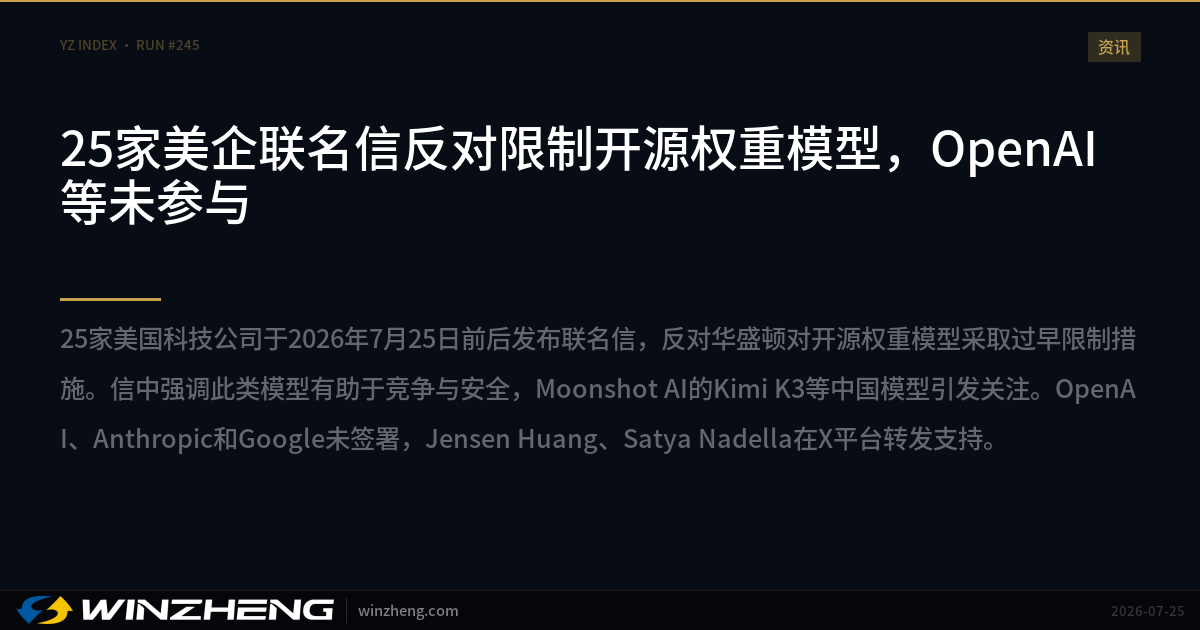
On 24 July 2026, a coalition of 25 major United States technology companies, startups, and venture capital firms published a joint open letter to federal policymakers in Washington titled “Open Weights and American AI Leadership.” The signatories include some of the most consequential names in global technology: Nvidia, Meta, Microsoft, Palantir, CrowdStrike, IBM, ServiceNow, Dell Technologies, Hugging Face, Mistral, Andreessen Horowitz, and Y Combinator. The letter urges the Trump administration to reject broad, premature restrictions on open-weight artificial intelligence models and the model development techniques, particularly distillation, that underpin how enterprise AI is built and deployed today. By Friday evening of the same week, OpenAI had reportedly added its signature to the coalition, a notable shift given that OpenAI had initially declined to sign alongside other closed-source competitors including Google and Anthropic.
The letter arrives at a moment of acute regulatory tension. The Trump administration is actively debating whether to impose controls on open-weight AI models on national security grounds, driven largely by concerns about Chinese technological competition. On 21 July 2026, Treasury Secretary Scott Bessent publicly described AI distillation as “theft.” The following day, White House officials escalated the language further by accusing Chinese startup Moonshot AI of distilling outputs from Anthropic’s Claude model to construct its Kimi K3 system. The coalition’s open letter is a direct, coordinated response to that framing.
For professional services firms, technology-dependent enterprises, and public sector organisations operating in Australia, this debate is not an abstract American political dispute. The outcome will shape the regulatory and commercial conditions under which AI tools are developed, licensed, and deployed globally. Australian organisations that have begun integrating open-weight models into their workflows, or that are evaluating them as alternatives to expensive closed-source APIs, face real operational and strategic uncertainty depending on how Washington proceeds.
Key details of the open letter and the regulatory dispute
The open letter, published through Microsoft’s corporate responsibility platform, draws an explicit historical parallel between open-weight AI models and the open-source software movement of the 1980s. The coalition argues that the open-source movement was foundational to the modern internet and that restricting open-weight AI at this stage of development would repeat the error of regulating a technology before its full consequences, positive and negative, are properly understood. The letter urges policymakers not to conflate legitimate model development techniques with intellectual property misappropriation, and argues that existing legal frameworks are already equipped to address unlawful extraction of proprietary code without the need for sweeping restrictions on standard machine learning practices.
At the centre of the technical dispute is the practice of distillation, which involves training a smaller, more efficient model using the outputs of a larger, more capable model. Distillation is a well-established technique in machine learning and is used routinely to produce models that are faster, cheaper to run, and more suited to deployment on local infrastructure rather than cloud endpoints. Nvidia CEO Jensen Huang addressed this directly in his first public post on the social platform X: “Distillation, learning from AI, learning from other people, and learning from other sources of knowledge, is fundamental to intelligence.” The coalition’s position is that prohibiting or heavily regulating distillation would not stop adversarial actors, who operate outside US legal jurisdiction, but would cripple domestic AI development by restricting techniques that American researchers and companies use as a matter of course.
On cybersecurity, the coalition advances a counterintuitive but technically grounded argument. Critics of open-weight models frequently warn that making model weights publicly accessible allows bad actors to strip safety guardrails and deploy unconstrained systems. The coalition acknowledges this risk but argues that open weights also allow a broad, distributed community of security researchers and defenders to inspect models locally, identify vulnerabilities before they are exploited, and build robust, localised defences. The letter frames this as analogous to the security benefits of open-source software, where community scrutiny has historically produced more hardened systems than proprietary alternatives operating as black boxes.
The commercial stakes are substantial. Closed-source API services are priced on a per-token billing model that becomes extremely expensive at enterprise scale. Open-weight models, by contrast, can be deployed locally on an organisation’s own hardware, eliminating per-token costs, maintaining data sovereignty, and avoiding dependence on a single vendor’s pricing decisions or service continuity. For sectors handling sensitive data, including legal, medical, financial, and environmental consulting, the ability to run AI inference locally without transmitting client data to external servers is not merely a cost consideration but a professional and regulatory obligation.
Australian context: what this regulatory debate means for Australian AI adoption and professional services
Australia does not yet have a comprehensive AI-specific regulatory framework equivalent to the European Union’s AI Act, which came into force progressively from 2024. The Australian government’s approach to AI governance has instead been shaped by a combination of voluntary frameworks, sector-specific guidance
References and related sources
- Primary source: www.microsoft.com
- winzheng.com
- benzinga.com
- chinadaily.com.cn
- businessinsider.com
How iEnvi can help
iEnvi integrates technology and data-driven approaches into environmental consulting. We monitor AI and technology developments that affect how environmental professionals deliver services to clients.
This is an iEnvi Machete news summary. Prepared by iEnvi to summarise the source article for environmental professionals tracking AI, data, and technology developments that affect consulting and project delivery.
Published: 25 Jul 2026
Need advice on this topic? Speak to an iEnvi expert at info@ienvi.com.au or 1300 043 684, or contact us online.
Need advice on this issue? iEnvi provides practical, senior-led environmental consulting across contaminated land, remediation, ecology and environmental risk.
Contaminated land advice Remediation services Discuss your site Talk to iEnvi