
New High-Resolution Mapping of Australian Ecosystem Disturbance
The publication of two high-resolution national datasets by researchers at the University of Queensland in April 2026 represents a major advancement in how environmental professionals map and evaluate ecosystem disturbance across Australia. The datasets, known as the Human Industrial Footprint and the Ecological Intactness Index, provide mapping at a 100-metre spatial resolution. This level of precision offers environmental consultants, land developers, local government authorities, and legal practitioners an unprecedented view of human-induced pressures across the continent. By compiling diverse spatial pressures into a single, standardised framework, the research group has delivered an open-source tool that shifts the baseline for site-specific conservation planning and environmental due diligence.
For Australian environmental professionals, the arrival of these datasets addresses a persistent challenge in desktop constraints assessments: the reliance on regional-scale, coarse resolution mapping that often fails to capture localised landscape degradation. Whether planning masterplanned residential communities, linear infrastructure corridors, or renewable energy precincts, project teams have historically struggled with spatial datasets that oversimplify or misrepresent the actual state of land disturbance. The new high-resolution indices provide a clearer pathway to establish defensible ecological baselines, allowing project stakeholders to identify existing human pressures prior to field-based environmental impact assessments.
Integrating these tools into early-stage development strategies is particularly critical as regulatory scrutiny over biodiversity loss and habitat fragmentation intensifies. With local councils, state environmental protection agencies, and federal regulators demanding more rigorous environmental impact statements, having access to standardised, high-resolution national data reduces planning uncertainty. It enables developers and their legal advisors to anticipate potential ecological constraints, assess regional landscape context, and make informed decisions during site acquisition and initial project design phases.
The Human Industrial Footprint and Ecological Intactness Index
The technical foundation of this release rests on the dual deployment of the Human Industrial Footprint mapping and the Ecological Intactness Index. Operating at a 100-metre resolution, these datasets track the cumulative intensity of human activities by evaluating multiple overlapping physical pressures. These pressures include transport infrastructure such as roads and railways, agricultural land clearing, industrial installations, and urban settlements. By assigning weighted values to these varied human interventions, the researchers have created a continuous gradient of ecosystem disturbance rather than relying on binary classifications of disturbed versus undisturbed land.
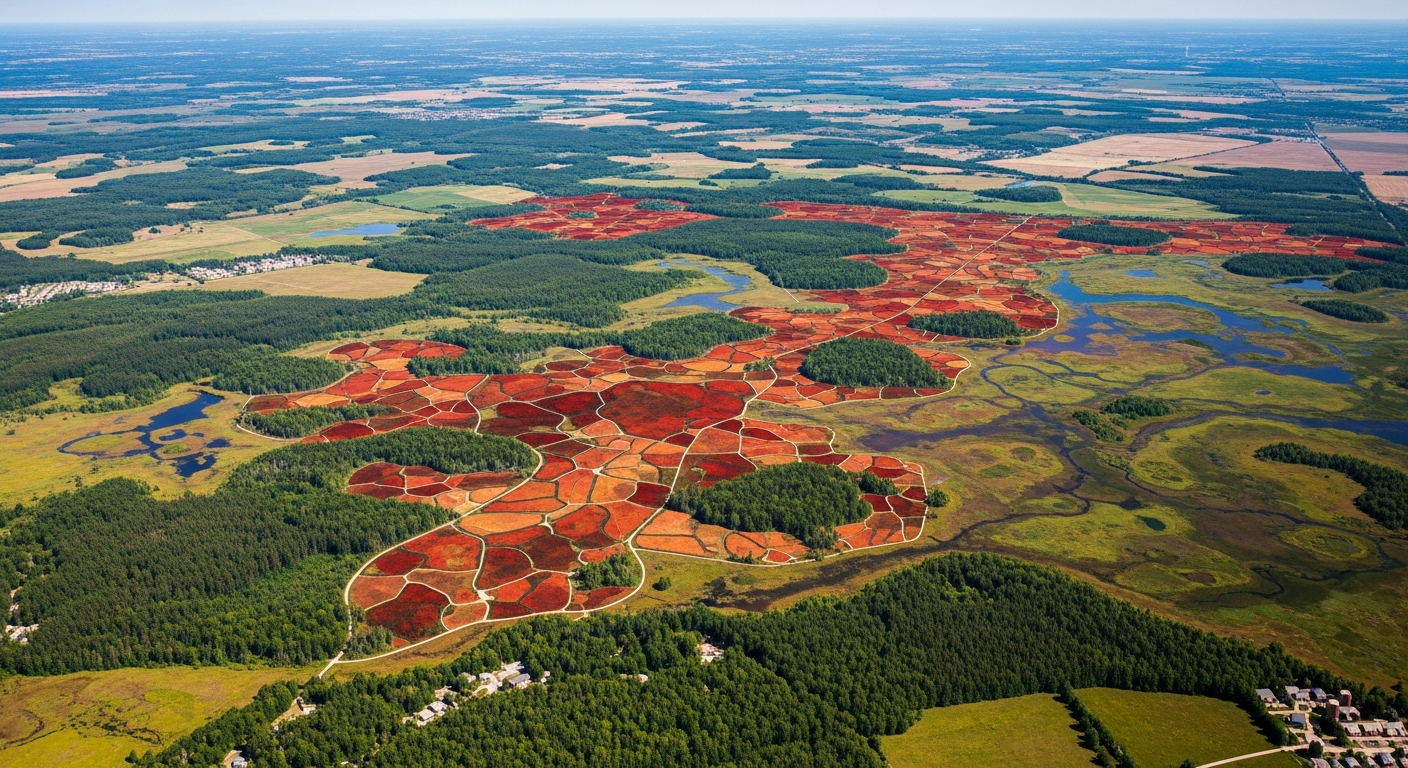
The resulting data reveals that approximately 30 percent of the Australian continent can still be classified as free or almost free of direct human industrial pressures. However, the spatial distribution of these intact landscapes highlights a critical ecological challenge: extreme fragmentation. The remaining intact zones are largely concentrated in arid, semi-arid, or remote regions, whereas the high-value coastal and agricultural zones of eastern, southern, and south-western Australia are highly dissected by human activities. This fragmentation means that even within seemingly continuous vegetative cover, small-scale infrastructure and agricultural activities have compromised the ecological integrity of the surrounding landscape.
By operating at a 100-metre scale, the mapping captures fine-scale disturbances that are often smoothed out or omitted in broader global or continental-scale assessments. For example, a narrow utility corridor or a minor access road intersecting a remnant woodland is quantified as a distinct spatial pressure, reflecting its actual impact on habitat connectivity and edge effects. This level of detail allows spatial analysts to calculate the precise footprint of overlapping infrastructure projects and agricultural encroachment within a defined boundary, providing a highly reliable data layer for regional biodiversity assessments.
Furthermore, the methodology applied to generate the Ecological Intactness Index offers a consistent metric to evaluate the ecological condition of a site relative to its undisturbed state. The index incorporates local disturbance metrics alongside broader landscape context variables, such as proximity to major transport vectors and the density of human settlements. This combination of local and regional metrics ensures that the index reflects not only the physical clearing of a site but also the secondary ecological degradation caused by surrounding land uses.
Australian context
In the context of Australian environmental regulation, these datasets arrive at a critical juncture for federal and state approvals. Under the Environment Protection and Biodiversity Conservation Act 1999, there are currently more than 2,100 species and approximately 100 ecological communities listed as threatened. Establishing an accurate, scientifically defensible baseline is one of the most substantial regulatory hurdles for major project approvals under this Act. The high-resolution mapping of the Human Industrial Footprint allows practitioners to better predict the likelihood of threatened species occurrence by analysing the exact level of surrounding disturbance, aligning directly with requirements under Commonwealth referral guidelines.
Additionally, the datasets provide critical spatial evidence that supports Australia’s national commitment to the international 30 by 30 initiative, which aims to protect 30 percent of the nation’s land and sea by the year 2030. Achieving this target requires state and federal governments to identify high-priority areas for protection and restoration.
References and related sources
- Primary source: news.uq.edu.au
- EPBC Act
How iEnvi can help
iEnvi provides specialist consulting services relevant to this topic. Our team includes CEnvP Site Contamination Specialists with experience across contaminated land, groundwater, remediation, ecology, and regulatory compliance.
- iEnvi due diligence services
- iEnvi remediation and validation services
- iEnvi expert services and independent review services
This is an iEnvi Machete news summary. Prepared by iEnvi to summarise the source article for contaminated land, groundwater, remediation, approvals and site risk professionals.
Published: 17 Jun 2026
Need advice on this topic? Speak to an iEnvi expert at info@ienvi.com.au or 1300 043 684, or contact us online.
Need advice on this issue? iEnvi provides practical, senior-led environmental consulting across contaminated land, remediation, ecology and environmental risk.
Team credentials Contaminated land services Remediation services Groundwater services Talk to iEnvi