
Overview
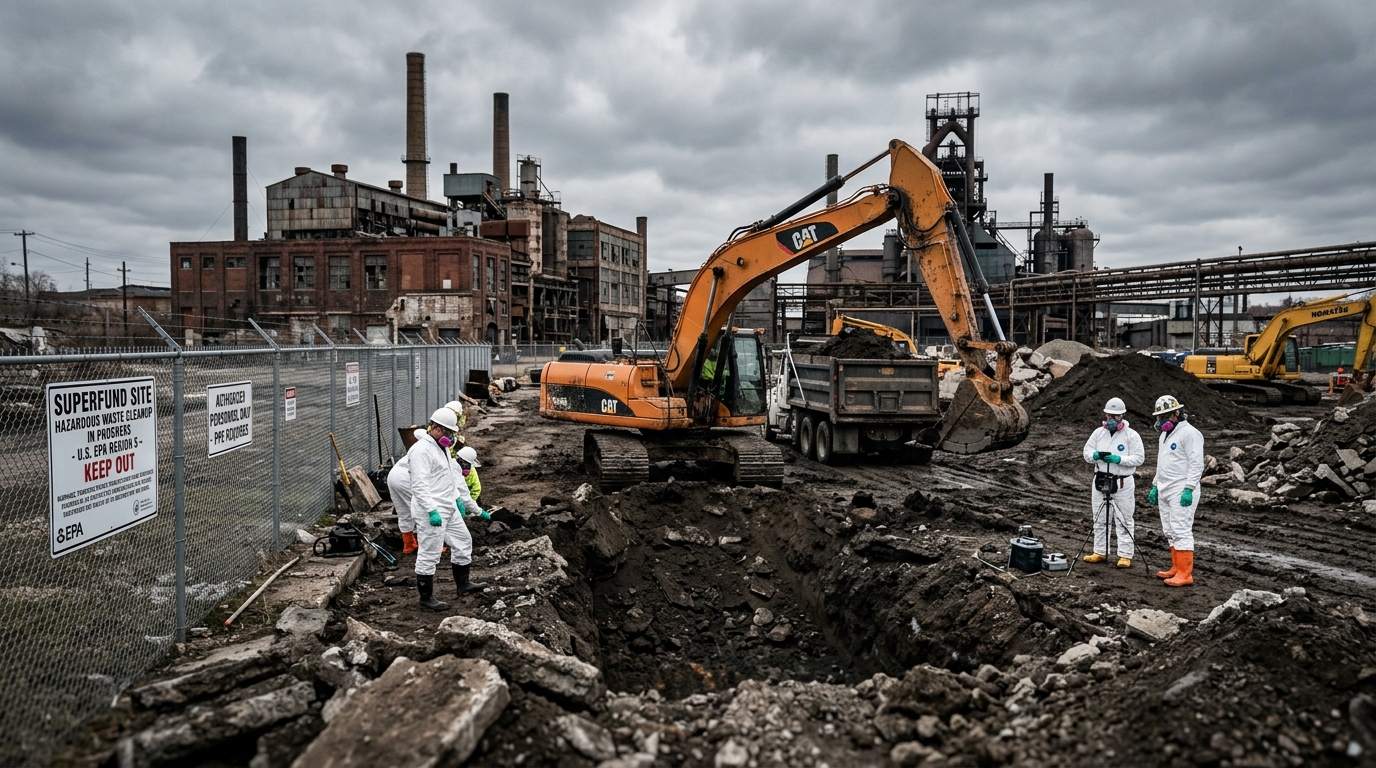
The US Environmental Protection Agency (EPA) is enforcing a blood lead level target of 5 micrograms per decilitre (5 ug/dL) for residential soil remediation at the Federated Metals Superfund site. This cleanup requires the physical excavation and removal of the top 300 millimetres of contaminated soil across affected residential properties. The agency has rejected capping as a standalone remedy, insisting on source removal to meet the health-based target. This enforcement action signals a global shift toward more stringent lead remediation standards and carries significant implications for Australian contaminated land practitioners who may face similar regulatory tightening in the near future.
Key details
The Federated Metals Superfund site is a legacy smelting operation that has left widespread lead contamination across surrounding residential soils. Under the Comprehensive Environmental Response, Compensation, and Liability Act (CERCLA), the EPA is applying its October 2025 Lead Directive to set the remediation goal. The directive mandates a target blood lead level of 5 ug/dL for children, which directly drives the soil cleanup criteria.
To achieve this target, the EPA is requiring the physical removal of contaminated soil to a depth of at least 300 millimetres across affected residential lots. Clean fill is imported to restore the surface profile. The agency has explicitly rejected containment strategies such as geotextile capping or soil stabilisation as standalone solutions for residential land use scenarios. The rationale is that caps degrade over time, can be disturbed by landscaping or construction activities, and do not eliminate the source of exposure.
This approach represents a decisive shift from risk management to source removal. The EPA’s position is that where children are the primary sensitive receptors, the only acceptable remedy is one that permanently removes the exposure pathway by eliminating the contaminated material from the residential environment.
The cleanup is expected to require the excavation and off-site disposal of tens of thousands of cubic metres of soil, with significant logistical challenges related to access, staging, dust suppression, and community engagement.
Australian context
Australia’s current regulatory framework for lead in residential soils presents a notable gap when compared with the direction being taken by the US EPA. The NEPM 2013 Schedule B1 Health Investigation Level (HIL) for lead in standard residential settings (HIL A) is 300 milligrams per kilogram (mg/kg). This threshold was derived using older biokinetic models, including the Integrated Exposure Uptake Biokinetic (IEUBK) model, which predated the recognition by health authorities that adverse health effects occur at blood lead levels well below 10 ug/dL.
In 2015, the National Health and Medical Research Council (NHMRC) revised Australia’s blood lead goal from 10 ug/dL down to 5 ug/dL, aligning with the US Centers for Disease Control and Prevention reference value. However, the NEPM soil screening criteria have not yet been updated to reflect this lower blood lead target. This means that a site meeting the current HIL A of 300 mg/kg for lead may still pose an unacceptable health risk under the revised blood lead goal.
When the inevitable regulatory alignment occurs and the NEPM criteria are recalculated to target a 5 ug/dL blood lead level, the resulting soil screening values for residential land use will drop substantially. Some preliminary modelling suggests the revised HIL could fall to between 100 and 150 mg/kg, depending on exposure assumptions. This would reclassify large numbers of sites currently considered compliant as requiring further investigation or remediation.
Practical implications
Environmental consultants and site owners should be preparing now for the likely tightening of Australian lead soil criteria:
- Risk assessment approach: Practitioners conducting Tier 2 site-specific risk assessments for lead should already be modelling against a 5 ug/dL blood lead target, consistent with NHMRC guidance, rather than relying solely on the published NEPM HIL A value of 300 mg/kg.
- Remediation strategy selection: The US EPA’s rejection of capping as a standalone remedy for residential lead sites sets an important precedent. Australian regulators, particularly in NSW and Victoria, may adopt a similar position. Consultants should consider whether proposed containment-based remediation strategies will remain defensible if criteria tighten.
- Legacy site re-evaluation: Sites that received a no-further-action determination based on lead concentrations between 100 and 300 mg/kg may need to be revisited. Property owners, developers, and local councils should be advised of the potential for reclassification.
- Cost planning: The shift from capping to full excavation and disposal significantly increases remediation costs. Budget estimates for lead-impacted residential sites should incorporate contingency for deeper or more extensive excavation than current criteria would suggest.
- Community engagement: Residential lead remediation is inherently sensitive. Early and transparent engagement with affected communities, including clear communication about health risks and remediation timelines, is essential for project success.
References and related sources
This article is based on US EPA records for the Federated Metals Superfund site. Related Australian frameworks include the NEPM 2013 Schedule B1, the NHMRC Statement on Lead (2015), and state-based contaminated land guidance from NSW EPA, EPA Victoria, and DES Queensland. The US EPA October 2025 Lead Directive provides the policy context for the enforcement approach described.
Read the primary source article
Join the discussion on LinkedIn
How iEnvi can help
iEnvi’s contaminated land specialists have extensive experience in lead site assessment, risk modelling, and management. Our team can conduct site-specific health risk assessments using current biokinetic models to evaluate lead exposure against the revised 5 ug/dL blood lead target. We also deliver remediation planning and oversight for residential lead sites, including excavation design, waste classification, and regulatory liaison. For complex or disputed sites, our expert witness practitioners can provide independent technical opinions.
This is an iEnvi Machete news summary. Prepared by iEnvi to summarise the source article for contaminated land, groundwater, remediation, approvals and site risk professionals.
Need advice on this topic? Speak to an iEnvi expert at info@ienvi.com.au or 1300 043 684, or contact us online.
Need advice on this issue? iEnvi provides practical, senior-led environmental consulting across contaminated land, remediation, ecology and environmental risk.
Soil remediation Contaminated land services Groundwater services Expert witness services Talk to iEnvi