
Overview
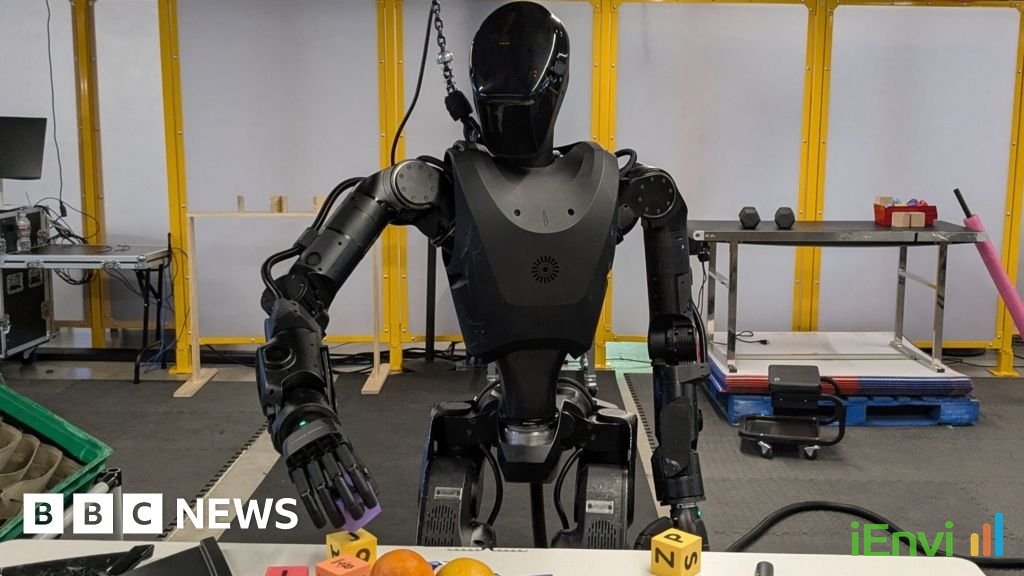
San Francisco-based startup Foundation Robotics is developing and field-testing Phantom, a dual-use humanoid robot designed specifically for military operations and combat support roles. Unlike the dominant trajectory of humanoid robotics development, which has been dominated by Tesla, Figure, Agility Robotics, and similar companies targeting controlled factory and warehouse environments, Foundation Robotics is deliberately pursuing high-consequence, unstructured defence settings. The company currently holds approximately USD 24 million (around AUD 36 million) in US military research contracts, and the first-generation Phantom MK-1 prototype has already undergone pilot logistics testing in active conflict environments, including reported deployments in Ukraine delivering ammunition and supplies to positions under fire. A BBC exclusive feature showcased the MK-1 performing spatial reasoning tasks at the company’s San Francisco facility in [DATE TO BE VERIFIED].
The significance of this development extends well beyond defence circles. The rapid commercialisation of embodied AI systems capable of operating in unstructured, high-risk environments signals a meaningful inflection point in physical AI maturity. For technology leaders, enterprise planners, engineers, and professional services firms, the dual-use nature of these platforms raises pressing questions about where this technology moves next. Capabilities developed under military research funding have a well-documented history of migrating into commercial and industrial applications, and the economics Foundation Robotics is targeting suggest that timeline could be shorter than many expect.
The development has also ignited serious ethical debate. Nicole Van Roijen, executive director of the NGO Stop Killer Robots, warned in response to the BBC feature that public familiarisation with humanoid machines in military roles increases the risk that people may not recognise the danger these systems represent, and called for international rules to curb the weaponisation of autonomous systems. Foundation Robotics CEO Sankaet Pathak has publicly countered that land-based autonomous humanoid systems can be more precise than aerial drone strikes and that arming such robots could reduce soldier casualties and collateral damage. These competing positions reflect a broader policy debate that will shape how dual-use robotics is regulated across allied nations, including Australia.
Key details of the Phantom MK-1 platform and Cortex AI system
The Phantom MK-1 stands 175 centimetres tall and weighs approximately 80 kilograms, placing it squarely within human scale. Its design philosophy centres on a camera-first helmet providing a near-360-degree field of view, a rated payload capacity of 20 kilograms, and a top operational speed of 1.7 metres per second. The robot uses cycloidal, back-drivable actuators, a drivetrain architecture chosen specifically to deliver high torque output while maintaining physical compliance, meaning the robot’s joints yield rather than resist when subjected to unexpected forces. This compliance characteristic is considered important for operating safely around human personnel and for recovering from collisions in unstructured environments.
The MK-1 is powered by an AI operating system called Cortex. Cortex is a layered system combining a reasoning model trained on task-specific examples with a broader world model trained on internet video datasets and real-time physical interaction data collected from the robot itself during operation. This architecture is consistent with current trends in embodied AI research, where foundation models trained on large passive datasets are fine-tuned through active physical interaction. Pathak described the data collection philosophy directly during the BBC demonstration: the company needs data from the robot interacting with its environment, and basic manipulation tasks with children’s building blocks represent a deliberate, structured approach to gathering foundational physical reasoning data before progressing to more complex tasks.
Despite the operational ambition, the MK-1 carries substantial hardware limitations that are openly acknowledged by the company. The current prototype has no onboard battery and requires a physical tether for power, which presents obvious constraints in field deployment. It is not dustproof or waterproof under any rated standard, cannot autonomously recover from a fall, and its hands lack the dexterity and grip strength required to reliably operate tools or weapons. These are not trivial shortcomings for a platform being considered for frontline logistics roles. Foundation Robotics is reportedly already developing the MK-2 generation, targeting element-proofing, an onboard battery system capable of up to six hours of runtime, autonomous fall recovery, a titanium frame construction, and highly articulated hands capable of operating existing human-scale tools and equipment.
The commercial scaling targets Foundation Robotics has disclosed are notable. The company is reportedly aiming to reach production of approximately 40,000 units annually by the end of 2027, with a target unit price point below USD 20,000 (approximately AUD 30,000). If those production and price targets are achieved, they would represent a significant reduction in cost compared to current-generation humanoid platforms from established competitors, most of which remain in the six-figure price range per unit. That cost trajectory, if realised, would substantially lower the barrier for commercial and industrial adoption of humanoid platforms originally developed for defence applications.
Australian context: dual-use robotics, defence technology transfer, and professional services implications
Australia’s strategic and commercial relationship with US defence technology development is well established. Under the AUKUS [SECTION INCOMPLETE — original text truncated here]
References and related sources
- Primary source: humanoid.guide
- caliber.az
- openthemagazine.com
- rbc.ua
- ratopati.com
- NEPM Assessment of Site Contamination
How iEnvi can help
iEnvi integrates technology and data-driven approaches into environmental consulting. We monitor AI and technology developments that affect how environmental professionals deliver services to clients.
This is an iEnvi Machete news summary. Prepared by iEnvi to summarise the source article for environmental professionals tracking AI, data, and technology developments that affect consulting and project delivery.
Published: 14 Jun 2026
Need advice on this topic? Speak to an iEnvi expert at info@ienvi.com.au or 1300 043 684, or contact us online.