
Overview
The State of Wisconsin in the United States has enacted landmark legislation establishing some of the most stringent PFAS drinking water limits in the world, alongside a USD $125 million funding package for contamination clean-up. The legislation includes a notable innocent landowner exemption that shields property owners from financial and legal liability for PFAS contamination they did not cause. This dual approach of strict regulation combined with liability protection and dedicated funding offers important lessons for Australian jurisdictions grappling with similar PFAS management challenges.
Key details
The Wisconsin legislative package comprises two main components: updated drinking water standards under Wisconsin Administrative Code chapter NR 809 and a clean-up funding mechanism under 2025 Assembly Bill 131.
New drinking water standards:
- PFOA and PFOS: Maximum Contaminant Levels (MCLs) set at 4 parts per trillion (ppt), equivalent to 0.004 micrograms per litre (ug/L). This is among the lowest enforceable standards globally
- Additional PFAS compounds: Three further PFAS compounds are limited to 10 ppt (0.01 ug/L)
- Hazard index approach: The state has adopted a hazard index methodology to account for the synergistic effects of multiple PFAS compounds present as mixtures, recognising that combined exposure may pose greater risk than individual compounds in isolation
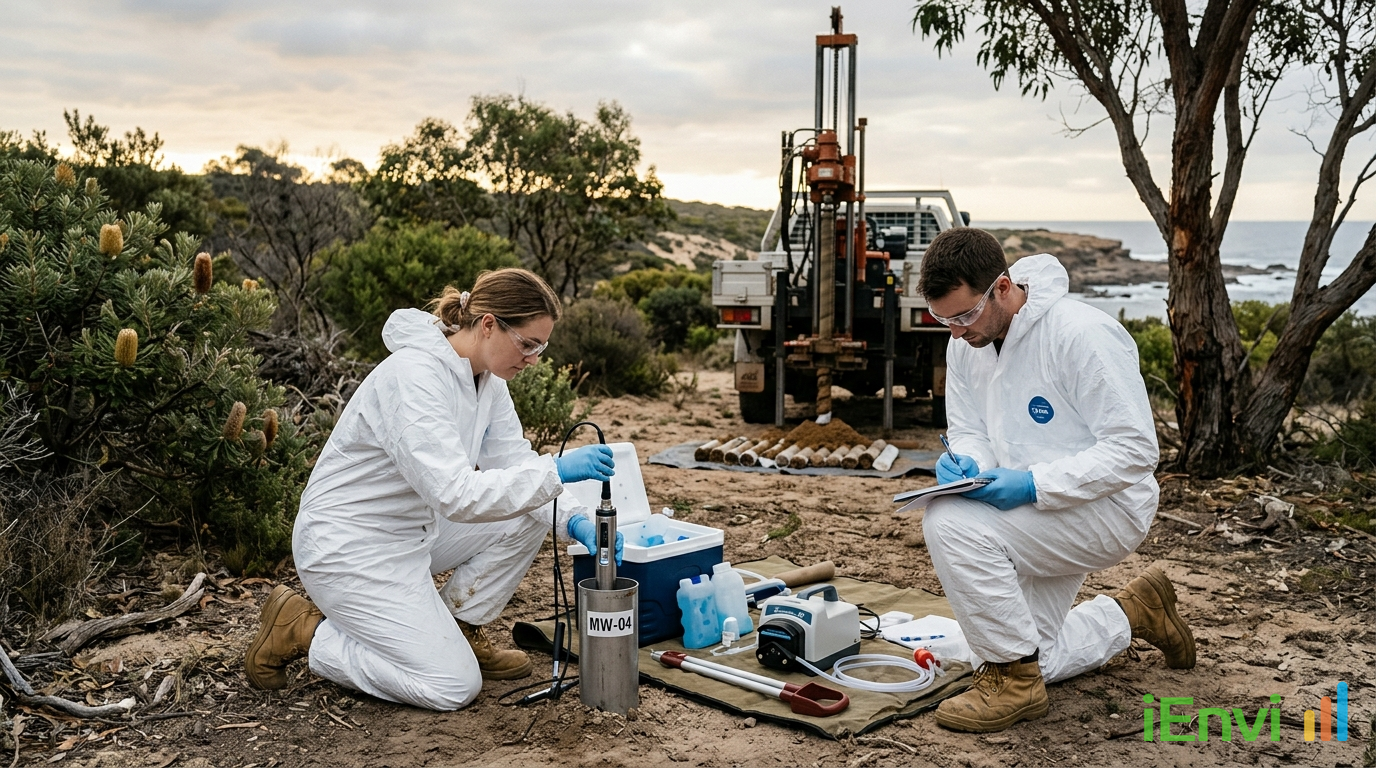
Analytical and sampling challenges: Achieving reliable compliance monitoring at 0.004 ug/L leaves virtually no margin for error in field sampling and laboratory analysis. At these concentrations, standard field practices become critical sources of potential false positive results. Key challenges include:
- Cross-contamination from sampling equipment containing PFAS-bearing materials (such as Teflon components, certain pump tubing, and waterproof field clothing)
- Inadequate decontamination procedures between sampling points
- Background contamination from sample containers, preservatives, or laboratory consumables
- The need for PFAS-free sampling kits and strict quality assurance/quality control (QA/QC) protocols including field blanks, trip blanks, and equipment rinsates
Innocent landowner protections: Assembly Bill 131 establishes a mechanism to release state clean-up funds while protecting property owners who acquired contaminated land without knowledge of PFAS contamination. This addresses one of the most significant commercial barriers to brownfield redevelopment: the risk that a purchaser inherits the remediation liability of previous operators.
Australian context
Australia’s PFAS regulatory framework is governed primarily by the PFAS National Environmental Management Plan (NEMP), currently in its third version (NEMP 3.0). The NEMP establishes guideline values rather than enforceable standards, with implementation varying across state and territory jurisdictions.
Current Australian drinking water guidance for PFAS, as set by the Australian Drinking Water Guidelines (ADWG) and the NEMP, includes:
- PFOS + PFHxS: 0.07 ug/L (70 ppt)
- PFOA: 0.56 ug/L (560 ppt)
These values are significantly less stringent than the Wisconsin limits of 4 ppt for PFOA and PFOS. While direct comparison requires caution due to differing risk assessment methodologies and exposure assumptions, the trend globally is towards lower and lower acceptable concentrations as toxicological understanding advances.
Australia does not currently have a comprehensive national framework equivalent to Wisconsin’s innocent landowner exemption. Contaminated land liability in Australia is generally governed by state-based legislation, with liability typically attaching to the person who caused the contamination or the current landowner. The absence of explicit innocent purchaser protections creates significant financial risk for parties acquiring brownfield sites, particularly former defence sites, airports, and industrial properties with legacy PFAS contamination.
Several Australian jurisdictions are actively reviewing their PFAS management approaches, and the Wisconsin model of combining strict standards with liability relief and dedicated funding may provide a useful template for future policy development.
Practical implications
Environmental consultants, site assessors, and property professionals should consider the following in light of these developments:
- Upgrade QA/QC protocols: Review and update field sampling procedures to ensure they can reliably achieve results at ultra-low reporting limits. This includes using PFAS-free sampling equipment, implementing rigorous decontamination procedures, and collecting comprehensive QA/QC samples (field blanks, trip blanks, equipment rinsates)
- Anticipate tightening Australian standards: The global trend towards lower PFAS limits suggests that Australian guideline values will likely be revised downward in future NEMP updates. Site assessments conducted now should consider whether current data will remain adequate under potentially stricter future criteria
- Assess brownfield acquisition risks: Parties considering the acquisition of potentially PFAS-impacted sites should factor in the absence of innocent landowner protections in Australian law. Comprehensive pre-acquisition PFAS investigations are essential to quantify potential remediation liabilities
- Review laboratory capabilities: Confirm that engaged laboratories can achieve the low reporting limits likely to be required under future regulatory updates. Not all commercial laboratories in Australia currently report to the levels needed for comparison with international standards at the 4 ppt level
- Monitor regulatory developments: Track both international developments (such as this Wisconsin legislation) and domestic regulatory reviews that may signal upcoming changes to Australian PFAS guidelines and liability frameworks
References and related sources
- Wisconsin Bar Association: Source article on PFAS legislation
- iEnvi LinkedIn discussion
- Australian Government PFAS management
- Australian Drinking Water Guidelines
How iEnvi can help
iEnvi provides specialist PFAS assessment and remediation services across Australia. Our team can assist with:
- Contaminated land assessments including PFAS detailed site investigations, human health and ecological risk assessments, and pre-acquisition due diligence for potentially impacted properties
- Remediation services including PFAS remediation options analysis, treatment system design, and long-term groundwater monitoring programmes
- Expert witness services for disputes involving PFAS contamination liability, property devaluation claims, and regulatory compliance matters
This is an iEnvi Machete news summary. Prepared by iEnvi to summarise the source article for contaminated land, groundwater, remediation, approvals and site risk professionals.
Need advice on this topic? Speak to an iEnvi expert at info@ienvi.com.au or 1300 043 684, or contact us online.
Need advice on this issue? iEnvi provides practical, senior-led environmental consulting across contaminated land, remediation, ecology and environmental risk.
DSI services Ecological risk assessment Environmental management plans Contaminated land advice Talk to iEnvi