
Overview
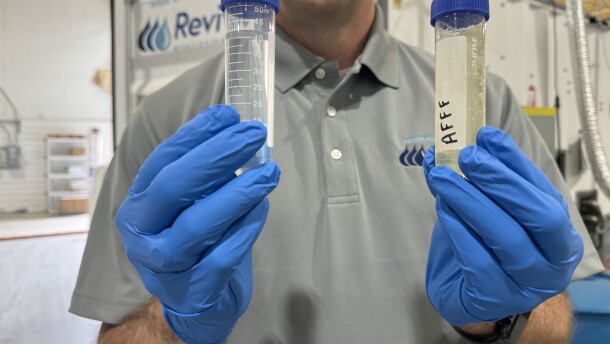
The Ohio Environmental Protection Agency has successfully destroyed approximately 53,000 litres (14,000 US gallons) of concentrated legacy aqueous film-forming foam (AFFF) using commercial-scale supercritical water oxidation (SCWO) technology. The stockpiled AFFF was collected from 118 regional fire departments and mineralised into clean water, demonstrating that complete PFAS destruction at scale is now a practical reality rather than a laboratory concept. This deployment represents one of the largest confirmed destructions of legacy AFFF using non-combustion technology.
Key details
Supercritical water oxidation works by heating water above its critical point, specifically above 374 degrees Celsius and 221 bar of pressure. Under these conditions, water enters a supercritical state where it behaves as both a liquid and a gas, creating an environment where organic compounds, including highly stable PFAS molecules, undergo rapid and complete oxidation. The strong carbon-fluorine bonds that make PFAS so persistent in the environment are broken down into simple inorganic products, primarily fluoride salts, carbon dioxide, and clean water.
Unlike traditional high-temperature incineration, SCWO operates in a closed system. This eliminates the risk of incomplete combustion and the formation of hazardous byproducts such as hydrogen fluoride gas or short-chain PFAS fragments that can occur when AFFF is burned in conventional incinerators. The Ohio deployment processed the collected AFFF concentrates through a commercial-scale SCWO unit, confirming destruction efficiencies that meet regulatory expectations for complete mineralisation.
The collection program itself is notable. By coordinating with 118 fire departments across the state, Ohio EPA addressed a widespread stockpiling problem. Many fire stations across Australia and internationally hold legacy AFFF supplies that were withdrawn from service following regulatory phase-outs but remain in storage because no approved destruction pathway was available locally.
Australian context
Australia’s regulatory framework for PFAS-containing firefighting foams is guided by the PFAS National Environmental Management Plan (PFAS NEMP 3.0), which prioritises destruction and irreversible transformation of PFAS over containment, landfilling, or discharge to wastewater. The NEMP establishes a clear waste management hierarchy that places permanent destruction at the top.
The challenge for Australian practitioners has been the limited availability of proven, commercial-scale destruction technologies onshore. While several pilot programs have been conducted, including trials at Defence sites and airports, the gap between laboratory-proven destruction and commercially available, regulator-approved technology has remained significant. Fire services, airports, and Defence facilities across Australia hold stockpiles of legacy AFFF awaiting destruction.
The Australian Department of Defence has been managing AFFF stockpiles from bases including Williamtown, Oakey, and Tindal, where historical AFFF use has resulted in extensive soil and groundwater contamination. A proven commercial-scale SCWO pathway, as demonstrated in Ohio, would provide an additional option for managing both stockpiled concentrates and liquid waste streams generated during remediation of contaminated sites.
State regulators including the NSW EPA, Queensland DES, and Victorian EPA have all signalled that destruction technologies will be required as part of remediation strategies for PFAS-contaminated sites. The Ohio demonstration strengthens the evidence base supporting SCWO as a viable technology for Australian regulatory approval processes.
Practical implications
Environmental consultants and remediation contractors should consider the following implications:
- Remedial options assessments for PFAS-contaminated sites should now include SCWO as a proven commercial-scale destruction technology, particularly for concentrated AFFF waste streams and extracted groundwater treatment residuals.
- Fire services and airport operators holding legacy AFFF stockpiles should engage with state regulators to discuss destruction pathways, referencing the Ohio deployment as evidence of commercial viability.
- Consultants preparing PFAS management plans should update the technology review sections to reflect the demonstrated capacity of SCWO for complete mineralisation of AFFF concentrates.
- Cost-benefit analyses for PFAS remediation projects should compare SCWO destruction costs against long-term storage, monitoring, and liability costs associated with landfilling or indefinite stockpiling.
- The closed-system nature of SCWO addresses community and regulatory concerns about atmospheric emissions from PFAS destruction, which have been a significant barrier to approval of thermal treatment facilities in Australia.
References and related sources
- WYSO Public Radio: Ohio EPA PFAS destruction program (primary source)
- Australian Government PFAS National Environmental Management Plan (NEMP 3.0)
- iEnvi LinkedIn discussion on this topic
How iEnvi can help
iEnvi provides specialist PFAS investigation, risk assessment, and remediation services. Our team assists defence facilities, airports, fire stations, and industrial clients with PFAS site characterisation, remedial options analysis, and regulatory engagement for PFAS management and destruction programs.
Our relevant services include contaminated land assessment for PFAS-impacted sites, remediation design and management for PFAS source zones and groundwater plumes, and expert witness services for PFAS contamination disputes.
This is an iEnvi Machete news summary. Prepared by iEnvi to summarise the source article for contaminated land, groundwater, remediation, approvals and site risk professionals.
Need advice on this topic? Speak to an iEnvi expert at info@ienvi.com.au or 1300 043 684, or contact us online.
Need advice on this issue? iEnvi provides practical, senior-led environmental consulting across contaminated land, remediation, ecology and environmental risk.
Groundwater investigation and treatment Environmental management plans Contaminated land advice Remediation services Talk to iEnvi