
Overview
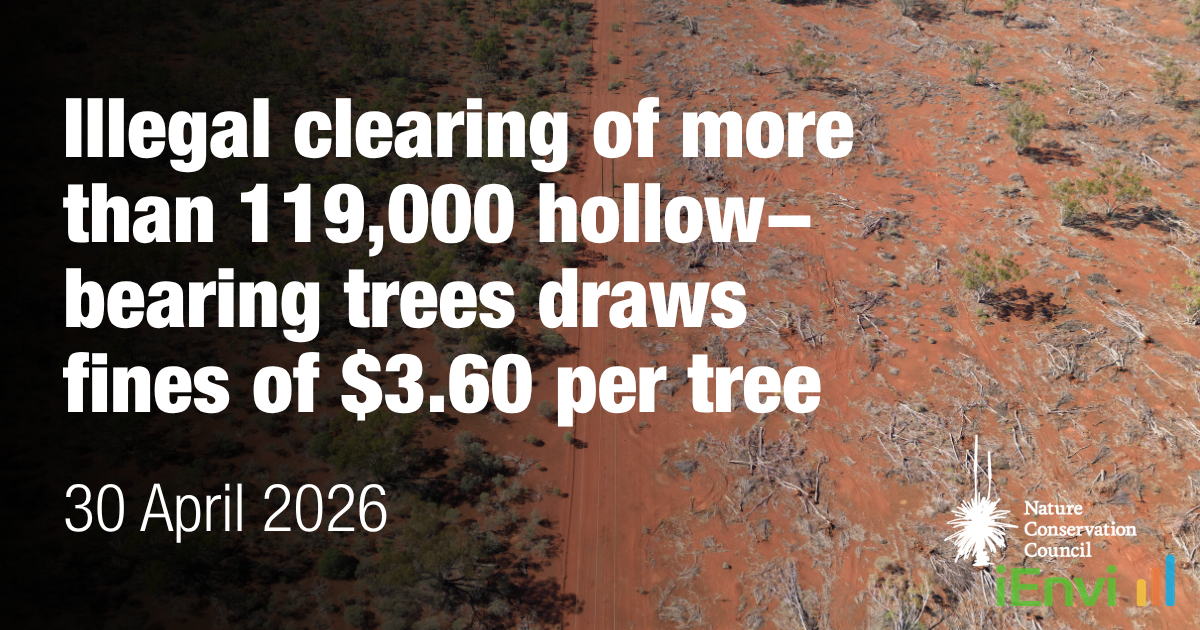
A recently reported enforcement outcome in New South Wales has exposed a significant gap between the ecological value of native vegetation and the financial penalties available under current law. Between October 2021 and April 2024, two landholders in Western NSW illegally cleared 2,400 hectares of native vegetation, destroying more than 167,000 mature native trees. Of those, 119,851 were hollow-bearing trees — ancient woodland structures that take hundreds of years to develop and provide irreplaceable habitat for threatened fauna. The resulting court-imposed penalty was $431,250, equating to an effective rate of approximately $3.60 per hollow-bearing tree destroyed. The Nature Conservation Council of NSW has characterised this outcome as wholly inadequate relative to the scale of ecological damage caused.
For environmental professionals advising agricultural landholders, developers, and councils in NSW, this case is indicative of a broader structural problem. The penalty framework under the Local Land Services Act does not appear to be calibrated to the actual ecological replacement cost of hollow-bearing trees, nor does it reflect the time value of habitat loss for hollow-dependent threatened species. Hollow-bearing trees are among the most ecologically significant structural elements in temperate and semi-arid woodland ecosystems, providing nesting and denning habitat for species including cockatoos, owls, gliders, bats, and the strip-faced dunnart (Sminthopsis macroura). Once removed, they cannot be functionally replaced within a human planning timeframe.
Compounding the severity of the ecological outcome is the reported compliance timeline. The NSW Environment Line was alerted to the clearing activity in February 2023. Regulatory intervention did not halt the activity until approximately 13 months later. During that period, clearing continued at scale across a landscape that supports listed threatened ecological communities and species. For practitioners working on biodiversity assessments, offset calculations, and environmental due diligence in NSW, this case raises immediate questions about the adequacy of current monitoring frameworks, penalty maxima, and the speed of the regulatory response system.
Key details of the Western NSW illegal clearing case
The clearing occurred across 2,400 hectares in Western NSW over a period spanning from October 2021 to April 2024, a total duration of approximately 30 months. The total number of mature native trees destroyed exceeded 167,000, of which 119,851 were confirmed as hollow-bearing trees. These are not saplings or regrowth stems. Hollow-bearing trees in semi-arid and temperate woodland ecosystems typically require between 100 and 300 or more years to develop hollows of sufficient size and depth to provide viable nesting and denning habitat. Their loss represents a permanent ecological deficit on any planning or management horizon relevant to current land use decisions.
The penalty of $431,250 was imposed under provisions of the Local Land Services Act. When divided across the 119,851 hollow-bearing trees confirmed as destroyed, the effective per-tree penalty is $3.60. To contextualise that figure against ecological replacement costs: biodiversity offset calculations under the NSW Biodiversity Offsets Scheme routinely assign credit values to hollow-bearing trees that can reach hundreds to thousands of dollars per tree depending on species association, hollow class, and local market conditions. The financial penalty imposed in this case is orders of magnitude below what the NSW offset framework implies these trees are worth in ecological credit terms. This misalignment between penalty levels and offset credit valuations is not a minor calibration issue. It represents a structural inconsistency that reduces the effectiveness of the enforcement regime.
The regulatory response timeline is equally significant for practitioners. A report was made to the NSW Environment Line in February 2023. The Environment Line is the primary reporting mechanism for alleged breaches of environmental legislation in NSW, including illegal vegetation clearing. Despite that notification, the clearing reportedly continued for a further 13 months before it was halted. The clearing activity therefore persisted through at least one full growing season and across what appears to have been multiple vegetation communities. The reasons for the 13-month delay between notification and effective intervention have not been publicly detailed, but the outcome has prompted calls for the integration of near real-time satellite and remote sensing monitoring to detect large-scale unauthorised clearing events without relying exclusively on reactive, complaint-driven inspection processes.
The threatened species implicated in this type of habitat loss in Western NSW include the pink cockatoo (Lophochroa leadbeateri), the barking owl (Ninox connivens), the squirrel glider (Petaurus norfolcensis), and the strip-faced dunnart (Sminthopsis macroura), among others. All of these species are hollow-dependent at one or more life stages. Loss of hollow-bearing trees at this scale in a single landscape does not simply reduce population density locally. It can fragment connectivity, eliminate recruitment habitat, and produce population-level effects that persist for decades regardless of whether the penalty is paid promptly. In biodiversity assessment terms, the harm caused is not reversible on any standard offset timeframe.

Australian context: native vegetation laws, biodiversity offsetting, and enforcement gaps
Illegal vegetation clearing remains one of the most persistent and damaging forms of environmental non-compliance in Australia. NSW, Queensland, Victoria, South Australia, and Western Australia all maintain statutory frameworks governing native vegetation clearing on freehold and leasehold land, yet enforcement outcomes across these jurisdictions continue to attract criticism for failing to reflect the true ecological cost of unlawful clearing at scale.
References and related sources
- Primary source: www.miragenews.com
- nature.org.au
- https://www.miragenews.com/illegal-tree-clearing-fines-360-per-hollow-tree-12255
- NSW EPA
- EPBC Act
How iEnvi can help
iEnvi provides specialist consulting services relevant to this topic. Our team includes CEnvP Site Contamination Specialists with experience across contaminated land, groundwater, remediation, ecology, and regulatory compliance.
- iEnvi contaminated land investigation services
- iEnvi remediation and validation services
- iEnvi expert services and independent review services
This is an iEnvi Machete news summary. Prepared by iEnvi to summarise the source article for contaminated land, groundwater, remediation, approvals and site risk professionals.
Published: 03 May 2026
Need advice on this topic? Speak to an iEnvi expert at info@ienvi.com.au or 1300 043 684, or contact us online.
Need advice on this issue? iEnvi provides practical, senior-led environmental consulting across contaminated land, remediation, ecology and environmental risk.
Contaminated land services Remediation services Groundwater services Ecological assessment Talk to iEnvi