
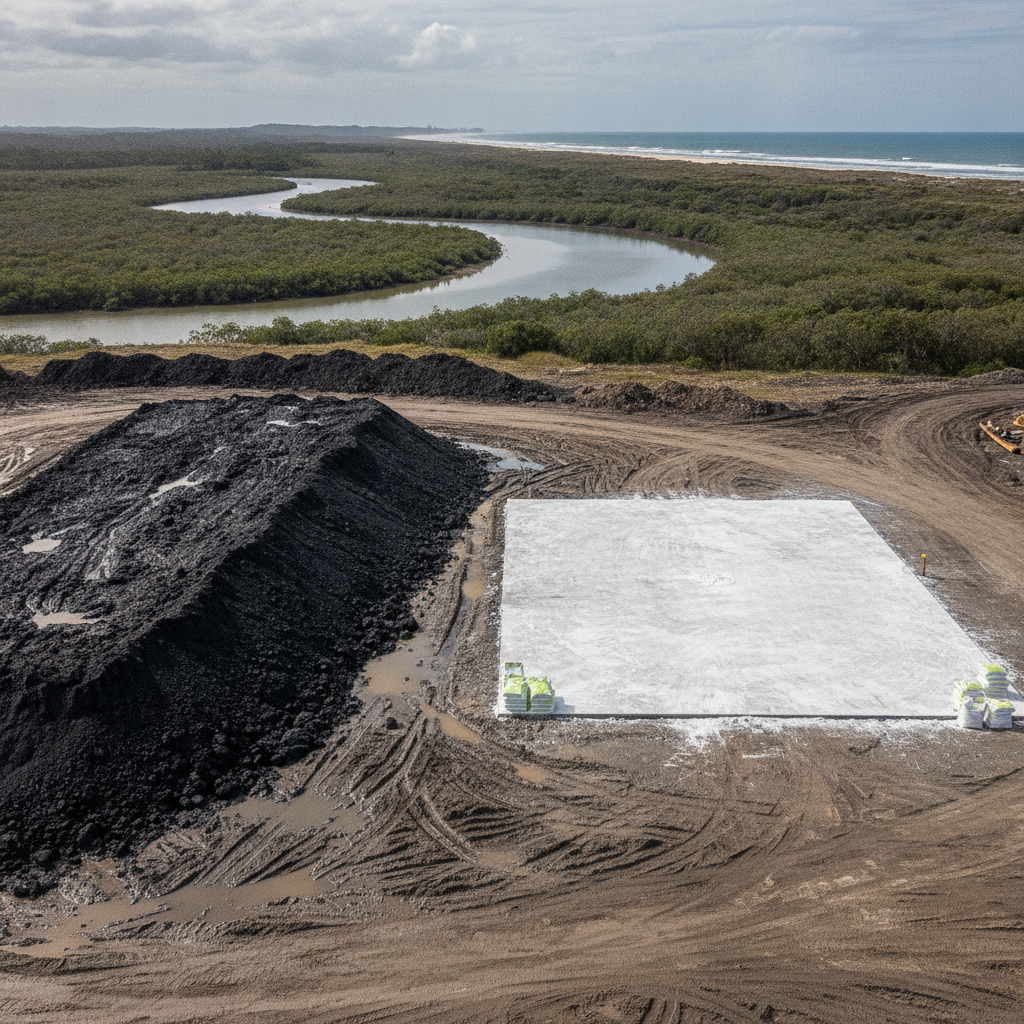
Acid sulfate soils (ASS) stay quiet while they stay wet and undisturbed. Once earthworks, dewatering, dredging or drainage expose sulfidic material to air, iron sulfides oxidise, sulfuric acid forms, and metals and metalloids can mobilise into soil and water. This is not a niche coastal issue. It turns up on floodplains, estuarine lots, low-lying industrial precincts, wetland fringes and, inland, in drying wetland sediments across the Murray-Darling Basin.
This article is a practical orientation for Australian practitioners: what ASS and potential acid sulfate soil (PASS) are, which national documents set the investigation method, how Queensland and New South Wales wrap that science into management and reuse rules, and what a usable Acid Sulfate Soil Management Plan (ASSMP) has to do on a real site. It is guidance for scoping and review, not a substitute for the current manuals, orders or planning controls that apply to your project.
What ASS and PASS actually are
ASS is the everyday name for soils and sediments that contain reduced inorganic sulfur, most often pyrite and related iron sulfides. Potential ASS (PASS), described as hypersulfidic material in national guidance, still has those sulfides locked away. Field pH can look neutral or only mildly acidic until oxidation starts. Actual ASS has already oxidised enough that acidity exceeds the soil’s buffering capacity. Field clues include jarosite along root channels, very low pH, and water that smells of sulfur or looks iron-stained.
Disturbance pathways that matter on consulting jobs include excavation for basements and services, temporary or permanent dewatering that lowers the water table across a sulfidic horizon, dredging and spoil handling, filling that leaves sulfidic material in the unsaturated zone, and drainage upgrades that dry wetland or floodplain sediments. Once acid forms, risks include fish kills and aquatic toxicity, corrosion of concrete and steel, release of aluminium, iron, arsenic and other metals, and rejection or reclassification of excavated material that was assumed to be clean fill.
National guidance is the investigation backbone
Commonwealth guidance developed with the National Committee for Acid Sulfate Soils under the National Water Quality Management Strategy is the current best-practice investigation method. Two manuals do most of the day-to-day work:
- The National Acid Sulfate Soils Sampling and Identification Methods Manual (Sullivan et al. 2018) for desktop assessment, site inspection and soil sampling design.
- The National Acid Sulfate Soils Identification and Laboratory Methods Manual (Sullivan et al. 2018) for conclusive identification, hazard quantification and interpretation, including chromium reducible sulfur suites, titratable actual acidity, retained acidity and acid neutralising capacity (ANC).
Related national documents cover dewatering in shallow groundwater settings, dredging and dredge spoil, and monosulfidic black ooze (MBO) in drains and wetlands. The Australian Standard AS 4969 series still sits behind many laboratory suites. Field screening with field pH (pHF) and field peroxide pH (pHFOX) is useful for targeting samples, but it is not a substitute for laboratory confirmation when a management or disposal decision hangs on the result.
National guidance is non-prescriptive science advice. States and territories decide how it is given legal effect through planning policies, waste classification, resource recovery instruments and development conditions. Always check the jurisdiction that owns the approval before you treat the national manuals as the whole answer.
Queensland: investigation plus Soil Management Guidelines v5.1
Queensland points investigations to the national sampling and laboratory manuals, and management practice to the Queensland Acid Sulfate Soil Technical Manual, Soil Management Guidelines Version 5.1 (Dear et al. 2024). Version 5 (December 2023) aligned Queensland practice more tightly with the 2018 national material and expanded guidance on neutralisation, verification testing, self-neutralising soils, water quality parameters, remediation and environmental management plans. Version 5.1 (May 2024) clarified trenching, acidic non-sulfidic soils and small-volume disturbances.
In practice, a Queensland ASS package usually needs a clear desktop risk map, sampling that tests the horizons that will actually be disturbed, laboratory results expressed as net acidity (usually reported in mol H+/t) with a transparent liming-rate calculation, and an ASSMP that ties triggers, treatment, stockpile controls, water management and verification testing to the earthworks program. Avoidance of disturbance remains the first preference. Where disturbance is unavoidable, treatment and verification have to be designed before the excavator arrives, not improvised after the first odorous stockpile appears.
Queensland planning and State Planning Policy settings also matter for development assessment. Do not rely on the technical manuals alone when a development application, operational works approval or environmental authority condition already specifies ASS assessment depth, reporting or management outcomes.
New South Wales: ASS Manual plus the 2025 resource recovery order
NSW still references the NSW Acid Sulfate Soil Manual (Stone et al. 1998) for much planning and local mapping work, with national guidance sitting beside it for modern sampling and laboratory practice. Waste classification for ASS leaving a site still has to satisfy the NSW EPA Waste Classification Guidelines where material is transported for treatment or disposal.
The material change for reuse is the acid sulfate soil (ASS) order 2025 and its matching exemption, which commenced on 5 December 2025 under the Protection of the Environment Operations Act resource recovery framework. Together they set the supplier and consumer rules for applying treated ASS to land as earthworks or engineering fill. Key points practitioners should not miss:
- ASS under the order means sulfidic or already oxidised material that can be treated with agricultural lime and that otherwise meets the order’s definitions of virgin excavated natural material (VENM) or excavated natural material (ENM). Monosulfidic black ooze and acid mine drainage materials are excluded.
- An ASS investigation must follow the national sampling and laboratory manuals before ASS is removed from the premises.
- If net acidity is below 18 mol H+/t after investigation, supply can proceed under a lighter path in the order. Where incubation testing is used to support that outcome, an Expert under the order (a Soil Science Australia Registered Soil Practitioner accredited in acid sulfate soils, RSP-ASS) must confirm the net acidity result in writing.
- Where treatment is required, an ASSMP must be prepared in accordance with Appendix 2 of the Queensland Soil Management Guidelines. If the environmental practitioner preparing it is not an Expert under the order, an Expert must review and approve the ASSMP.
- A proof of performance (POP) trial is required: three consecutive compliant treated stockpiles at the nominated volume, sampled at one discrete sample per 50 m3, before the reduced rate of one sample per 100 m3 is allowed.
- Post-treatment chemical criteria include pHKCl within the bounds set in the order and a verification net acidity of no greater than 0 mol H+/t (with a 95% UCL option for the mean under stated conditions). NATA-accredited methods from the national laboratory manual apply.
- Consumers may only apply the material as engineering fill or earthworks, and only where planning approvals allow receipt of waste under a resource recovery order and exemption. Treated ASS can swell as secondary minerals form, so geotechnical fitness for purpose is a separate question from chemical compliance.
Read the order and exemption together. The order binds suppliers. The exemption sets consumer conditions. Neither replaces contaminated land assessment under the Contaminated Land Management Act where other contaminants are present, and neither authorises use as a growing medium.
Victoria and other jurisdictions in brief
Victoria still leans on coastal ASS planning maps, the Victorian Best Practice Guidelines for Assessing and Managing Coastal Acid Sulfate Soils, and EPA Publication 655.1 for industrial waste aspects, while national investigation methods are the usual technical reference for sampling and analysis. South Australia and Western Australia maintain their own ASS mapping and management guidance. Inland ASS in drying wetlands needs the national inland aquatic ecosystem guidance, not only coastal manuals. Wherever you work, match the desktop tools, the laboratory suite and the management plan to the approval pathway that will actually receive the report.
What a usable ASS investigation and ASSMP look like
Desktop work should use ASRIS and state ASS risk maps, elevation, geology, tidal or flood influence, and proposed excavation or dewatering depths. Say which horizons are likely sulfidic and which earthworks will intersect them. Fieldwork should sample those horizons, keep samples wet and cold, and record field pH, texture, colour, odour and jarosite. Laboratory work should report the chromium reducible sulfur suite (or an equivalent national method), actual and retained acidity where required, ANC, and a clear net acidity calculation. If ANC is used to reduce liming rates, corroborate it properly. National guidance and the NSW order both put weight on incubation testing before ANC is trusted to cancel potential acidity.
An ASSMP earns its keep when it is written for the construction program. Useful plans name the disturbance volumes and depths, the preferred avoidance or treatment method, liming rates with a stated safety factor, treatment pad or pugmill controls, stockpile segregation, water collection and treatment triggers, verification sampling density, contingency for hotspots, and who holds authority to stop work. Vague statements such as “ASS will be managed in accordance with guidelines” do not protect a contractor, a certifier or a regulator when the first sulfidic load hits the pad.
Common mistakes
- Treating ASS risk as a coastal-only issue and skipping desktop screening on floodplain or estuarine industrial sites.
- Using field pH screening alone to clear material for fill or off-site reuse.
- Designing dewatering without checking whether drawdown will oxidise PASS outside the excavation footprint.
- Calculating liming rates without a transparent net acidity basis, safety factor or verification plan.
- Assuming treated ASS that meets a chemical criterion is automatically suitable engineered fill.
- In NSW, planning reuse under the 2025 order without an ASSMP aligned to the Queensland appendix the order actually cites, or without the Expert steps the order requires when the practitioner does not hold RSP-ASS accreditation.
- Mixing ASS management with general waste classification and forgetting that other contaminants can knock material out of VENM and ENM pathways even when sulfides are controlled.
Practical takeaways
- Start with the national sampling and laboratory manuals for identification and hazard quantification, then add the state planning, waste and resource recovery instruments that apply to the site.
- In Queensland, build management around Soil Management Guidelines Version 5.1 and write the ASSMP before disturbance.
- In NSW, treat the ASS order and exemption 2025 as the live rulebook for supplying treated ASS as earthworks or engineering fill. Budget for investigation, the ASSMP, POP trial sampling and, where required, Expert review.
- Keep avoidance first. Where treatment is needed, verify with NATA-accredited methods and keep the paper trail the next auditor, council or EPA officer will ask for.
- Separate chemical compliance from geotechnical suitability. Neutralised ASS is not automatically structural fill.
Need advice on an acid sulfate soil investigation, ASSMP or reuse pathway? iEnvi provides practical, senior-led environmental consulting across contaminated land, acid sulfate soils, remediation, ecology and environmental risk.
Need advice on this issue? iEnvi provides practical, senior-led environmental consulting across contaminated land, remediation, ecology and environmental risk.
Environmental management plans Contaminated land services Remediation services Groundwater services Talk to iEnvi