
Overview
In July 2024, Anthropic Chief Executive Dario Amodei published a formal position paper explicitly stating that his company does not support a blanket ban on open-weight artificial intelligence models. The statement came at a critical moment in the global AI policy debate, with US officials reportedly considering restrictions on domestic companies using open-weight models developed by Chinese firms. Amodei’s intervention was notable because Anthropic was the only major frontier AI laboratory that had not signed a joint industry letter defending open weights, a coalition that included Nvidia, Microsoft, Meta, and OpenAI, representing more than 50 significant technology companies.
The position paper reframes the policy question away from a binary debate between open-source and proprietary AI towards a more targeted, capability-based and hardware-centric regulatory strategy. Rather than restricting model access by architecture type, Amodei proposed three specific intervention pillars: stricter chip export controls, measures to prevent industrial-scale distillation, and mandatory pre-release safety testing for any model that crosses defined capability thresholds. For professional services firms, enterprise developers, and consultancies building bespoke AI tools, this shift signals a material change in the regulatory environment they are likely to face in the near to medium term.
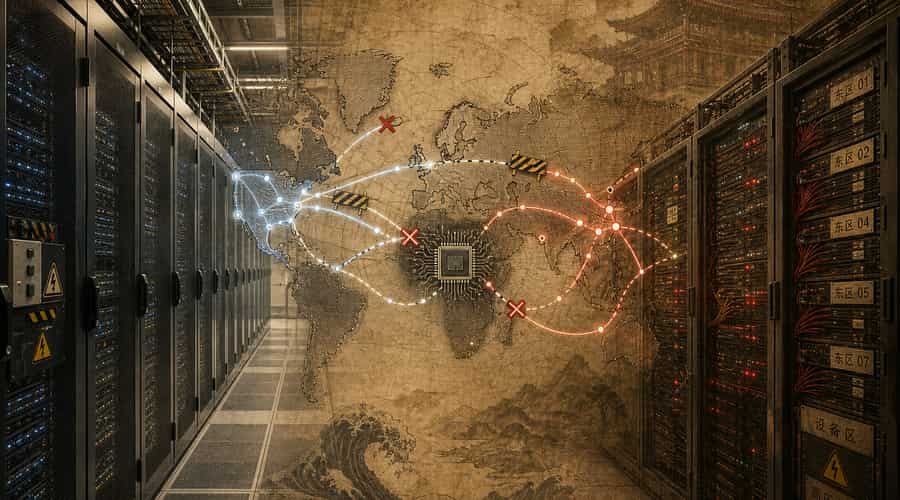
The immediate geopolitical catalyst for this debate is the public release of a large-scale mixture-of-experts model developed by Chinese firm Moonshot AI. Despite US chip export sanctions, the model’s weights were released freely on the Hugging Face platform and benchmarked near the performance of closed-source frontier systems. This demonstrated that competitive frontier-level AI capability can be developed, distributed, and adopted globally even under existing hardware export controls, undermining the assumption that chip sanctions alone are sufficient to contain the spread of advanced AI.
Key details of Anthropic’s open-weight AI policy position
Amodei’s position paper is unambiguous on one point. He wrote: “Let me state it clearly so that there is no doubt: Anthropic has never advocated for a ban on open-weights models.” He further characterised open-weight models without dangerous capabilities as a “public good” that provides genuine value to businesses, developers, and researchers. This language is deliberately conciliatory towards the open-source AI community while simultaneously carving out a security-focused exception for highly capable systems that could pose national security or biosecurity risks.
The first of Amodei’s three proposed policy pillars centres on stricter chip export controls, specifically preventing advanced AI hardware from reaching authoritarian governments before dangerous capability thresholds are reached domestically. The second pillar addresses what Amodei calls “industrial-scale distillation,” which is the practice of systematically querying a large frontier model through its application programming interface (API) and using those outputs to train a smaller, more efficient model that closely replicates the frontier system’s capabilities. This technique allows organisations to effectively clone frontier AI performance without the capital expenditure of initial large-scale training, and without owning the hardware required for that training. Amodei’s position is that this loophole enables foreign competitors to circumvent hardware export controls and acquire US AI capabilities at a fraction of the cost.
The third pillar is mandatory capability-based safety testing. Under this proposal, any model reaching a defined capability threshold would be required to undergo rigorous safety evaluations before public release, regardless of whether it is open-weight or proprietary. The policy does not specify exact technical thresholds in the publicly reported summary, but the framing is consistent with existing responsible scaling policies that leading frontier labs have individually adopted voluntarily. The shift being proposed is from voluntary internal testing to mandated external verification.
The release of Moonshot AI’s model is central to understanding why these proposals are being made now. The model’s large parameter scale and mixture-of-experts architecture allowed it to achieve near-parity with closed-source frontier systems while being distributed freely. Its availability on Hugging Face means that any organisation, including those in jurisdictions subject to US sanctions, can download and deploy the weights without restriction. This sequence of events exposed a gap in the existing US export control framework that Amodei’s proposals are directly aimed at closing.
Australian context: AI regulation, capability thresholds, and enterprise compliance implications
Australia does not currently have a specific legislative framework governing the development or deployment of frontier AI models, though the Australian Government has published voluntary AI Ethics Principles and the Department of Industry, Science and Resources released a voluntary AI Safety Standard in late 2024. The regulatory posture in Australia has to date been considerably more permissive than what Amodei is proposing for the United States. However, given the degree to which Australian technology policy and trade law are aligned with US and Five Eyes partner positions, any capability-based thresholds or distillation restrictions that are legislated in the United States are likely to affect Australian firms operating across those markets or using US-hosted API infrastructure.
For Australian professional services firms, including engineering consultancies, legal practices, and environmental advisory businesses, the practical concern is the use of frontier AI APIs for internal workflows and client-facing tools. If distillation restrictions or mandatory safety testing requirements are introduced in the United States, Australian firms relying on US-hosted models via API may face additional compliance obligations, contractual restrictions, or changes to the terms under which those services are provided. Firms with operations or clients in the United States would be most directly exposed, but the broader signal is that the era of largely unrestricted access to frontier AI via commercial APIs may be approaching a regulatory inflection point.
References and related sources
- Primary source: www.anthropic.com
- startupfortune.com
- businessinsider.com
- trendingtopics.eu
- indiatimes.com
How iEnvi can help
iEnvi integrates technology and data-driven approaches into environmental consulting. We monitor AI and technology developments that affect how environmental professionals deliver services to clients.
This is an iEnvi Machete news summary. Prepared by iEnvi to summarise the source article for environmental professionals tracking AI, data, and technology developments that affect consulting and project delivery.
Published: 28 Jul 2026
Need advice on this topic? Speak to an iEnvi expert at info@ienvi.com.au or 1300 043 684, or contact us online.
Need advice on this issue? iEnvi provides practical, senior-led environmental consulting across contaminated land, remediation, ecology and environmental risk.
Contaminated land advice Remediation services Discuss your site Talk to iEnvi