
Anthropic and TeraWulf Partner in Landmark $19B Infrastructure Deal
On 6 July 2026, high-performance computing infrastructure operator TeraWulf Inc. announced one of the most significant physical infrastructure transactions in the history of artificial intelligence. The company signed a 20-year lease agreement with Anthropic PBC, the AI laboratory behind the Claude model family, covering 401 megawatts (MW) of critical IT load at TeraWulf’s Justified Data campus in Hawesville, Kentucky. The contracted revenue over the initial lease term is approximately USD $19 billion, making this a landmark deal not just for the AI sector but for industrial real estate and energy infrastructure globally.
The transaction signals a fundamental shift in how frontier AI developers are approaching infrastructure. Rather than relying solely on hyperscaler cloud platforms or co-location providers, companies like Anthropic are now securing dedicated, long-term physical capacity on terms that more closely resemble industrial utility contracts than traditional data centre leases. The 20-year term in particular reflects a strategic horizon that extends well beyond typical enterprise IT procurement cycles, suggesting Anthropic is locking in compute capacity ahead of model generations that have not yet been designed.
For enterprise technology leaders, professional services firms, and infrastructure investors, the implications are direct. The deal validates a thesis that has been circulating in energy and technology circles for several years: that raw grid capacity, not semiconductor production or software development, is the primary constraint on AI scaling. This carries real consequences for corporate digital transformation strategies, infrastructure investment planning, and the energy transition more broadly.
Key details of the Anthropic and TeraWulf 401 MW data centre lease
The Justified Data campus occupies a site of approximately 320 hectares (790 acres) in Hawesville, Kentucky, on the former footprint of an aluminium smelting facility. The choice of a former heavy industrial site is deliberate and technically significant. Aluminium smelting is among the most energy-intensive industrial processes in existence, which means the Hawesville site was originally built with access to high-voltage transmission infrastructure capable of sustaining continuous, large-scale electrical loads. By occupying this brownfield industrial site, Anthropic and TeraWulf bypass the utility interconnection queues that routinely delay greenfield data centre projects by three to five years in the current grid environment across North America.
The 401 MW of critical IT load being leased represents a substantial fraction of what major hyperscalers have historically deployed across entire national portfolios. To put this in context, a standard enterprise data centre typically draws between 1 MW and 20 MW of critical IT load. The Hawesville campus at full build-out will deliver roughly 20 to 400 times that capacity from a single contiguous facility. TeraWulf has indicated it will invest between USD $3 billion and USD $4 billion to construct the campus, against a contracted lease return of approximately USD $19 billion, representing a substantial premium on invested capital over the lease term. This deal also lifts TeraWulf’s total AI infrastructure orderbook to USD $27 billion.
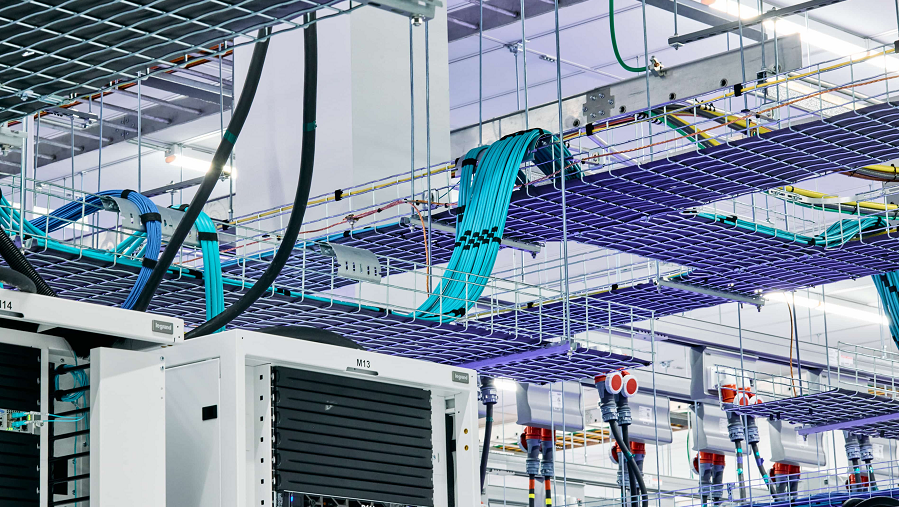
Thermal management at this scale presents a significant engineering challenge. The campus will deploy a closed-loop liquid cooling system that circulates a mixture of water and food-grade propylene glycol behind server racks. This approach absorbs heat generated by processors and radiates it externally via fans rather than evaporating water into the atmosphere or drawing continuously from municipal water supplies. This is a direct response to increasing regulatory and community scrutiny of data centre water consumption, particularly in regions where water availability is constrained. The closed-loop design substantially reduces consumptive water use compared to conventional evaporative cooling towers.
The delivery schedule is structured in phases. Initial capacity is expected to come online in the second half of 2027, with the campus ramping to its full 401 MW by early 2028. To fund the Kentucky development, TeraWulf simultaneously executed an agreement to divest its 50.1% majority stake in its Abernathy, Texas joint venture to Fluidstack for USD $530 million (approximately AUD $800 million at current exchange rates) in staged cash payments. This capital recycling strategy reflects a deliberate portfolio rationalisation, concentrating TeraWulf’s balance sheet on the higher-margin, longer-duration Kentucky asset rather than maintaining a diversified joint venture structure.
Australian context: power availability, AI infrastructure, and business implications for Australian professionals
Australia does not have a direct regulatory equivalent to the Kentucky transaction, but the infrastructure dynamics underpinning it are highly relevant to Australian enterprise and government technology planning. The Australian Energy Market Operator (AEMO) has documented sustained growth in electricity demand driven by data centres, electrification, and industrial loads in its annual Integrated System Plan. Major data centre precincts in Western Sydney, Melbourne’s outer suburbs, and South East Queensland are already facing elongated connection timelines due to transmission network constraints, a dynamic that mirrors the grid bottleneck Paul Prager described at TeraWulf. The Hawesville approach of occupying former heavy industrial sites with existing high-voltage infrastructure has clear parallels to brownfield redevelopment opportunities around former steelworks, smelters, and power station sites in Australia, including Newcastle, Whyalla, Port Pirie, and the Hunter and Latrobe valleys.
For Australian professional services firms, enterprise technology leaders, and infrastructure investors, the TeraWulf–Anthropic deal offers a concrete reference point for how large-scale AI infrastructure commitments are being structured globally. Organisations planning significant AI workloads should be factoring grid access and power tenure into their infrastructure strategies well ahead of procurement decisions. The 20-year lease horizon and the brownfield site selection logic both point to a market in which early movers with secured energy access will hold a durable competitive advantage over those who defer. Australian firms advising clients on data centre strategy, energy procurement, or industrial site redevelopment would do well to examine the Hawesville model closely as a template for how underutilised heavy industrial land with existing transmission infrastructure can be repositioned to meet the energy demands of next-generation AI compute.
References and related sources
- Primary source: investors.terawulf.com
- siliconangle.com
- terawulf.com
- qz.com
- tradingview.com
How iEnvi can help
iEnvi integrates technology and data-driven approaches into environmental consulting. We monitor AI and technology developments that affect how environmental professionals deliver services to clients.
This is an iEnvi Machete news summary. Prepared by iEnvi to summarise the source article for environmental professionals tracking AI, data, and technology developments that affect consulting and project delivery.
Published: 08 Jul 2026
Need advice on this topic? Speak to an iEnvi expert at info@ienvi.com.au or 1300 043 684, or contact us online.
Need advice on this issue? iEnvi provides practical, senior-led environmental consulting across contaminated land, remediation, ecology and environmental risk.
Contaminated land advice Remediation services Discuss your site Talk to iEnvi