
Summary
🔬
Standard targeted analytical suites miss up to 96 per cent of the fluorinated organic load on contaminated sites.
Research from The University of Alabama, which secured the 2026 Metrohm USA Young Chemist Award, highlights a blind spot in remediation. By pairing targeted PFAS analysis with Adsorbable Organic Fluorine (AOF) testing, researchers quantified up to 25 times more fluorinated organics in water than standard methods detect.
For Australian consultants and site owners, these undetected precursors act as dark matter in a conceptual site model. Years after a site is supposedly cleaned up, these unknown compounds can oxidise into regulated substances like PFOS or PFOA, causing post-remediation rebound and unexpected regulatory liabilities.
Under the current PFAS NEMP 3.0 framework, practitioners are expected to characterise source zones and prioritise destruction over disposal. Integrating non-target screening methods like AOF provides a defensible mass balance, allowing auditors to verify that thermal or chemical treatments have mineralised the contaminants rather than simply shifting them to another medium.
How confident are you that your current monitoring suite is capturing the true extent of your site liability?
This is an iEnvi Machete news summary. Full summary and source references at the link below.
Further detail
The technical application of AOF testing provides a more accurate way to verify remediation success.
Relying solely on the standard 28 or 33 PFAS analyte suites leaves a substantial mass balance gap. When evaluating active remediation technologies, such as heat-driven chemical destruction, the disappearance of targeted PFAS compounds does not necessarily equate to complete destruction. These compounds may simply be transforming into shorter-chain, unmeasured terminal products.
By tracking the total loss of organic fluorine through AOF analysis, environmental scientists can demonstrate an overall reduction in the fluorinated load. While AOF mass balance is a useful indicator, site auditors will still look for corroborating analytical evidence, such as fluoride ion recovery and the absence of volatile organofluorine by-products, to definitively confirm complete mineralisation.
As Australian environmental protection agencies tighten their requirements around proof of destruction, adopting dual-analytical approaches will become necessary for high-risk source zones.
Background and context
Headline Summary: Breakthrough research highlights Adsorbable Organic Fluorine (AOF) as a critical tool for revealing hidden PFAS mass and verifying complete thermal destruction.
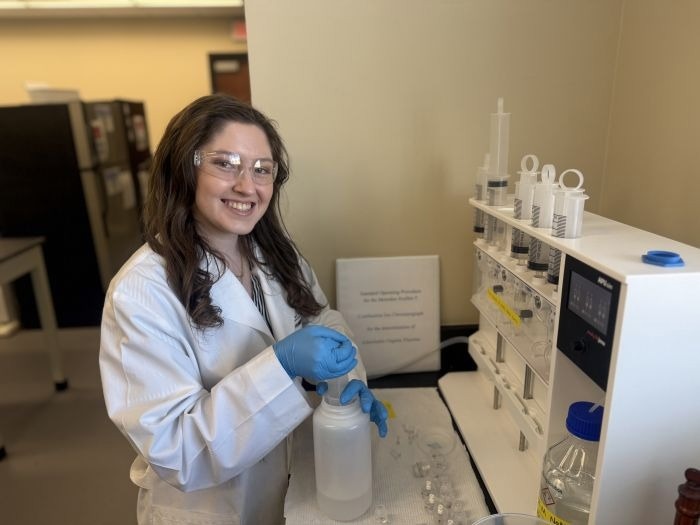
On 23 March 2026, Metrohm USA awarded the 2026 Young Chemist Award to Sarah Ortbal from The University of Alabama for her breakthrough research in PFAS monitoring and treatment. Her work addresses a critical blind spot in environmental remediation by pairing targeted PFAS analysis with Adsorbable Organic Fluorine (AOF) testing. Ortbal’s research demonstrated that non-target AOF analysis can quantify up to 25 times more fluorinated organics in wastewater and surface waters than standard targeted methods alone.
Crucially, she applied this dual-analytical approach to remediation technologies. After using activated carbon to extract PFAS from water, Ortbal evaluated a heat-driven chemical process to break the compounds apart. By tracking the loss of organic fluorine via AOF, her lab tests indicated an overall reduction of the PFAS organic fluorine load. The source does not claim this approach alone verified complete mineralization — AOF mass balance is a strong indicator of destruction but corroborating analytical evidence (e.g. fluoride ion recovery, absence of volatile organofluorine by-products) is typically required to confirm true mineralization., proving that the "forever chemicals" were destroyed rather than just shifted to another medium.
Why it Matters for Environmental Professionals and Their Clients
For Australian contaminated land professionals, this research exposes a significant liability gap in standard site assessments. Relying solely on standard targeted analytical suites (e.g., 28 or 33 PFAS analytes) often leaves a massive portion of the "fluorinated organic load" undetected. These unknown precursors act as "dark matter" in a Conceptual Site Model (CSM) and can unexpectedly oxidize into regulated compounds like PFOS or PFOA years later, causing post-remediation rebound and regulatory headaches.
Under the current PFAS NEMP 3.0 (March 2025), practitioners are expected to rigorously characterize source zones and prioritize treatment over disposal. By integrating non-target screening methods like AOF into groundwater and wastewater monitoring, consultants can give clients a true mass balance of the contamination. Furthermore, as Australian EPAs increasingly demand proof of destruction rather than simple landfilling, Ortbal’s methodology provides a highly defensible framework for site auditors: using AOF to definitively prove the loss of organic fluorine confirms that a thermal or chemical destruction technology has successfully mineralized the contaminants.
References and related sources
- Primary source: www.azom.com
- PFAS National Environmental Management Plan (NEMP)
How iEnvi can help
iEnvi provides specialist consulting services relevant to this topic. Our team includes CEnvP Site Contamination Specialists with experience across contaminated land, groundwater, remediation, ecology, and regulatory compliance.
- iEnvi remediation services
- iEnvi PFAS services
- iEnvi expert services and independent review services
This is an iEnvi Machete news summary. Prepared by iEnvi to summarise the source article for contaminated land, groundwater, remediation, approvals and site risk professionals.
Published: 25 Mar 2026
Need advice on this topic? Speak to an iEnvi expert at info@ienvi.com.au or 1300 043 684, or contact us online.
Need advice on this issue? iEnvi provides practical, senior-led environmental consulting across contaminated land, remediation, ecology and environmental risk.
Team credentials Environmental management plans Contaminated land advice Remediation services Talk to iEnvi