

Overview
On 10 November 2026, at COP31 in Antalya, Türkiye, Australia’s Minister for Climate Change and Energy, Chris Bowen, and Denmark’s Minister for Climate, Energy and Utilities, Samira Nawa, signed a Memorandum of Understanding (MoU) establishing the Australia-Denmark Climate and Energy Partnership. According to the ministerial media release, the partnership creates a bilateral cooperation framework across six priority pillars. These are offshore wind and marine renewable energy, industrial decarbonisation, renewable hydrogen, energy storage and grid integration, energy efficiency, and climate finance and resilience for Pacific Island neighbours.
The signing followed high-level discussions with Her Majesty Queen Mary of Denmark. It builds on clean energy dialogues that began during the Danish Royal Visit to Australia earlier in 2026. Denmark’s relevance to Australia is straightforward. It commissioned the world’s first offshore wind farm at Vindeby in 1991 and has since developed one of the most mature offshore wind regulatory and technical regimes in the world. Australia’s offshore wind sector, by contrast, is still largely at the feasibility stage.
The MoU does not amend any Australian statute, approval pathway or guideline value. Its practical effect will be on expectations: what regulators, proponents, financiers and the community regard as good practice in environmental impact assessment, baseline monitoring and approval conditions. Developers, in-house counsel, council planners and landholders with an interest in offshore wind, cable landfalls, transmission corridors, hydrogen hubs or Safeguard-covered industrial facilities should understand where the partnership is likely to shape technical practice.
Key details
The partnership sets out six priority pillars. The ministerial release describes them as follows:
- Offshore wind and marine renewable energy deployment, drawing on Danish engineering and marine consenting expertise to support Australia’s declared offshore wind areas.
- Industrial decarbonisation, covering low-carbon manufacturing and the transition of heavy industry.
- Renewable hydrogen, focused on accelerating research and commercial scale-up of production.
- Energy storage and grid integration, including sharing regulatory and technical models for utility-scale storage and system reliability.
- Energy efficiency, with deployment of system-wide efficiency technologies across commercial and industrial infrastructure.
- Climate finance and Pacific resilience, jointly supporting developing nations, particularly Pacific Island neighbours, to access international climate finance and strengthen adaptation.
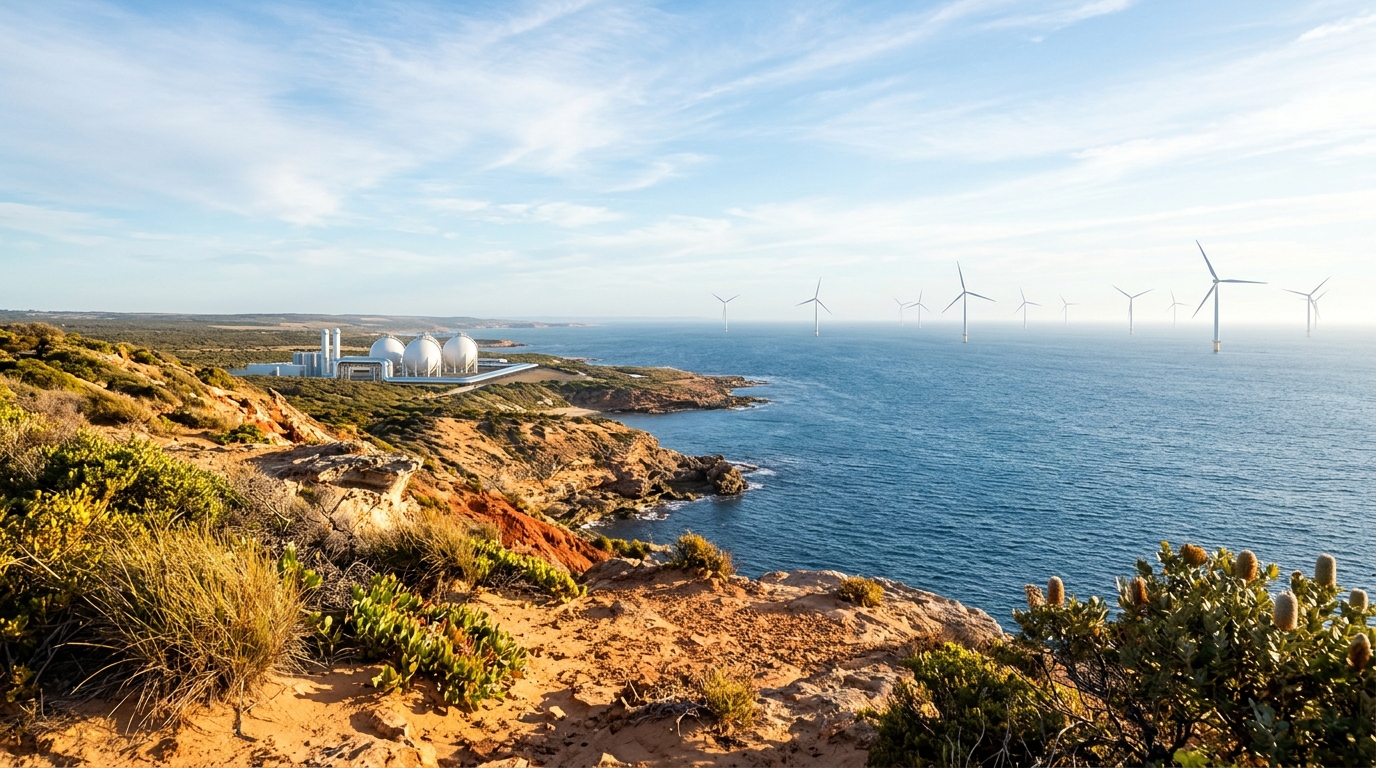
The offshore wind pillar connects directly to the five areas declared for offshore renewable energy under the Offshore Electricity Infrastructure Act 2021 (Cth) between 2022 and 2024. These are Gippsland and the Southern Ocean region off Victoria, the Hunter and Illawarra off New South Wales, and Bunbury off Western Australia. The technical areas where Danish practice is most transferable are pre-construction benthic baseline surveys, underwater noise modelling for pile driving, mitigation for migratory marine fauna including cetaceans and seabirds, and the design of post-construction monitoring programs.
Under the OEI Act, a proponent progresses from a feasibility licence to a commercial licence. Construction cannot begin until the Offshore Infrastructure Regulator, a function performed by NOPSEMA, approves a management plan for the project. Environmental approval runs on a separate track under the Environment Protection and Biodiversity Conservation Act 1999 (Cth). For offshore wind, the controlling provisions typically include the Commonwealth marine area, listed threatened species and ecological communities, and listed migratory species. Cetaceans, seabirds and migratory shorebirds are frequently the species that drive survey effort and approval conditions.
For the industrial decarbonisation pillar, the relevant Commonwealth instruments are the National Greenhouse and Energy Reporting Act 2007 (Cth) and the National Greenhouse and Energy Reporting (Safeguard Mechanism) Rule 2015. The Safeguard Mechanism applies to facilities emitting more than 100,000 tonnes of carbon dioxide equivalent (scope 1) per year. Following the reforms that commenced on 1 July 2023, facility baselines decline by a default 4.9% per year to 2030. These obligations sit within the national targets legislated in the Climate Change Act 2022 (Cth): a 43% reduction in emissions below 2005 levels by 2030 and net zero by 2050.
Australian context
Australia’s offshore renewable energy regime is young. The OEI Act was enacted in 2021, and no commercial-scale offshore wind farm has yet been built in Australian waters. Regulators and proponents are therefore setting precedents in real time, particularly on survey effort, acceptable data gaps and the form of approval conditions. In that setting, an established international regime becomes a natural benchmark. A formal bilateral partnership with Denmark makes it more likely that Danish methods for baseline survey design, noise thresholds and adaptive monitoring will be cited in EPBC Act referrals, submissions on management plans and decision documents.
The Commonwealth environmental approval system is also undergoing reform, including the establishment of a National Environmental Protection Agency. As those reforms are implemented, offshore wind projects in the declared areas will be among the first large infrastructure proposals to be assessed under the revised settings. Projects that can show their baseline and monitoring design matches mature international practice will be better placed to defend their assessment documentation, whichever agency is making the decision.
References and related sources
- Primary source: minister.dcceew.gov.au
- alp.org.au
- capitalmonitor.com.au
- EPBC Act
How iEnvi can help
iEnvi provides specialist consulting services relevant to this topic. Our team includes CEnvP Site Contamination Specialists with experience across contaminated land, groundwater, remediation, ecology, and regulatory compliance.
- iEnvi contaminated land investigation services
- iEnvi remediation and validation services
- iEnvi expert services and independent review services
This is an iEnvi Machete news summary. Prepared by iEnvi to summarise the source article for contaminated land, groundwater, remediation, approvals and site risk professionals.
Published: 11 Nov 2026
Need advice on this topic? Speak to an iEnvi expert at info@ienvi.com.au or 1300 043 684, or contact us online.
Need advice on this issue? iEnvi provides practical, senior-led environmental consulting across contaminated land, remediation, ecology and environmental risk.
Team credentials Contaminated land services Remediation services Groundwater services Talk to iEnvi