
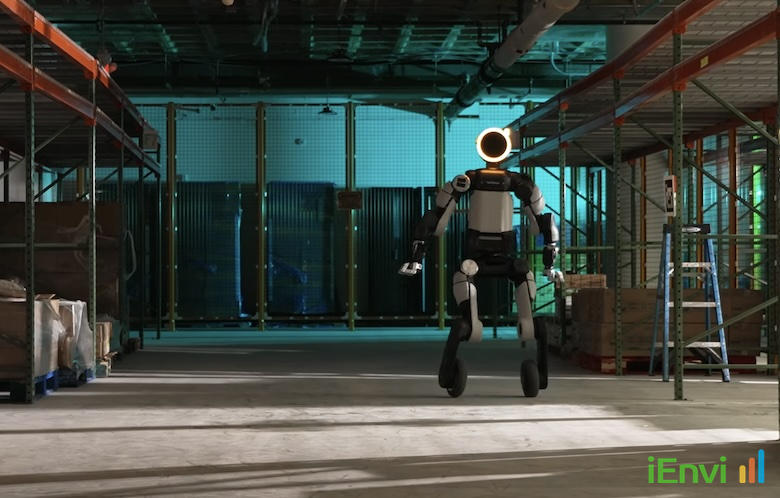
Boston Dynamics tests a wheeled Atlas humanoid
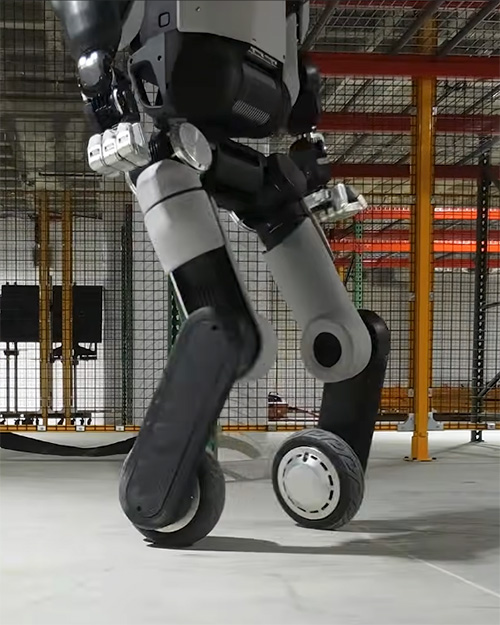
Boston Dynamics has replaced the feet on its fully electric Atlas humanoid with driven wheels. According to The Robot Report (9 November 2026), the change is experimental and is not a product release. It is a research configuration built to stress-test the whole-body control software that keeps the robot balanced. In testing demonstrated by Boston Dynamics controls engineer Andy Wu, the wheeled Atlas performs aggressive manoeuvres, skater-style rolling glides and high-speed pirouettes while holding its balance on an ordinary shop floor.
The wheels attract attention, but the control architecture is the substance. Boston Dynamics combined conventional model-based motor control with a learned whole-body reinforcement learning (RL) policy. The company reports that purely model-based control often fails when a robot meets slip, small variations in friction and floor conditions that cannot be modelled in advance. The learned policy is designed to fill that gap by correcting posture and actuator torque as conditions change.
For Australian environmental professionals and their clients, the relevance is indirect and should be stated carefully. Nobody should expect wheeled humanoids on a remediation site in the near term, and Boston Dynamics has not suggested any environmental use. Developers, asset owners, councils and in-house counsel are increasingly approached with proposals for robotic inspection and monitoring. Understanding the difference between a research demonstration and a deployable field tool, and knowing which questions to ask, is now part of giving sound advice.
How the hybrid control system works
The wheeled Atlas uses a hybrid control topology that pairs physics-based model control with an end-to-end trained RL policy. Model-based control handles the predictable physics of motor actuation. The whole-body RL policy continuously takes in two inputs: velocity commands, which tell the robot where and how fast to move, and real-time proprioceptive feedback, which is the robot’s internal sense of its own joint positions, loads and body state. From these inputs the policy adjusts the whole body, not a single limb, to keep the robot upright and on its intended path.
The specific failure mode Boston Dynamics is targeting is the transition between rolling and sliding. When a wheel loses grip, the forces acting on the robot change abruptly. A model-based controller depends on an accurate prior description of the contact surface, and micro-friction variations, dust, moisture or uneven flooring break that description. According to the report, the learned policy allows the robot to recover its posture and adjust actuator torques instantly during these transitions, rather than relying on a model that has already been invalidated by the surface it is standing on.
Boston Dynamics has been explicit that the wheeled variant is not an upcoming commercial SKU. It is described as an extreme-dynamics research platform intended to push Atlas’s high-torque electric actuators towards their thermal and velocity limits. The control advances developed on this platform are intended to transfer back into the standard bipedal production Atlas and into other systems across the company’s fleet. In practical terms, the first benefit is likely to be better balance and recovery in walking robots, not a new wheeled machine.
The experiment also tests a long-standing design trade-off in robotics, often described as wheels versus legs. Bipedal walking handles stairs, thresholds and multi-level plant rooms, but carries an energy penalty and slower transit on flat, graded ground. Wheeled mobile robots are faster and more energy efficient on level surfaces but struggle with steps and with the mechanical advantage needed for complex manipulation. A hybrid that combines wheeled transport with an articulated humanoid upper body points towards a class of multipurpose mobile manipulators that do not need to copy human walking to achieve human-scale reach and dexterity.
What it means for Australian sites and advisers
This development has no direct regulatory consequence in Australia, and no Australian contaminated land framework refers to robotic platforms. Its relevance is to business and professional services practice: how consultants, site owners and their advisers assess vendor claims and plan for robotic tools when they are eventually proposed. Facilities that environmental teams routinely work on, such as wastewater treatment plants, fuel terminals and tank farms, combine long runs of sealed pavement with stairs, bund walls and grated platforms. That mixed terrain is exactly the problem the wheels versus legs trade-off describes.
Any robot used on an Australian work site is plant for the purposes of work health and safety law. In jurisdictions that have adopted the model Work Health and Safety Act 2011, the person conducting a business or undertaking has duties covering the safe use of plant, and in Victoria equivalent duties sit under the Occupational Health and Safety Act 2004. Where flammable vapours may be present, such as at service station sites, fuel depots or landfill gas zones, electrical equipment must be suitable for the hazardous area classification. In Australia that means the AS/NZS 60079 series and, commonly, IECEx certification. A high-torque electric actuator running near its thermal limit is a relevant consideration in that assessment.
Contaminated land practice adds further obligations if a robot is used to support investigation or monitoring. Sampling for site assessment under the National Environment Protection (Assessment of Site Contamination) Measure, as amended in 2013, relies on Schedule B2 and on standards such as AS 4482.1 for field methods, decontamination and quality control. Laboratory results that will support a Site Audit Statement or regulatory submission must have a defensible chain of custody. None of these frameworks makes special provision for robotic sampling, so any robot-assisted program would need to meet the same requirements for field methods, decontamination, quality control and chain of custody that apply to manual work. Until a vendor can show that, a demonstration such as the wheeled Atlas is best read as a sign of where robot control software is heading, not as a tool ready for site work.
References and related sources
- Primary source: www.therobotreport.com
How iEnvi can help
iEnvi integrates technology and data-driven approaches into environmental consulting. We monitor AI and technology developments that affect how environmental professionals deliver services to clients.
This is an iEnvi Machete news summary. Prepared by iEnvi to summarise the source article for environmental professionals tracking AI, data, and technology developments that affect consulting and project delivery.
Published: 11 Nov 2026
Need advice on this topic? Speak to an iEnvi expert at info@ienvi.com.au or 1300 043 684, or contact us online.
Need advice on this issue? iEnvi provides practical, senior-led environmental consulting across contaminated land, remediation, ecology and environmental risk.
Contaminated land services Remediation services Service station environmental advice Talk to iEnvi