
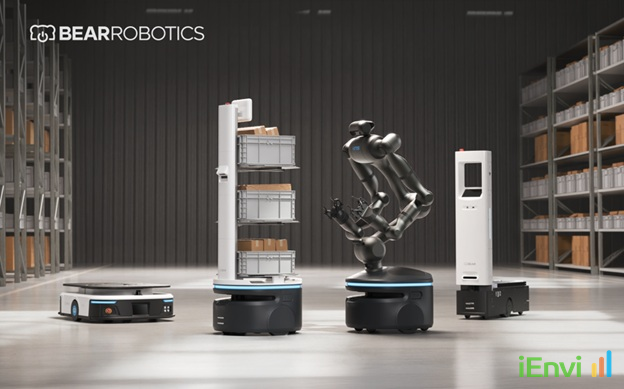
Bear Robotics acquires Kinisi Robotics to complete its end-to-end Physical AI platform
Overview
Bear Robotics announced it had signed a definitive agreement to acquire Kinisi Robotics, a Bristol-based developer of humanoid robotic platforms and manipulation AI. The deal brings together two complementary capabilities that have, until now, defined the ceiling of commercial robotics deployment: Bear’s large-scale autonomous navigation and logistics fleet, and Kinisi’s advanced manipulation intelligence. For professionals managing physical operations across logistics, facility management, healthcare, and industrial sectors, this acquisition represents a meaningful inflection point in what robotic systems can actually do on a worksite or in a built environment.
Bear Robotics currently operates a commercially deployed fleet of more than 16,000 service robots across hospitality, healthcare, retail, and logistics environments. Those robots have been effective at autonomous navigation and passive transport, moving items from point A to point B without human assistance. What they have lacked is the ability to physically interact with objects in an unstructured environment. Kinisi’s KR1 humanoid platform and its proprietary Vision-Language-Action (VLA) models directly address that limitation, giving Bear’s fleet the functional equivalent of hands and the contextual intelligence to use them.
The strategic significance of the transaction extends beyond the two companies involved. It reflects a broader consolidation trend in the embodied AI sector, where the competitive advantage is shifting from solving the navigation problem, which is now largely considered solved, to solving the manipulation problem. John Ha, Founder and CEO of Bear Robotics, described the rationale directly: “Bear was built to put robots to work in the real world. Kinisi completes that platform. Its manipulation AI is the layer that lets our robots move from navigating and delivering to actually handling the work in front of them.” Brennand Pierce, founder and CEO of Kinisi Robotics and a former co-founder of Bear Robotics, will rejoin Bear’s leadership team as Chief Robotics Officer following the close of the transaction.
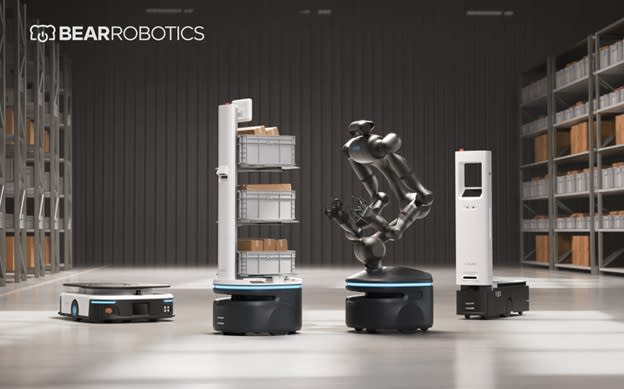
Key details of the Bear Robotics and Kinisi Robotics acquisition
The centrepiece of the acquisition is Kinisi’s KR1 platform, a wheeled semi-humanoid robot designed specifically for picking, sorting, and moving objects across complex industrial and logistics environments. Unlike fully bipedal humanoid robots, the wheeled base of the KR1 is engineered for operational reliability and energy efficiency in real-world commercial settings, where the floor-based mobility demands of warehouses, hospital corridors, and logistics hubs differ substantially from uneven outdoor terrain. The manipulation capability is delivered through the upper-body humanoid configuration, which is where Kinisi’s core AI investment is concentrated.
A technically significant aspect of the KR1 is that it runs its Vision-Language-Action model and its Robot Foundation Model entirely onboard, without reliance on cloud infrastructure. This is a deliberate architectural decision with practical consequences. Removing cloud dependency eliminates latency between perception and action, which matters enormously when a robot is making real-time decisions about how to grasp an irregularly shaped object or respond to an unexpected item on a conveyor. It also addresses two concerns that are increasingly relevant to enterprise clients: data privacy and operational continuity in environments with poor or unreliable network connectivity, including deep warehouse spaces, underground facilities, and rural or remote industrial sites.
Kinisi’s training methodology is another technically differentiated element. The company uses a low-cost, robot-agnostic glove to capture human hand manipulation demonstrations. This approach decouples the process of training the AI model from the operational use of the physical robot hardware. Rather than requiring the robot itself to perform thousands of repetitive training cycles, human operators wearing the glove generate the manipulation data. This allows Bear to scale its physical training dataset rapidly and cost-effectively, without consuming robot uptime or requiring specialised robotics facilities. The robot-agnostic nature of the glove means the captured demonstrations are not tied to a single hardware platform, which supports Bear’s intention to integrate Kinisi’s manipulation models across its existing and future robot fleet.
The most structurally important technical detail for understanding Bear’s long-term competitive position is the compounding data loop created by integrating Kinisi’s models with the existing 16,000-plus robot fleet. Each robot in active commercial deployment generates a continuous stream of real-world environmental data, covering spatial layouts, object variability, human interaction patterns, and edge cases that simulated environments cannot reliably reproduce. As Kinisi’s manipulation models are trained against this volume of real-world data, their performance improves at a rate that competitors relying on simulation or smaller test fleets cannot easily match. This data network effect is the structural moat that Bear is constructing through the acquisition.
Australian context: implications for physical operations, logistics, and professional services
Australia’s logistics, resources, and facility management sectors have been early adopters of autonomous mobile robots for navigation and transport tasks, particularly in large-format distribution centres, mining support facilities, and aged care environments. The Australian robotics market has grown substantially over the past three years, driven by persistent labour shortages across logistics, healthcare, and hospitality, combined with
References and related sources
- Primary source: uk.finance.yahoo.com
- investing.com
- kinisi.com
How iEnvi can help
iEnvi integrates technology and data-driven approaches into environmental consulting. We monitor AI and technology developments that affect how environmental professionals deliver services to clients.
This is an iEnvi Machete news summary. Prepared by iEnvi to summarise the source article for environmental professionals tracking AI, data, and technology developments that affect consulting and project delivery.
Published: 22 Jun 2026
Need advice on this topic? Speak to an iEnvi expert at info@ienvi.com.au or 1300 043 684, or contact us online.
Need advice on this issue? iEnvi provides practical, senior-led environmental consulting across contaminated land, remediation, ecology and environmental risk.