
Overview
In an exclusive interview with Forbes published on 2 July 2026, Alberto Rodriguez, Director of Robot Behavior for Atlas at Boston Dynamics, revealed that the company’s fifth-generation electric Atlas humanoid robot achieves “almost an order of magnitude reduction in complexity compared to the previous generation.” The claim, made directly by Rodriguez, describes a deliberate engineering strategy to slash both total part count and the number of unique components, resulting in faster assembly, lower production costs, and meaningfully higher hardware reliability. For industrial operations and professional services sectors that have watched physical AI development from a cautious distance, this is a material shift rather than an incremental update.
The practical significance of this development extends well beyond robotics enthusiasts. The previous generations of Atlas were high-cost research platforms, historically priced upwards of $200,000 per unit, and were largely confined to laboratory demonstrations. The fifth-generation electric Atlas represents a deliberate pivot toward commercial scalability, supported by Hyundai’s commitment to establish a dedicated manufacturing facility capable of producing 30,000 Atlas units annually by 2028. Hyundai Mobis, the automotive components arm of the Hyundai group, is reported to be handling actuator production, drawing on automotive-grade supply chain discipline to achieve the cost and volume targets required for enterprise deployment.
For Australian business leaders, operations managers, and professional services firms working in industrial, logistics, and technically demanding field environments, the timing of this development is worth noting. The convergence of dramatically reduced hardware complexity, automotive-scale manufacturing ambition, and integration with advanced AI reasoning models from Google DeepMind creates a platform that is qualitatively different from anything previously available in the bipedal robotics category. The question is no longer whether humanoid robots will enter industrial workspaces, but how quickly the economics and operational readiness will align.
Key details of the Boston Dynamics Atlas fifth-generation platform
The central technical claim from Alberto Rodriguez is that the fifth-generation electric Atlas has “way, way less parts, and way less unique parts,” and that “the process of manufacturing it is much faster and simpler, which leads to higher reliability and lower cost.” An order of magnitude reduction in complexity, if taken at face value, suggests a reduction approaching a factor of ten compared to the previous generation. Rodriguez was explicit that the team achieved the same level of performance as earlier generations, or higher, through this simplification rather than despite it. This is a significant engineering claim because it inverts the conventional assumption that capability and complexity scale together in robotics hardware.
The operational specifications of the fifth-generation Atlas are designed for real industrial environments rather than controlled laboratory conditions. The platform is rated water-resistant and capable of operating across a temperature range of -20 degrees Celsius to 40 degrees Celsius. This range covers the conditions found in unconditioned warehouses, heavy manufacturing plants, cold storage facilities, and a broad range of Australian outdoor industrial environments across seasonal extremes. The environmental rating is not a minor detail. Previous humanoid platforms have been fragile and sensitive to dust, moisture, and temperature variation, which has been a consistent barrier to practical deployment outside of carefully managed settings.
Rodriguez also addressed the longstanding industry debate about whether bipedal locomotion is worth the mechanical complexity it adds compared to wheeled platforms. His position is that the complexity penalty of bipedal systems is substantially lower than the industry has assumed, while the advantages in manoeuvrability and footprint within human-centric built environments are considerable. Bipedal robots can navigate stairwells, narrow aisles, uneven terrain, and spaces designed around the proportions and movement of people, without requiring infrastructure modifications that wheeled or tracked alternatives would demand.
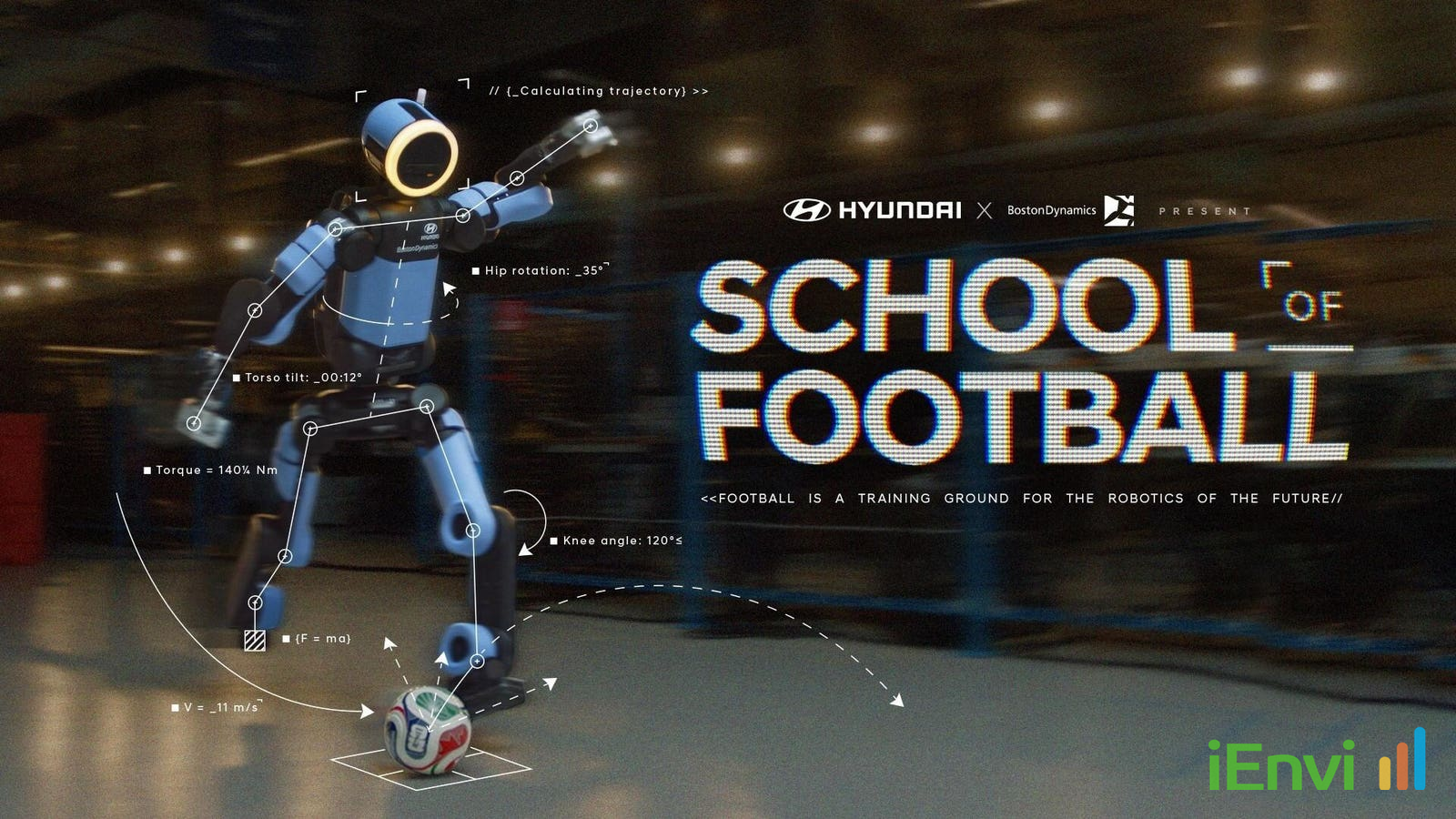
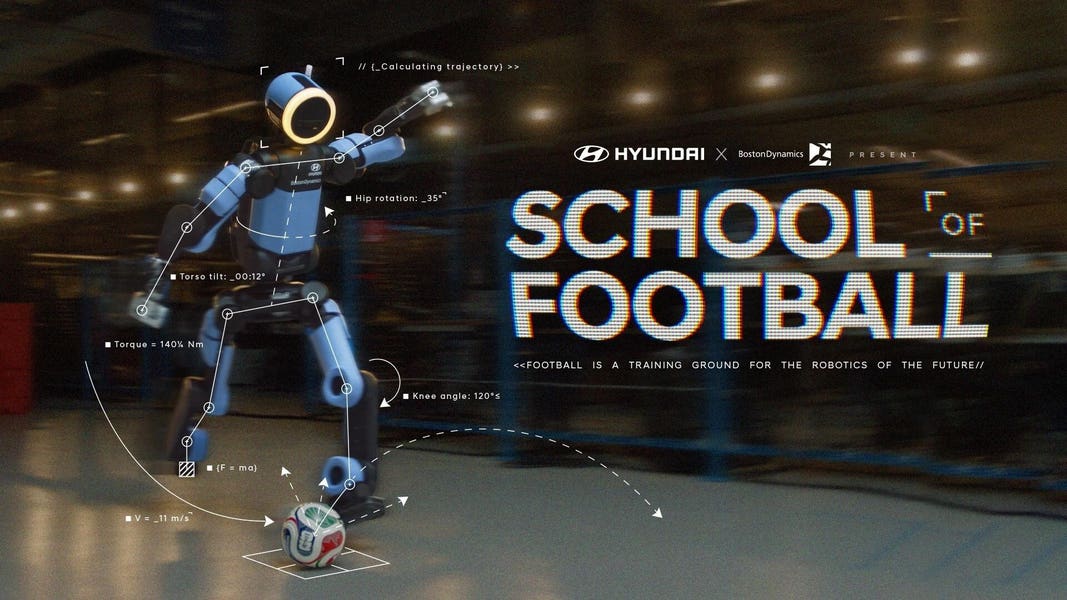
To demonstrate the platform’s physical intelligence training methodology, Boston Dynamics and Hyundai showcased Atlas executing a “Ghost Rabona,” a cross-legged soccer kick requiring exceptional balance, timing, and dynamic body control. The movement was trained using human motion capture data processed through Blender and retargeted to the Atlas frame, combined with high-speed reinforcement learning. The significance of this demonstration is not the athletic feat itself but the training pipeline it illustrates. Rather than manually programming robot movements through conventional code, the team used motion capture retargeting and reinforcement learning to achieve rapid skill acquisition. Google DeepMind’s advanced reasoning foundation models are integrated into the platform, providing higher-level task reasoning that sits above the physical motion layer.
Australian business and professional services context for physical AI adoption
Australia presents a specific set of conditions that make the commercial viability trajectory of humanoid robotics particularly relevant. The country faces persistent labour shortages in technically demanding roles, high wage costs relative to comparable economies, geographically dispersed industrial operations, and a regulatory environment that increasingly scrutinises workplace safety in hazardous settings. Industrial sectors including mining, resources, logistics, construction, and utilities have each identified autonomous and semi-autonomous platforms as a medium-term operational priority.
References and related sources
- Primary source: www.forbes.com
- robozaps.com
- gasgoo.com
- hyundai.com
- 80.lv
How iEnvi can help
iEnvi integrates technology and data-driven approaches into environmental consulting. We monitor AI and technology developments that affect how environmental professionals deliver services to clients.
This is an iEnvi Machete news summary. Prepared by iEnvi to summarise the source article for environmental professionals tracking AI, data, and technology developments that affect consulting and project delivery.
Published: 03 Jul 2026
Need advice on this topic? Speak to an iEnvi expert at info@ienvi.com.au or 1300 043 684, or contact us online.
Need advice on this issue? iEnvi provides practical, senior-led environmental consulting across contaminated land, remediation, ecology and environmental risk.