
Overview
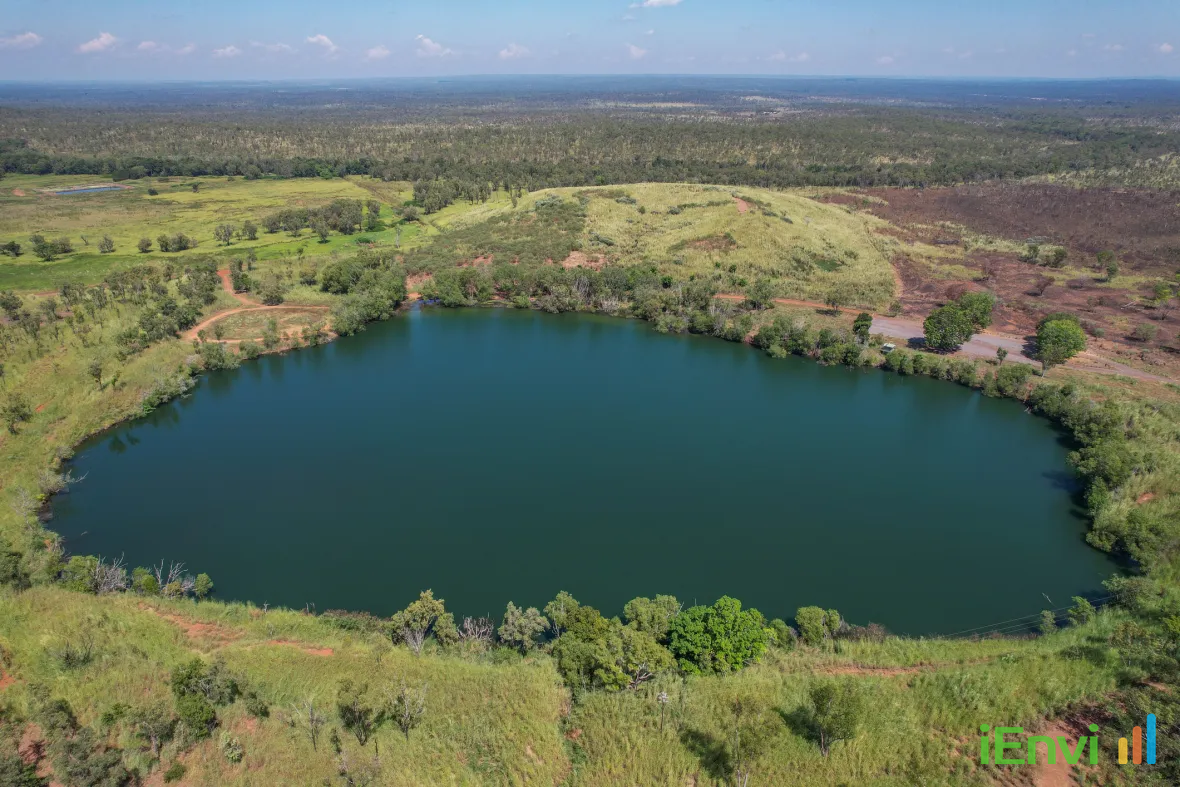
Charles Darwin University (CDU) has published what it describes as the first multi-trophic study of how metals from the former Rum Jungle uranium and copper mine move through the Finniss River food web in the Northern Territory. The study, led by CDU researcher Isabel Ely and published in the Journal of Hazardous Materials Advances (2026), tracked copper (Cu), manganese (Mn), zinc (Zn), arsenic (As), lead (Pb) and cadmium (Cd) from primary producers through to top predators such as barramundi (Lates calcarifer). It found the highest metal concentrations at the base of the food web, in filamentous green algae (Spirogyra) and detritus, and in benthic invertebrates such as freshwater mussels. Fish contained comparatively low concentrations of the non-essential elements.
Rum Jungle, near Batchelor, was Australia’s first large-scale uranium mine and closed in 1971. Water quality and individual aquatic species downstream of the site have been monitored for decades, but the food web had not been examined as a connected system. CDU announced the findings on 12 November 2026. According to the authors, filamentous algae and detritus had never previously been monitored as routine contamination matrices in the Finniss River catchment.
The study matters beyond the Top End. Many Australian mine closure, acid and metalliferous drainage (AMD) and legacy metals programmes rely mainly on water grab samples and, where human health is in question, fish tissue. If the metal burden in a receiving environment sits mostly in algae, detritus and benthic invertebrates, programmes that do not sample those matrices can understate what the system is carrying. For site owners, developers, councils and lawyers dealing with metals impacts on waterways, this raises the question of whether an existing monitoring dataset actually measures the right part of the ecosystem.
Key details
The CDU study assessed six metals and metalloids across multiple trophic levels of the Finniss River: Cu, Mn, Zn, As, Pb and Cd. Samples spanned basal resources (filamentous algae and detritus), benthic invertebrates (including freshwater mussels) and fish up to barramundi. Concentrations were generally highest in basal resources and benthic invertebrates. Freshwater mussels stood out for Cu and Mn, both of which are found in drainage from the Rum Jungle site.
Fish carried comparatively low concentrations of non-essential elements such as Pb, As and Cd. The authors describe this pattern as consistent with trophic dilution, where contaminant concentrations decrease rather than increase with each step up the food chain. This is the opposite of biomagnification, the process seen with persistent organic contaminants such as some PFAS and organochlorine pesticides. The reported findings describe relative concentrations across trophic levels. They are not, on their own, a food safety assessment for people who catch and eat fish from the river.
The most practically useful finding concerns matrix selection. Filamentous green algae and detritus act as biological sinks and transfer points for chronic metalliferous contamination, yet neither had been a routine monitoring matrix in the catchment. Water chemistry captures conditions at the moment of sampling. Algae respond relatively quickly to changes in dissolved metal concentrations, while detritus integrates exposure over a longer period. Together they provide a record of bioavailable metal that a grab sample cannot.
The timing aligns with active remediation. The Rum Jungle rehabilitation is being delivered by the Northern Territory Government with Australian Government funding, in partnership with Traditional Owners. The current stage of works involves relocating high-sulfide waste rock and backfilling open pits, alongside water treatment. Lower trophic biological data offers a direct way to test whether these engineering and treatment controls reduce the amount of metal entering the Finniss River food web, rather than simply reducing concentrations measured at a compliance point.
Australian context
Aquatic ecological risk from metals in Australia is assessed primarily under the Australian and New Zealand Guidelines for Fresh and Marine Water Quality (ANZG 2018), a living, web-based framework. According to the ANZG, new bioavailability-based freshwater default guideline values (DGVs) for copper, nickel and zinc were published on 10 September 2026, together with a new tiered assessment framework and a metal bioavailability tool. The freshwater DGVs for arsenic, cadmium, lead and manganese still date from the ANZECC/ARMCANZ guidelines of 2000. Four of the six metals in the CDU study are therefore assessed against values more than 25 years old, which places more weight on site-specific lines of evidence such as biota data.
ANZG supports a weight-of-evidence approach in which water chemistry against DGVs is one line of evidence alongside sediment quality, toxicity testing and biological indicators. The CDU findings show what biota data can add: evidence of where metals accumulate and whether they move up the food chain. For contaminated land, the National Environment Protection (Assessment of Site Contamination) Measure 1999, as amended in 2013 (NEPM 2013), provides Schedule B5a (Guideline on Ecological Risk Assessment) and Schedule B5b (Guideline on Methodology to Derive Ecological Investigation Levels in Contaminated Soils). Both schedules focus mainly on terrestrial ecosystems. Where receptors include aquatic or riparian food webs, ANZG and site-specific ecological risk assessment do most of the work. Trophic transfer data such as the CDU dataset can inform the derivation of site-specific guideline values (ANZG) or site-specific ecological investigation levels (NEPM), although how it is used depends on the derivation method adopted.
In the Northern Territory, the Environment Protection Act 2019 (NT) governs environmental regulation and has been amended to bring mining activities under an environmental licensing framework administered by the Northern Territory Environment Protection Authority. For legacy and operating mine sites in the Territory, biota monitoring of the kind used in the CDU study could support licence conditions and closure criteria that track ecological outcomes as well as water quality.
References and related sources
- Primary source: www.cdu.edu.au
- targetednews.com
- nt.gov.au
- NEPM Assessment of Site Contamination
- ANZG Water Quality Guidelines
How iEnvi can help
iEnvi provides specialist consulting services relevant to this topic. Our team includes CEnvP Site Contamination Specialists with experience across contaminated land, groundwater, remediation, ecology, and regulatory compliance.
- iEnvi remediation services
- iEnvi contaminated land investigation services
- iEnvi expert services and independent review services
This is an iEnvi Machete news summary. Prepared by iEnvi to summarise the source article for contaminated land, groundwater, remediation, approvals and site risk professionals.
Published: 14 Nov 2026
Need advice on this topic? Speak to an iEnvi expert at info@ienvi.com.au or 1300 043 684, or contact us online.
Need advice on this issue? iEnvi provides practical, senior-led environmental consulting across contaminated land, remediation, ecology and environmental risk.
Team credentials Ecological risk assessment Contaminated land advice Remediation services Talk to iEnvi