
EPA Victoria Cracks Down on Construction Site Stormwater Runoff
EPA Victoria recently penalised a residential construction company $2,035 for failing to manage sand and cement runoff during a rainstorm at a building site in Lara. The builder, based in Greenvale, was penalised during an active residential construction compliance programme targeting builders and developers across the state. Martha-Rose Loughnane, the EPA Southwest Regional Manager, issued a clear warning to the sector, stating that anything blowing or flowing offsite remains the responsibility of the polluter. This enforcement action highlights a shifting regulatory posture where passive boundary controls and unmonitored site conditions are no longer tolerated by environmental regulators.
For Australian environmental professionals, developers, infrastructure operators, and local government councils, this penalty represents more than a minor administrative fine. It highlights a strict, zero-tolerance approach to perimeter management and construction site compliance under the modernised environmental protection laws. The incident demonstrates that the regulators are actively auditing residential, commercial, and civil development sites to verify that preventative controls are functioning prior to major meteorological events.
Site contamination specialists, environmental lawyers, and municipal planners must recognise that the definition of pollution and waste escape is being interpreted broadly. Sediment runoff, tracked soils, and construction material migration across site boundaries are being prosecuted under streamlined regulatory instruments. This shifting compliance environment demands a reassessment of how construction management plans are drafted, implemented, and maintained on active and inactive work sites alike.
Sediment Control and Compliance Requirements for Builders
The enforcement action carried out by EPA Victoria was executed under section 115(1) of the Environment Protection Act 2017, which governs the unlawful deposit of litter. The penalty notice issued to the Greenvale builder carried a direct financial penalty of $2,035. This prosecution was part of a targeted, proactive compliance campaign conducted by the state authority. It represents the fourth major penalty issued to construction firms within this specific residential compliance programme, indicating a systemic effort by the EPA to enforce strict boundary controls across the building sector.
The technical failure at the Lara site occurred because sand and cement stockpiles were left exposed and uncontained during an unattended period, which coincided with a rainstorm. In the absence of primary physical barriers, stormwater runoff mobilised the loose material, transporting cementitious waste and fine sands off the property boundaries and into the public stormwater infrastructure. Under Victorian environmental law, the fact that the site was unstaffed at the time of the storm does not act as a defence or a mitigating factor. Rather, it highlights a failure to implement effective erosion and sediment control measures that remain functional without manual intervention.
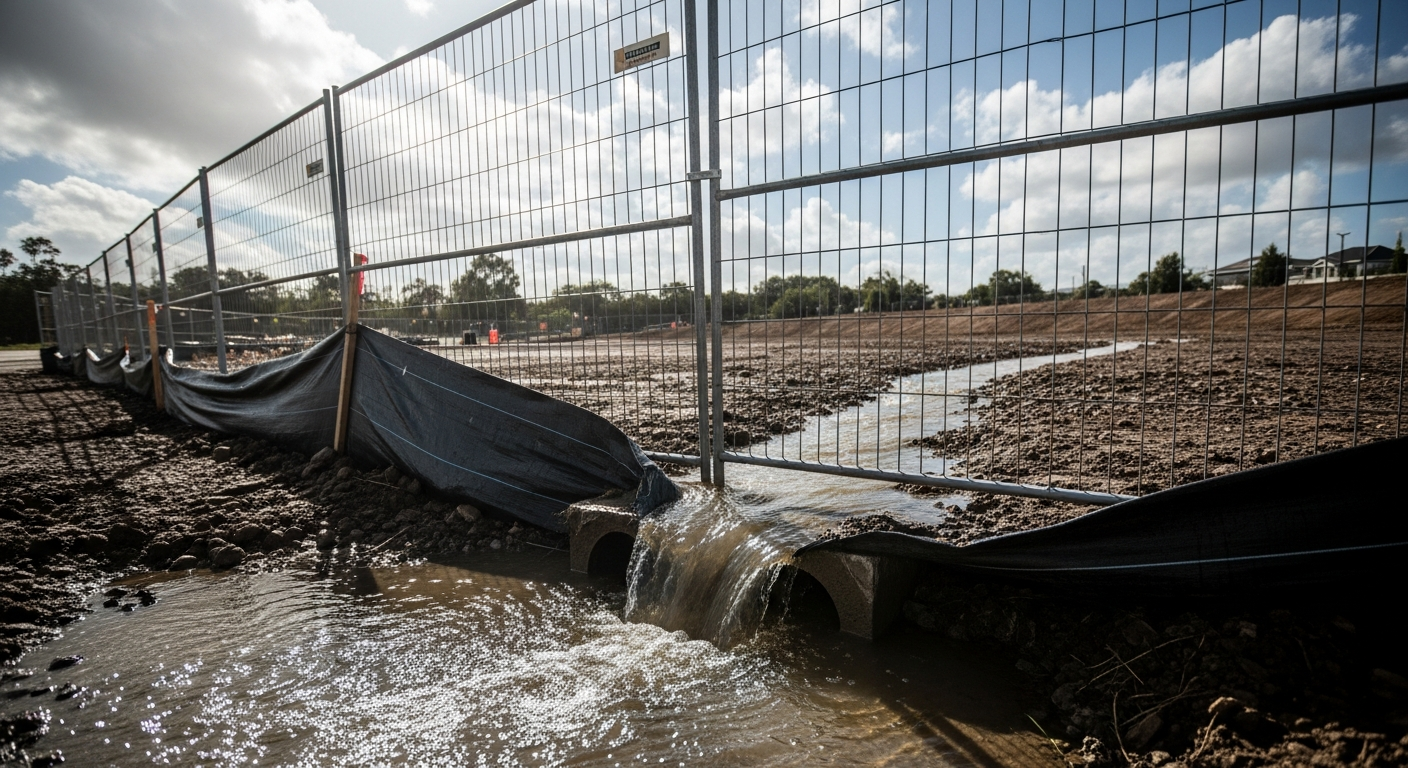
To understand the regulatory expectations, practitioners must reference EPA Victoria Publication 1834, titled Civil Construction, Building and Demolition Guide. This document serves as the official state of knowledge under the state’s environmental protection framework. Publication 1834 details the specific containment standards required for construction sites, including the mandate that stockpiles must be located away from drainage lines, concentrated flow paths, and site boundaries. It also outlines the requirement for sediment fences, straw bales, or geo-synthetic barriers to be properly installed, trenched into the soil, and capable of withstanding localised hydraulic loading during high-intensity rainfall events.
Crucially, the regulator’s enforcement scope extends to all forms of material transport across the site boundary. This includes sediment tracking, where damp soil or clay adheres to the tyres of heavy vehicles and is subsequently deposited onto public roads. Under the current interpretation of the Environment Protection Act 2017, this tracked sediment is classified as actionable pollution once it leaves the site boundary, as it can easily wash into stormwater grates during subsequent rain events. Therefore, physical controls such as rumble grids, aggregate wash-down bays, and street-sweeping protocols are treated not as optional best-practice measures, but as primary compliance requirements.
National Harmonisation of Environmental Duties Across Australia
The enforcement action in Victoria reflects a broader, national harmonisation of environmental protection duties that directly influences how site assessments and construction management are conducted across Australia. The core of this regulatory approach is the General Environmental Duty (GED) established under Section 25 of the Victorian Environment Protection Act 2017. The GED requires any person or entity conducting an activity that poses a risk of harm to human health or the environment to minimise those risks so far as reasonably practicable. In the context of site construction and civil works, failing to secure loose materials against wind, gravity, and rain is increasingly prosecuted as a direct breach of this statutory duty, independent of whether a major pollution incident occurs.
This preventative, duty-based framework is mirrored in other Australian states, creating a unified regulatory expectation for developers and environmental consultants. For example, in New South Wales, the Protection of the Environment Operations (POEO) Act 1997 contains strict provisions under Section 120 prohibiting the pollution of waters, which carries substantial penalties for corporations and individuals alike. In Queensland, the Environmental Protection Act 1994 imposes a General Environmental Duty under Section 319, requiring operators to take all reasonable and practicable measures to prevent or minimise environmental harm from their activities. These parallel legislative frameworks mean that construction firms operating across state lines must align their site management practices with a consistent set of preventative obligations, regardless of jurisdiction. Environmental consultants and project managers are therefore expected to apply a unified compliance benchmark, treating sediment control, stockpile containment, and boundary protection as baseline requirements on every project nationally.
References and related sources
- Primary source: www.epa.vic.gov.au
- EPA Victoria
How iEnvi can help
iEnvi provides specialist consulting services relevant to this topic. Our team includes CEnvP Site Contamination Specialists with experience across contaminated land, groundwater, remediation, ecology, and regulatory compliance.
- iEnvi contaminated land investigation services
- iEnvi remediation and validation services
- iEnvi expert services and independent review services
This is an iEnvi Machete news summary. Prepared by iEnvi to summarise the source article for contaminated land, groundwater, remediation, approvals and site risk professionals.
Published: 17 Jun 2026
Need advice on this topic? Speak to an iEnvi expert at info@ienvi.com.au or 1300 043 684, or contact us online.
Need advice on this issue? iEnvi provides practical, senior-led environmental consulting across contaminated land, remediation, ecology and environmental risk.
Team credentials Contaminated land services Remediation services Groundwater services Talk to iEnvi