
EPA Victoria Enforcement: Smoke Management Failures in E-waste Recycling
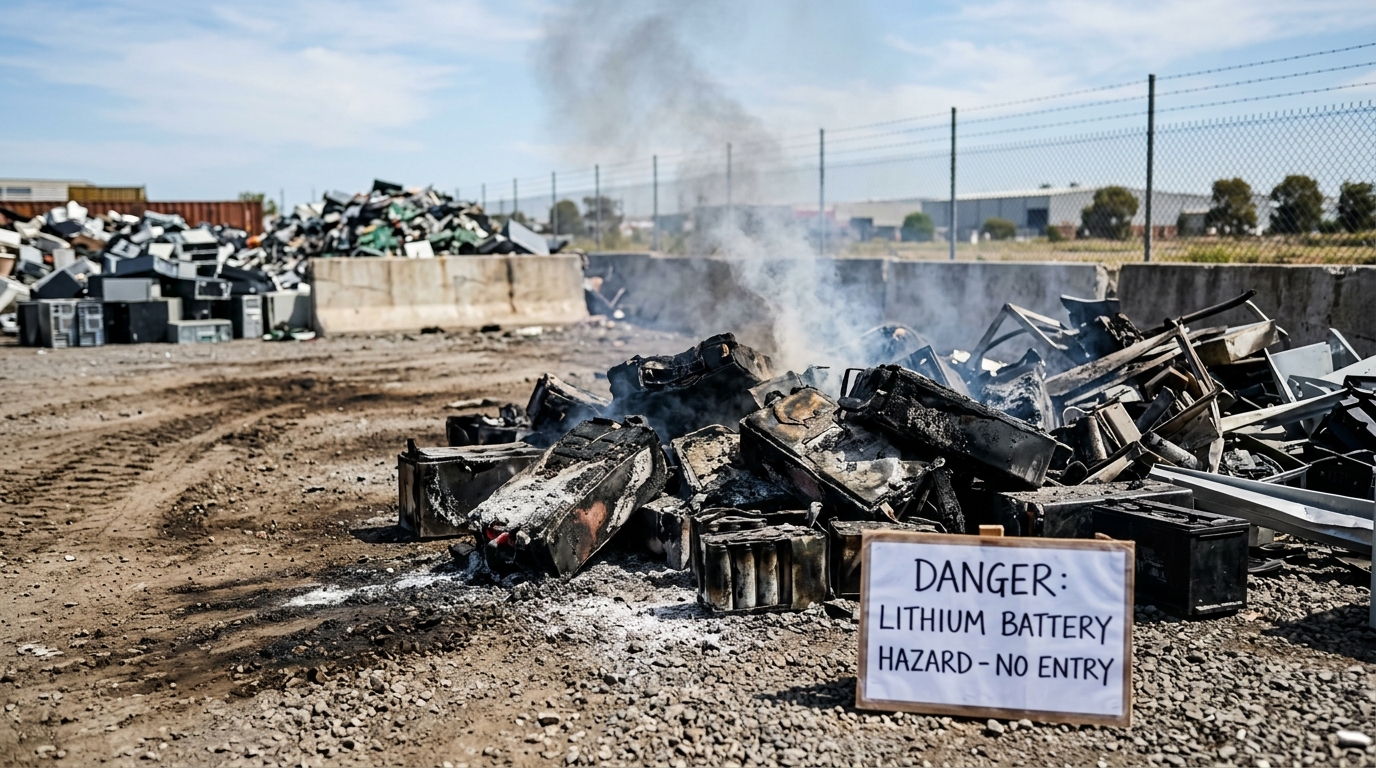
On 30 April 2026, EPA Victoria announced a $10,000 fine against ReSource Pty Ltd, a recycling company based in Derrimut, following a fire at its Swann Street facility on 4 March 2026. CCTV footage captured the fire igniting within recycling material suspected to contain lithium-ion batteries. The enforcement action is notable not because the fire itself caused catastrophic damage, but because the facility’s response exposed two distinct compliance failures that regulators are now making an example of across the waste and resource recovery sector.
The fine was issued on two grounds. ReSource failed to promptly notify EPA Victoria of the incident as required under its EPA Permissions, and the facility lacked adequate smoke management controls. Unfiltered smoke, potentially carrying toxic combustion products from burning lithium-ion cells, discharged into the surrounding environment through open roller doors and ceiling vents. The fact that the facility’s internal sprinkler system activated and controlled the fire is almost beside the point from a regulatory perspective. Active suppression addresses the immediate fire hazard; it does nothing to capture or filter the toxic plume that accompanies a lithium-ion battery thermal runaway event.
What makes this enforcement action particularly significant is the broader pattern it reveals. EPA Victoria explicitly noted this was the facility’s third fire in the 2026 calendar year and warned that further regulatory action remains available to the regulator. For environmental consultants advising operators in the waste, resource recovery, and e-waste sectors, this case is a direct signal that EPA Victoria is scrutinising not just fire suppression adequacy, but the complete emissions management picture that surrounds any combustion event at a facility handling combustible recyclable and waste materials.
Key details: the regulatory breaches, penalty, and technical failures at Derrimut
The $10,000 penalty issued to ReSource Pty Ltd was grounded in two separate failures under the Environment Protection Act 2017 (Vic). The first was a breach of EPA Permissions conditions requiring timely notification of a pollution incident. EPA Permissions, which function as the operating licence framework under Victoria’s modernised environment protection regime, impose explicit obligations on licence holders to report incidents promptly. The threshold for notification is not contingent on whether harm has actually occurred or whether the fire was fully extinguished. The obligation to notify is triggered by the incident itself, and delays in reporting are treated as a standalone contravention regardless of the environmental outcome.
The second and technically more complex breach relates to the facility’s failure to implement adequate smoke management controls. Lithium-ion battery fires, particularly during thermal runaway, generate a cocktail of hazardous combustion products. These include hydrogen fluoride, hydrogen cyanide, carbon monoxide, and fine particulate matter at sizes that penetrate deep into the respiratory system. When a facility relies entirely on passive building openings such as roller doors and ceiling vents for ventilation, there are no controls in place to capture, filter, or treat that plume before it leaves the facility boundary. Under the General Environmental Duty established by section 25 of the Environment Protection Act 2017 (Vic), persons engaged in activities that pose risks of harm to human health or the environment are required to minimise those risks so far as is reasonably practicable. Uncontrolled offsite discharge of unfiltered combustion gases from burning e-waste is, by any reasonable interpretation, inconsistent with that duty.
The Management and storage of combustible recyclable and waste materials guideline (EPA Victoria, 2021), which applies across jurisdictions and informs facility design and operational risk management at sites handling materials prone to spontaneous combustion or fire escalation, provides guidance on managing fire risk in storage and processing areas. These guidelines address separation distances, storage configuration, and suppression systems, but the ReSource case highlights that compliance with CRWM guidelines is insufficient on its own if facilities have not addressed the secondary emissions pathway. AS/NZS 5377, which covers the collection, storage, transport and treatment of end-of-life electrical and electronic equipment, similarly imposes requirements around the management of hazardous materials present in e-waste streams. Lithium-ion batteries are specifically identified as a high-risk item within e-waste streams under that standard because of their propensity for thermal runaway and the toxic nature of their combustion products.
The three-fires-in-one-year pattern is also technically significant. Repeated ignition events at a single facility strongly suggest that the root cause has not been addressed between incidents. This could indicate inadequate pre-processing screening to remove battery-containing items from the general recycling stream, insufficient storage segregation, inadequate hot-work and static controls, or a combination of all three. EPA Victoria’s statement that further regulatory action remains an option is consistent with an escalating compliance posture. Facilities with repeated incidents face the prospect of licence conditions being tightened, operations being suspended, or in serious cases, prosecution under the Act rather than infringement notices.
Australian context: how this enforcement action fits into national waste sector regulation and CRWM obligations
Victoria’s Environment Protection Act 2017 represents one of the most substantive restatements of environmental law in Australia over the past decade. The introduction of the General Environmental Duty as a standalone, enforceable obligation fundamentally shifted the compliance baseline for all persons conducting activities with the potential to cause harm to human health or the environment. Rather than prescribing specific controls for every scenario, the duty requires duty holders to proactively assess risk and implement proportionate controls. In the context of facilities handling e-waste or mixed recyclables containing lithium-ion batteries, this means that the absence of a regulatory incident in the past does not establish compliance. The duty is ongoing, and a fire event that results in uncontrolled toxic emissions is direct evidence that the duty was not being met.
References and related sources
- Primary source: www.epa.vic.gov.au
- NEPM Assessment of Site Contamination
- EPA Victoria
How iEnvi can help
iEnvi provides specialist consulting services relevant to this topic. Our team includes CEnvP Site Contamination Specialists with experience across contaminated land, groundwater, remediation, ecology, and regulatory compliance.
- iEnvi contaminated land investigation services
- iEnvi remediation and validation services
- iEnvi expert services and independent review services
This is an iEnvi Machete news summary. Prepared by iEnvi to summarise the source article for contaminated land, groundwater, remediation, approvals and site risk professionals.
Published: 04 May 2026
Need advice on this topic? Speak to an iEnvi expert at info@ienvi.com.au or 1300 043 684, or contact us online.
Need advice on this issue? iEnvi provides practical, senior-led environmental consulting across contaminated land, remediation, ecology and environmental risk.
Contaminated land services Remediation services Groundwater services Ecology consulting Talk to iEnvi