
EPA Victoria Targets Agricultural Waste Burning
EPA Victoria has issued a $10,176 infringement notice and an Environmental Action Notice (EAN) after a targeted compliance sweep of 12 large-scale agricultural and viticultural properties across the Sunraysia and Mallee regions of north-west Victoria. The enforcement action, confirmed by the regulator on 3 August 2023, centres on illegal burning of treated timber, tyres and mixed waste on farmland near Robinvale, with EPA officers linking the practice directly to soil contamination and groundwater leaching risks affecting neighbouring properties.
For environmental professionals working across regional and rural land in Australia, this matters because it confirms that state regulators are actively resourcing proactive, unannounced regional audits of agricultural land rather than relying solely on complaint-driven investigation. Farm waste burning has historically operated in a compliance blind spot, particularly on properties that predate current waste and hazardous substance regulations. This case demonstrates that historical or ongoing burning of CCA-treated timber and mixed waste is now a live enforcement priority, with direct consequences for landholders, corporate operators, and anyone conducting due diligence on rural land.
The action also signals a broader shift in how EPA Victoria is using its powers under the Environment Protection Act 2017 to compel remediation rather than simply penalise. The combination of a monetary infringement, an EAN requiring major clean-up, and multiple official warnings across the wider inspection group shows a graduated enforcement approach that environmental consultants advising agricultural clients need to understand in detail.
Robinvale Offence Details and Regulatory Enforcement
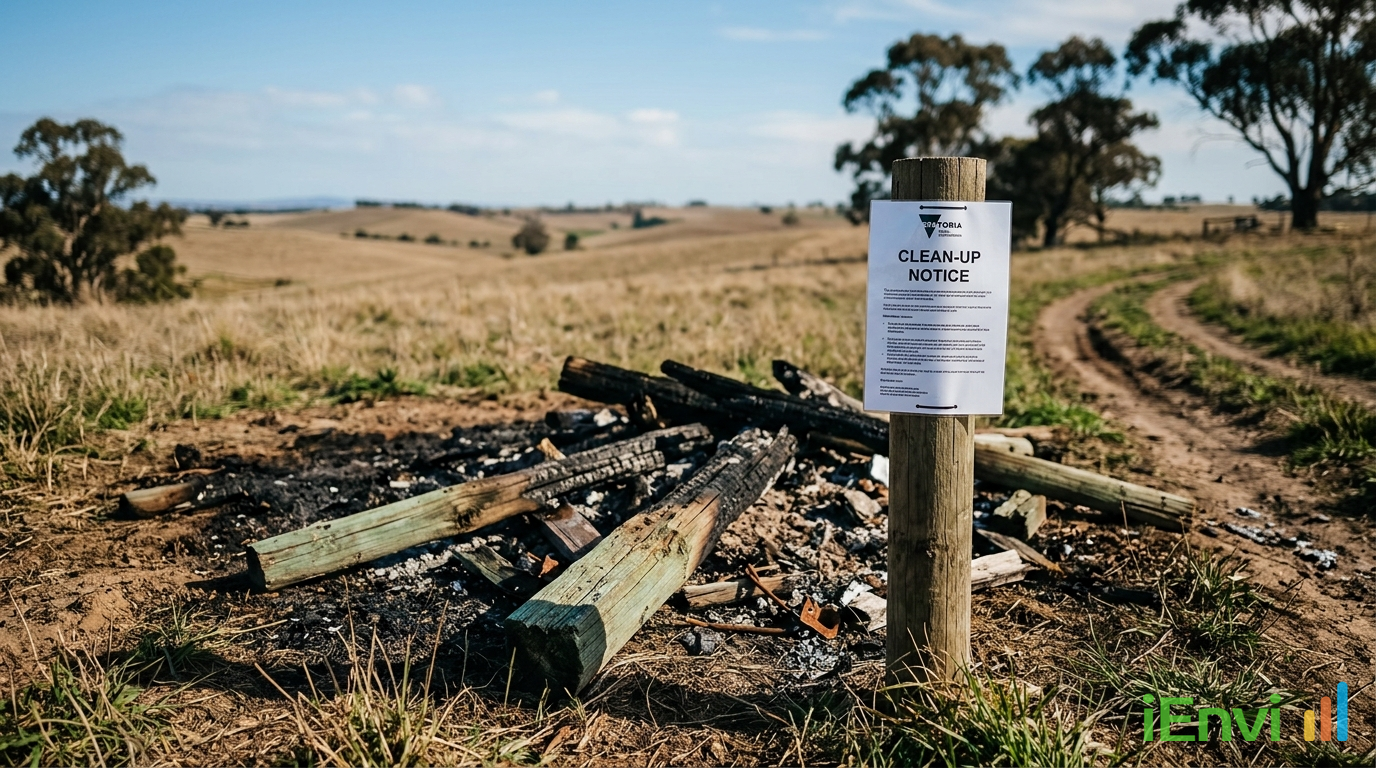
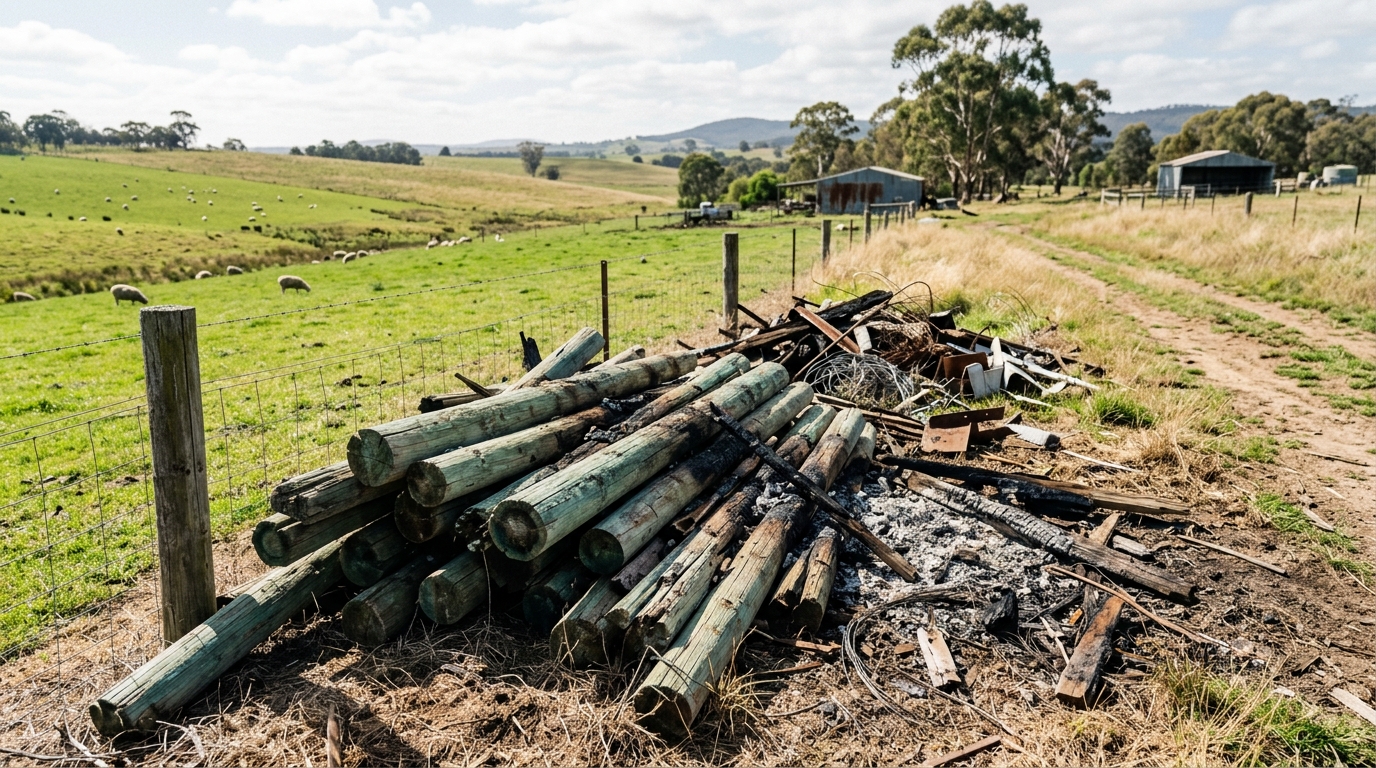
EPA officers inspected a property on New Britain Road, Robinvale, and identified a burn site measuring 20 metres by 70 metres containing burnt grape vines, CCA-treated pine posts, metal trellises and wire. A separate waste pile measuring 20 metres by 10 metres on the same property contained burnt tyres, a mattress, additional treated pine posts, wooden pallets and a plastic bollard base. Across the broader 12-property sweep, inspectors documented treated pine, tyres, grape vine covers, plastics, chemical drums and household waste, indicating a pattern of mixed agricultural and general waste disposal by burning rather than isolated incidents.
The operating company, Preston-based A & L Romeo Pty Ltd, received a $10,176 infringement notice for unlawfully depositing waste exceeding 1,000 litres via burning, a specific offence threshold under the Environment Protection Act 2017 (Vic). This sits alongside the Act’s General Environmental Duty under section 25, which requires occupiers of land to minimise risks of harm to human health and the environment from pollution and waste so far as reasonably practicable, and section 115, which governs the unlawful deposit of industrial waste. Related duties under section 133 apply to the deposit of industrial waste specifically, and enforcement was administered under the Infringements Act 2006 (Vic).
Beyond the infringement notice, EPA Victoria issued an Environmental Action Notice requiring a major clean-up at the Robinvale site. An EAN is a statutory instrument that compels the recipient to undertake specified remedial works, which in a case involving CCA-treated timber ash and mixed waste burning would typically extend to characterisation of burnt residues, removal of contaminated soil, and validation sampling to confirm remaining site conditions no longer pose an unacceptable risk. Several other farm operators inspected during the sweep received official warnings rather than infringements, along with compliance advice, suggesting EPA applied a risk-based tiering of enforcement responses depending on the severity and volume of waste identified at each property.
EPA Northwest Regional Manager Paul Ratajczyk stated that burning practices of this kind lead to contamination of soil and surface water, including runoff into nearby waterways, and leaching of hazardous substances into groundwater that affects nearby farms. This framing is significant because it explicitly links a waste offence to off-site groundwater and surface water impacts rather than treating it as a standalone land management breach, reinforcing that EPA views these sites through a contaminated land and water quality lens, not just a waste compliance lens.
Australian context
Victoria’s enforcement approach here reflects a pattern seen across other Australian jurisdictions where EPAs are increasingly targeting rural and agricultural land as a source of unregulated legacy contamination. Copper chrome arsenate (CCA) treated timber has been widely used in vineyard posts, fencing and trellising across inland Victoria, South Australia’s Riverland, and southern New South Wales for decades. When burnt rather than disposed of through licensed waste channels, CCA combustion releases inorganic arsenic, hexavalent chromium and copper into ash and surface soils, contaminants that fall squarely within the assessment criteria of the National Environment Protection (Assessment of Site Contamination) Measure 1999 as amended in 2013 (NEPM 2013).
Consultants conducting Preliminary Site Investigations (PSIs) or Detailed Site Investigations (DSIs) on rural and viticultural properties in Victoria, South Australia, New South Wales or Queensland should treat undocumented burn scars, ash deposits and drum disposal pits as Areas of Environmental Concern under NEPM 2013, particularly where aerial imagery or site walkovers reveal historical burn footprints of the scale identified at Robinvale. Heavy metal analysis for arsenic and chromium, alongside PAH testing where tyres or plastics were co-mingled in the burn pile, should be scoped into the sampling design from the outset rather than added reactively after anomalous field observations.
References and related sources
- Primary source: www.epa.vic.gov.au
- https://www.epa.vic.gov.au/epa-farm-visits-spark-10k-fine-and-clean`
- EPA Victoria
How iEnvi can help
iEnvi provides specialist consulting services relevant to this topic. Our team includes CEnvP Site Contamination Specialists with experience across contaminated land, groundwater, remediation, ecology, and regulatory compliance.
- iEnvi groundwater services
- iEnvi remediation and validation services
- iEnvi expert services and independent review services
This is an iEnvi Machete news summary. Prepared by iEnvi to summarise the source article for contaminated land, groundwater, remediation, approvals and site risk professionals.
Published: 04 Aug 2026
Need advice on this topic? Speak to an iEnvi expert at info@ienvi.com.au or 1300 043 684, or contact us online.
Need advice on this issue? iEnvi provides practical, senior-led environmental consulting across contaminated land, remediation, ecology and environmental risk.
PSI services DSI services Team credentials Contaminated land services Talk to iEnvi