
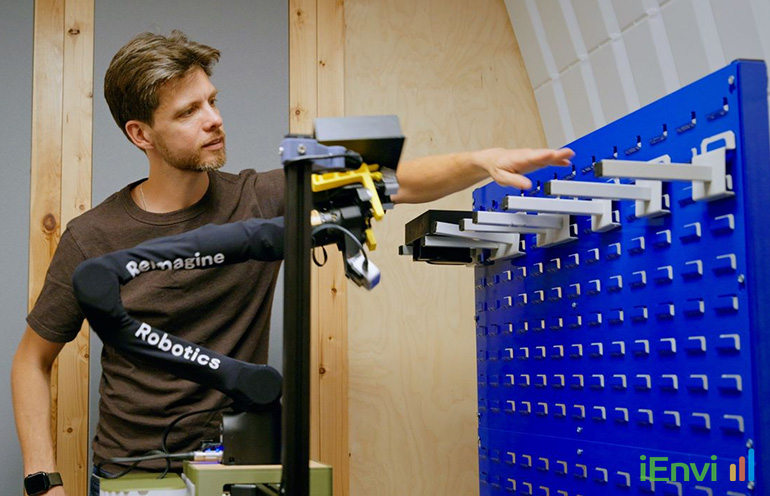
Reimagine Robotics: training industrial robots by human demonstration
Reimagine Robotics has emerged from stealth with a physical AI platform that lets shop-floor workers train industrial robots through direct demonstration rather than software code. The company was founded by Jonathan Scholz, who led Google DeepMind’s Applied Robotics team for seven years, alongside former DeepMind colleagues Oleg Sushkov, Akhil Raju and Misha Denil. It operates with dual headquarters in London and Sydney, a detail that puts this development squarely on the radar of Australian industrial, resource recovery and waste management operators.
The core proposition is a departure from how industrial automation has traditionally been deployed. Conventional robotics platforms rely on pre-programmed trajectories, precise CAD models of components, and specialist engineers to reprogram behaviour whenever a task, product or line layout changes. Reimagine Robotics instead lets a process worker physically guide the robot through a task, observe how it performs the trial, and correct it on the spot. Scholz describes this as “monkey-see, monkey-do” learning, where the robot behaves like a new colleague asking how it can help rather than a fixed-function machine waiting for a script update.
This matters for Australian environmental professionals and their clients because a meaningful share of contaminated land, resource recovery and waste handling work involves exactly the kind of high-variability, non-standardised material streams that have historically made robotic automation uneconomic. Where robots previously struggled with wear, orientation or component variation, a system that adapts through human demonstration rather than offline reprogramming changes the calculus for where and how automation can be justified on cost and safety grounds.
Pilot results: hard drive disassembly for critical material recovery
The most concrete figure from the launch is a prototyping time reduction from approximately 24 hours down to 10 minutes, achieved during a pilot deployment on a critical material recovery project involving the disassembly of used computer hard drives. In practical terms, this means the interval between identifying a new task variant and having the robot competently performing it dropped by roughly 144 times, based on figures disclosed by the company at launch.
The underlying method is human-in-the-loop teaching. A worker demonstrates a physical motion, the robot attempts the task, and the worker provides an instant correction, either physically or through a visual interface, without needing to touch code or retrain an offline model. The AI system generalises from these corrections in near real time, which is the technical departure from standard industrial robotics platforms that require precise trajectory programming or CAD-accurate part models to function reliably.
Reimagine Robotics has positioned its commercial strategy around high-variability industrial, disassembly and flexible manufacturing environments, specifically the categories of work where conventional automation has historically been too rigid or too costly to justify. The hard drive disassembly pilot is the only detailed case study released publicly at this stage, and it was framed explicitly as a critical material recovery application, meaning the recovery of rare earth elements, magnets or other valuable components from electronic waste streams.
No independent third-party validation of the 24-hour to 10-minute figure has yet been published, and the company has not disclosed detection accuracy rates, failure rates, or safety certification status for the platform in industrial settings. These are the kinds of technical benchmarks that operators and their engineering or environmental advisers should expect to see published as the technology moves from pilot to commercial deployment.
Australian context
This is a technology and business development rather than a regulatory one, so the relevant Australian frame is professional services and resource recovery capability rather than a specific instrument such as the NEPM 2013 or a state EPA guideline. That said, the Sydney headquarters location signals that Reimagine Robotics is treating Australia as a primary commercial market rather than an afterthought, which is notable given the country’s relatively small domestic manufacturing base compared with automation-heavy economies.
The direct relevance to Australian environmental and waste practice sits in resource recovery and e-waste processing. Australia’s e-waste volumes continue to grow, and disassembly of end-of-life electronics for critical material recovery, including hard drives, batteries and circuit boards, is precisely the high-variability task category the company has piloted. If a robot can be retrained on the fly by a shop-floor operator rather than requiring a dedicated automation engineer for every new device model entering the waste stream, that lowers a barrier that has kept a lot of disassembly work manual in Australian materials recovery facilities.
For consultancies and businesses advising on facility design, occupational health and safety, or resource recovery feasibility, the practical implication is a shift in what “automatable” means for a facility. Feasibility assessments for new materials recovery or hazardous waste handling infrastructure have typically discounted robotic automation for anything other than highly standardised, high-volume streams. A platform that can be retaught in minutes rather than reprogrammed over a day changes that assumption and should be tested rather than assumed away in any forward-looking facility design or business case.
Practical implications
Operators of materials recovery facilities, e-waste processors and hazardous waste handlers in Australia should treat this as an early signal to test, not a proven solution to deploy at scale. The 10-minute prototyping figure comes from one pilot on one task type, and the company is yet to publish accuracy rates, failure rates or safety certification data for industrial settings. Before committing capital, operators and their advisers should request independently verified performance benchmarks, confirm the platform’s compliance pathway under Australian work health and safety requirements, and trial the technology on their own material streams. Where feasibility studies for new recovery infrastructure are underway, human-in-the-loop retraining capability is now a variable worth including in the assessment rather than dismissing automation of variable streams as uneconomic by default.
References and related sources
- Primary source: venturebeat.com
- therobotreport.com
- https://therobotreport.com/reimagine-robotics-emerges-from-stealth-with-robots-t
How iEnvi can help
iEnvi integrates technology and data-driven approaches into environmental consulting. We monitor AI and technology developments that affect how environmental professionals deliver services to clients.
This is an iEnvi Machete news summary. Prepared by iEnvi to summarise the source article for environmental professionals tracking AI, data, and technology developments that affect consulting and project delivery.
Published: 04 Aug 2026
Need advice on this topic? Speak to an iEnvi expert at info@ienvi.com.au or 1300 043 684, or contact us online.
Need advice on this issue? iEnvi provides practical, senior-led environmental consulting across contaminated land, remediation, ecology and environmental risk.