

Revised ANZG PFOS Guidelines for Freshwater
The finalisation of the Australian and New Zealand Guidelines (ANZG) Default Guideline Values (DGVs) for Perfluorooctane sulfonate (PFOS) in freshwater ecosystems, published by Water Quality Australia in May 2023, marks a significant milestone for the environmental sector. For years, the contaminated land industry in Australia has struggled with highly conservative draft guidelines that were difficult to achieve in practice. This regulatory update provides a revised framework that fundamentally alters the ecological risk assessment pathways for sites impacted by Per- and polyfluoroalkyl substances (PFAS), offering a much-needed balance between environmental protection and practical clean-up targets.
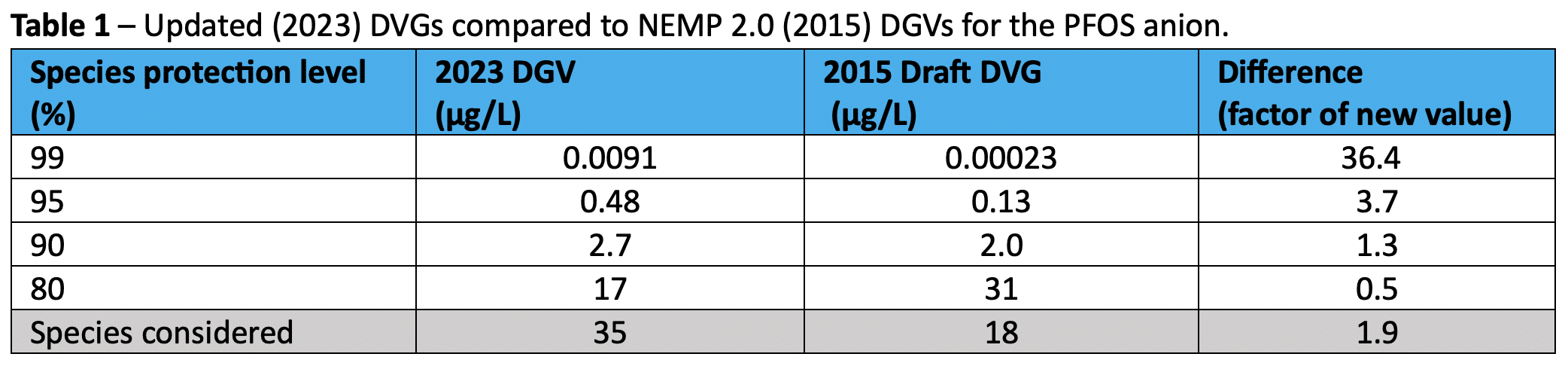
The core of this development is the revision of the 99 percent species protection level for freshwater ecosystems to 0.02 micrograms per litre (µg/L). This represents a substantial shift from the previous 2015 draft value of 0.00023 µg/L, which was frequently exceeded by ambient, diffuse background concentrations in urban environments. For developers, local councils, and environmental lawyers, this regulatory change means that direct toxicity compliance criteria for surface water discharges and groundwater migration are now based on more comprehensive, up-to-date scientific datasets, removing the near-impossible remediation targets that previously stalled major infrastructure and land development projects.
However, the update is not a simple relaxation of standards. Instead, it introduces a dual-track assessment system by establishing a strict biota screening threshold of 0.0005 µg/L. This threshold acknowledges the highly bioaccumulative nature of PFOS, which often poses a greater threat to high-order predators through biomagnification than to lower-order aquatic organisms through direct water exposure. As a result, clearing a site of PFAS risk now requires a more complex, multi-tiered approach. If surface water concentrations exceed the biota screening threshold, practitioners must undertake extensive secondary assessments, bridging the gap between standard water sampling and complex food web ecological risk models.
Direct Toxicity vs. Biota Screening Thresholds
The technical underpinnings of the May 2023 update highlight the scientific maturation of PFAS regulation in Australia. The transition of the 99 percent species protection DGV from the 2015 draft of 0.00023 µg/L to the final 0.02 µg/L represents a nearly hundred-fold increase. This adjustment reflects a more comprehensive toxicological database and a refined methodology for calculating species sensitivity distributions. The previous draft value of 0.00023 µg/L was so low that it was often below standard laboratory limits of reporting, meaning that any detectable concentration of PFOS effectively constituted an exceedance, regardless of the actual ecological risk present in a typical urban watercourse.
In addition to the 99 percent species protection level, which is typically applied to slightly to moderately disturbed freshwater ecosystems, the final ANZG update establishes clear default guideline values for other protection levels. The 95 percent species protection DGV has been formalised at 0.9 µg/L, while the 90 percent species protection level is set at 4 µg/L. These values provide clear, graduated benchmarks for site auditors and regulators to apply based on the specific environmental values of the receiving water body. Highly disturbed urban drains, for example, may be assessed against the 90 or 95 percent protection levels, whereas pristine conservation areas or drinking water catchments will continue to demand the more stringent 99 percent species protection DGV.
The most critical structural change in the guidelines is the formal introduction of the 0.0005 µg/L biota screening threshold. This value is set forty times lower than the direct toxicity DGV of 0.02 µg/L. Because PFOS does not easily biodegrade and has a high affinity for binding to proteins in biological tissue, it accumulates rapidly in aquatic food chains. The guidelines dictate that while a surface water concentration between 0.0005 µg/L and 0.02 µg/L does not pose an immediate direct toxic threat to aquatic organisms, it does represent a significant risk of biomagnification. This biomagnification can lead to adverse effects in air-breathing predators, such as birds and semi-aquatic mammals, as well as humans consuming wild-caught fish or crustaceans.
Consequently, exceeding the 0.0005 µg/L biota screening threshold triggers a mandatory requirement for secondary ecological assessments. Under this trigger, practitioners are required to design and execute aquatic tissue sampling programmes, collecting species such as fish, crabs, or macroinvertebrates to determine the actual tissue concentration of PFOS. This biological data is then used to perform site-specific food web modelling and ecological risk calculations. For laboratories supporting these assessments, standard analytical limits of reporting must be significantly lower than the screening threshold. Laboratories must achieve ultra-trace limits of reporting, often down to 0.0001 µg/L or lower, to ensure that assessments can accurately determine whether the biota screening threshold has been breached.
Regulatory Impact on Australian Contaminated Land Management
The integration of the final ANZG freshwater DGVs into the Australian regulatory landscape directly intersects with several key national and state-level environmental frameworks. Most notably, these values align with the ongoing updates to the PFAS National Environmental Management Plan, specifically the PFAS NEMP 3.0 framework, and the National Environment Protection (Assessment of Site Contamination) Measure 1999, as amended in 2013. State environmental protection authorities, including the New South Wales Environment Protection Authority, the Victorian Environment Protection Authority (EPA), and the Queensland Department of Environment, Science and Innovation, are progressively incorporating these revised values into site assessment guidance and licensing conditions. For consultants, auditors, and landholders, this alignment offers a clearer national benchmark for managing PFOS-impacted sites, while still requiring careful attention to the biota screening threshold and the secondary assessment obligations it triggers.
References and related sources
- Primary source: ade.group
- PFAS National Environmental Management Plan (NEMP)
- NEPM Assessment of Site Contamination
- ANZG Water Quality Guidelines
How iEnvi can help
iEnvi provides specialist consulting services relevant to this topic. Our team includes CEnvP Site Contamination Specialists with experience across contaminated land, groundwater, remediation, ecology, and regulatory compliance.
- iEnvi remediation services
- iEnvi groundwater services
- iEnvi expert services and independent review services
This is an iEnvi Machete news summary. Prepared by iEnvi to summarise the source article for contaminated land, groundwater, remediation, approvals and site risk professionals.
Published: 17 Jun 2026
Need advice on this topic? Speak to an iEnvi expert at info@ienvi.com.au or 1300 043 684, or contact us online.
Need advice on this issue? iEnvi provides practical, senior-led environmental consulting across contaminated land, remediation, ecology and environmental risk.
Team credentials Ecological risk assessment Environmental management plans Contaminated land advice Talk to iEnvi