
Overview
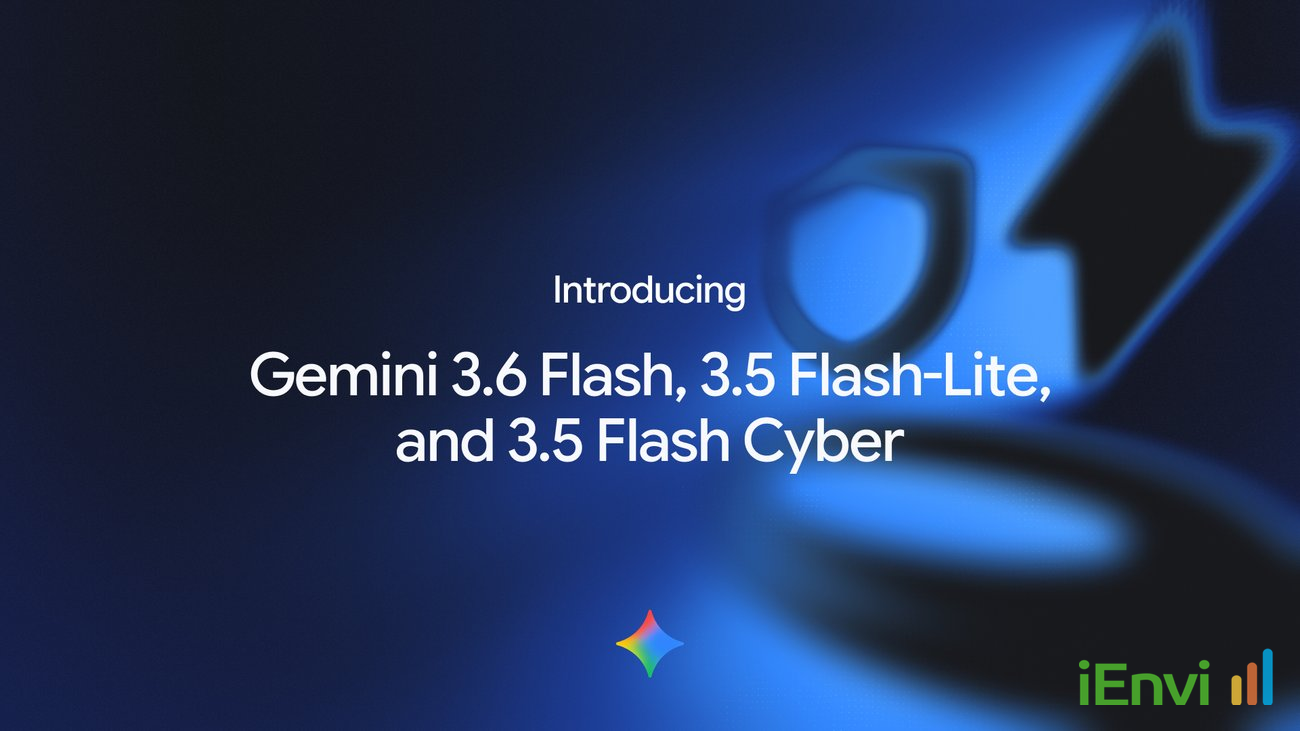
On 21 July 2026, Google DeepMind released three new proprietary artificial intelligence models: Gemini 3.6 Flash, Gemini 3.5 Flash-Lite, and Gemini 3.5 Flash Cyber. Rather than delivering the long-awaited flagship Gemini 3.5 Pro, which remains in restricted partner testing, Google instead concentrated its engineering effort on optimising the cost and token efficiency of its mid-tier model lineup. This represents a deliberate strategic pivot: instead of competing on raw benchmark performance, Google is competing on the economics of enterprise-scale AI deployment.
The significance of this release is not immediately obvious from the model names. What matters is the underlying shift in commercial calculus. For professional services firms, technical consultancies, legal practices, engineering organisations, and government agencies that have been piloting AI agents, the recurring obstacle has not been model capability. It has been the prohibitive running costs of multi-turn reasoning workflows. Every time an AI agent loops through a complex task, querying databases, parsing documents, or testing outputs across multiple steps, it consumes tokens at rates that make large-scale deployment economically unviable. Google’s 21 July update directly attacks that constraint.
Google also confirmed on 21 July 2026 that pre-training has officially commenced for Gemini 4, described by the company as its “most ambitious pre-training run yet.” That announcement triggered an immediate public exchange with a member of OpenAI’s technical staff on the social media platform X, who replied: “Hope it finishes one day too.” The exchange, while brief, captures the competitive tension between the leading AI laboratories and the industry-wide scrutiny now focused on Google’s ability to deliver its flagship models on schedule. For enterprise decision-makers evaluating AI platform commitments, this competitive dynamic is worth understanding.
Key details of Gemini 3.6 Flash, 3.5 Flash-Lite, and 3.5 Flash Cyber
Gemini 3.6 Flash is the primary replacement for Gemini 3.5 Flash and is positioned as the core workhorse model for enterprise agentic workflows. It is priced at USD $1.50 per million input tokens and USD $7.50 per million output tokens. The output token rate represents a direct 17 per cent reduction from the previous 3.5 Flash output rate of USD $9.00 per million tokens. Beyond the price cut, the model’s architecture has been redesigned to consume 17 per cent fewer output tokens on average compared to its predecessor, and up to 65 per cent fewer tokens on long-horizon software engineering tasks. This dual reduction in both price and token consumption compounds to substantially lower the cost-per-task for complex, multi-step agentic workloads.
Performance improvements are measurable and traceable to specific benchmarks. On the DeepSWE benchmark, which evaluates autonomous software engineering capability, Gemini 3.6 Flash scores 49 per cent, up from 37 per cent for 3.5 Flash. On MLE-Bench, a machine learning engineering evaluation, the model scores 63.9 per cent, up from 49.7 per cent. For agentic computer use tasks measured under the OSWorld-Verified framework, the model achieves 83 per cent, rising from 78.4 per cent on the prior generation. The knowledge cutoff for Gemini 3.6 Flash has been updated to March 2026, which is directly relevant for any deployment involving current regulatory, legislative, or technical reference material.
Gemini 3.5 Flash-Lite occupies a distinct position in the lineup, optimised for high-throughput, low-latency tasks rather than complex multi-step reasoning. It is priced at USD $0.30 per million input tokens and USD $2.50 per million output tokens, making it among the cheapest capable models available from a major AI laboratory. It operates at 350 output tokens per second, which is a significant throughput rate suited to document parsing, data extraction, classification tasks, and subagent execution within larger multi-agent systems. Both Gemini 3.6 Flash and Gemini 3.5 Flash-Lite maintain a 1-million-token input window and support a maximum output limit of 64,000 tokens per response.
Gemini 3.5 Flash Cyber is a separately fine-tuned variant designed specifically for identifying and patching software vulnerabilities. It is not publicly accessible. Access is currently gated to governments and trusted partners through a limited programme called CodeMender. This model falls outside the general enterprise deployment conversation for most professional services organisations, though its existence signals Google’s intent to address specialised cybersecurity applications with purpose-built fine-tuned variants rather than general-purpose flagship models. Addressing the delayed Gemini 3.5 Pro, Google DeepMind Product Lead Logan Kilpatrick stated on X that the model “is currently testing with partners and we plan to make it broadly available as soon as it’s” ready, leaving the timeline explicitly open.
Australian context: enterprise AI deployment costs and professional services implications
For Australian professional services firms, including engineering consultancies, legal practices, environmental advisers, planning and infrastructure organisations, and government agencies, the commercial relevance of this release centres on one question: at what price point does deploying an AI agent across a high-volume, multi-step workflow become financially justifiable? Until mid-2026, the answer for most mid-market Australian organisations was that it did not, outside of narrow, well-scoped pilot use cases. Google’s 21 July release materially changes that calculation for firms using the Google AI platform or building on Google Cloud’s Vertex AI infrastructure.
[Article incomplete — final paragraph requires completion before publication.]
References and related sources
- Primary source: blog.google
- 9to5google.com
- iclarified.com
- venturebeat.com
- vortx.ch
How iEnvi can help
iEnvi integrates technology and data-driven approaches into environmental consulting. We monitor AI and technology developments that affect how environmental professionals deliver services to clients.
This is an iEnvi Machete news summary. Prepared by iEnvi to summarise the source article for environmental professionals tracking AI, data, and technology developments that affect consulting and project delivery.
Published: 24 Jul 2026
Need advice on this topic? Speak to an iEnvi expert at info@ienvi.com.au or 1300 043 684, or contact us online.
Need advice on this issue? iEnvi provides practical, senior-led environmental consulting across contaminated land, remediation, ecology and environmental risk.
Contaminated land advice Remediation services Discuss your site Talk to iEnvi