
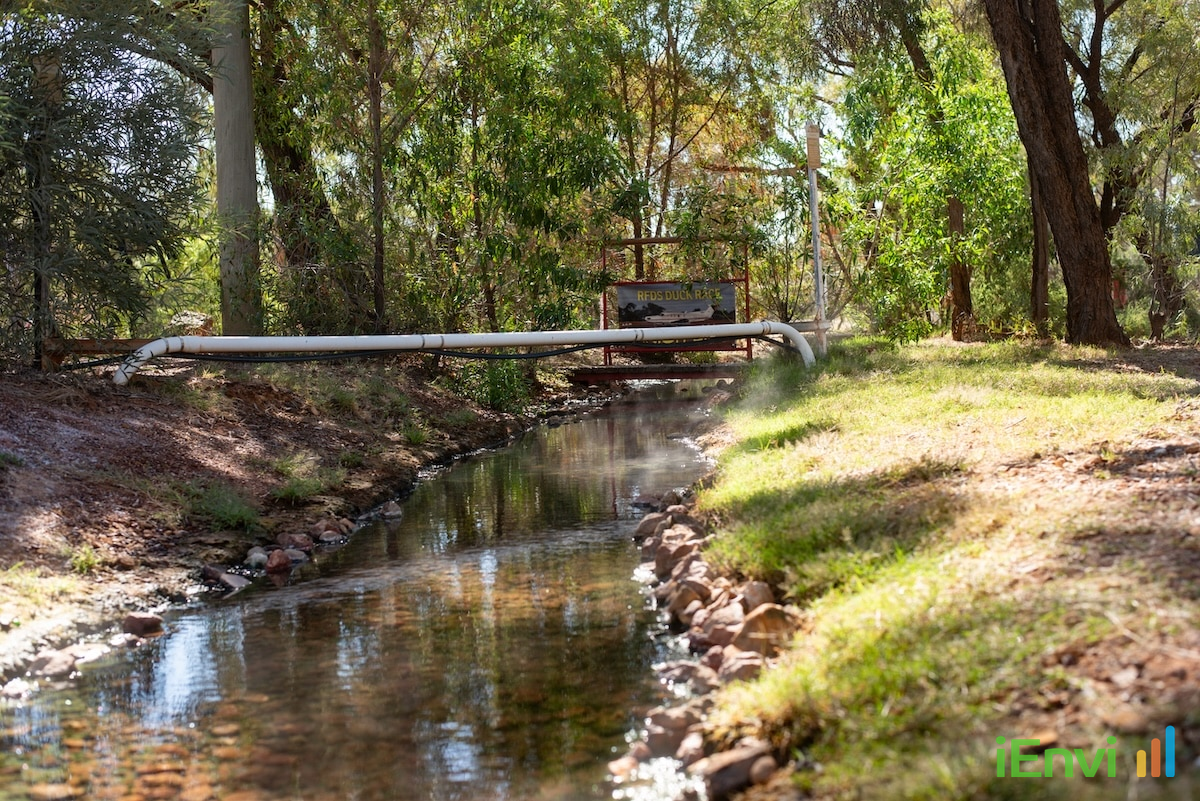
Overview of Great Artesian Basin Groundwater Recovery
The Great Artesian Basin Rehabilitation Program (GABRP) has recorded groundwater savings of 4,923 megalitres (ML) during the 2023-24 financial year, marking one of the most tangible annual conservation outcomes in the program’s history. Achieved through a combination of bore capping, controlled watering system installation, and the replacement of open bore drains with piped infrastructure, these results reflect decades of coordinated effort between the Federal Government, the Queensland Government, industry partners, and individual landholders. Federal Minister for the Environment and Water, Murray Watt, described the Great Artesian Basin (GAB) as “one of the largest underground freshwater resources in the world and a critical pillar to Australia’s water security.”
For hydrogeologists, groundwater-dependent ecosystem (GDE) specialists, and environmental consultants working across inland Queensland and regional Australia, these figures are not simply a water accounting milestone. They represent measurable progress in stabilising artesian pressure across an aquifer system that underpins more than 80 regional towns and supports industries generating over $22.6 billion annually, including grazing, cropping, mining, and tourism. The recovery of artesian pressure across the system has direct ecological consequences, including the re-emergence of natural springs that serve as critical habitat for rare and endemic macroinvertebrate and flora species.
With $9.7 million in funding already committed for 36 new infrastructure projects in 2024-25, the GABRP continues to generate demand for hydrogeological modelling, environmental impact assessment, ecological monitoring, and compliance reporting. This funding cycle and its associated project pipeline have immediate relevance for regional developers, resource companies, local councils, and environmental consultants operating in areas overlying or adjacent to the GAB.
Key details of the 2023-24 GABRP works and 2024-25 project pipeline
During the 2023-24 financial year, GABRP crews capped and rehabilitated 30 uncontrolled artesian bores, installed seven controlled watering systems, and replaced 150 kilometres of open bore drains with managed pipe networks. The combined effect of these works is the 4,923 ML per annum water saving now attributed to this program year. To contextualise that volume, 4,923 ML is equivalent to approximately 4.923 billion litres, roughly sufficient to fill nearly 2,000 Olympic-sized swimming pools. This is water that was previously lost to uncontrolled artesian flow, evaporation from open drains, and soil seepage before it could be put to productive use.
Open bore drains are a legacy of early pastoral development across the GAB, where free-flowing artesian water was directed into unlined earth channels to reach watering points for livestock. These drains are thermally and hydraulically inefficient. Evaporation losses from open channel systems in the arid and semi-arid zones overlying the GAB can be substantial, with solar radiation and low humidity accelerating surface water loss considerably compared to enclosed pipe systems. Seepage losses through the channel bed and walls further reduce delivery efficiency. By replacing 150 kilometres of these drains with piped systems during 2023-24, the program has directly addressed two of the three primary loss mechanisms, with uncontrolled bore capping addressing the third.
Looking forward to 2024-25, the committed $9.7 million in funding will support 36 new infrastructure projects. The projected outcome for this next program year is an additional 4,960 ML per annum in water savings. The mechanism for achieving this is the replacement of 138 kilometres of open bore drains with 242 kilometres of piped, controlled distribution systems. The expansion from 138 km of drains replaced to 242 km of new pipe reflects the branching and reticulated nature of modern piped watering networks, where a single replaced drain line may serve multiple troughs or tanks through a more efficient distribution topology. These figures are directly comparable to the 2023-24 outputs, confirming a consistent and well-resourced delivery rhythm for the program.
The regulatory framework governing these works draws on both state and Commonwealth legislation. In Queensland, bore construction, capping, and artesian water management are governed by the Water Act 2000 (Qld), which sets out requirements for water licences, works approvals, and the sustainable management of groundwater. At the Commonwealth level, the Water Act 2007 (Cth) provides the overarching framework for basin-scale water resource management, including the GAB. Projects involving ecological impacts on GDEs or natural springs will also be assessed against the Australia and New Zealand Guidelines for Fresh and Marine Water Quality 2018 (ANZG 2018), which provides default guideline values (DGVs) for aquatic ecosystem protection and specific guidance on the protection of freshwater springs and GDE-associated water bodies.
Australian context: Great Artesian Basin management, GDE protection, and groundwater regulation
The Great Artesian Basin is one of the largest and deepest freshwater aquifer systems in the world, underlying approximately 22% of Australia’s land area across Queensland, New South Wales, South Australia, and the Northern Territory. It provides the only reliable source of freshwater across vast stretches of inland Australia and has been subject to artesian pressure decline since the onset of widespread pastoral bore drilling in the late 19th century. The GABRP has operated since 1999 as the primary mechanism for addressing this decline, having now capped or rehabilitated hundreds of uncontrolled bores and replaced thousands of kilometres of open drains. The 2023-24 results add to this cumulative record, but they also signal an ongoing and unresolved management challenge for regional water security.
References and related sources
- Primary source: insidewater.com.au
- beefcentral.com
- insidewater.com.au
- insidewater.com.au
- environment.qld.gov.au
- ANZG Water Quality Guidelines
How iEnvi can help
iEnvi provides specialist consulting services relevant to this topic. Our team includes CEnvP Site Contamination Specialists with experience across contaminated land, groundwater, remediation, ecology, and regulatory compliance.
- iEnvi groundwater services
- iEnvi remediation and validation services
- iEnvi expert services and independent review services
This is an iEnvi Machete news summary. Prepared by iEnvi to summarise the source article for contaminated land, groundwater, remediation, approvals and site risk professionals.
Published: 27 Jul 2026
Need advice on this topic? Speak to an iEnvi expert at info@ienvi.com.au or 1300 043 684, or contact us online.
Need advice on this issue? iEnvi provides practical, senior-led environmental consulting across contaminated land, remediation, ecology and environmental risk.
Team credentials Contaminated land services Remediation services Groundwater services Talk to iEnvi