
Overview
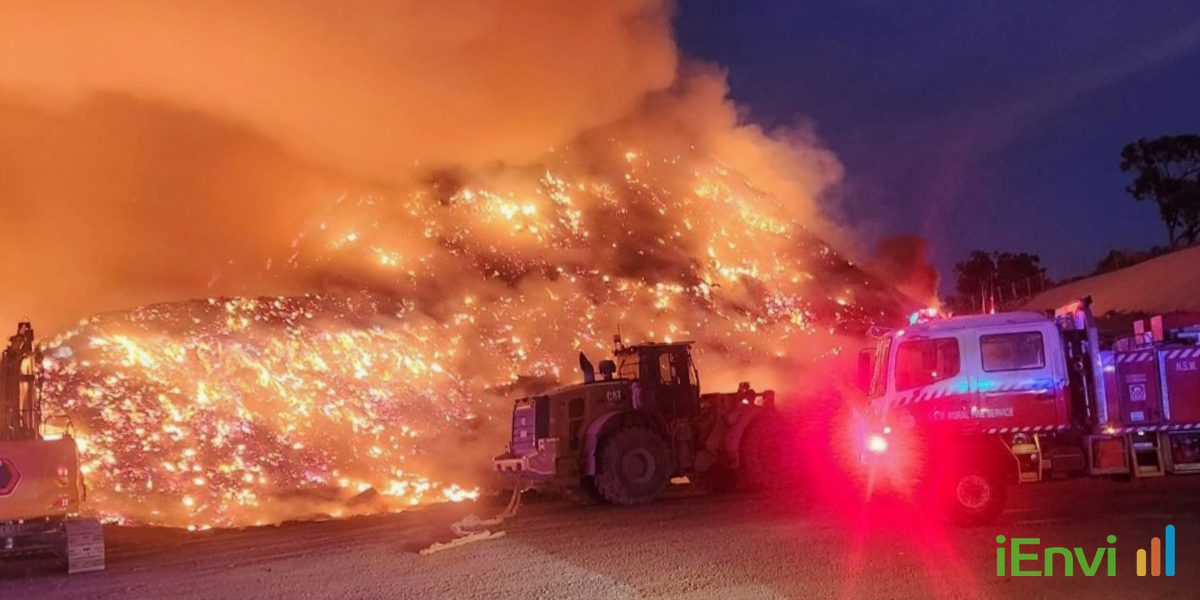
A NSW landfill operator has been convicted and ordered to pay $52,000 following a prosecution by the NSW Environment Protection Authority (EPA) over unauthorised combustible waste stockpiling at the Marys Mount landfill in Mullaley, near Gunnedah. Gunnedah Quarry Products Pty Ltd (GQP) was found to have placed large volumes of plastic, timber, and cardboard into a landfill cell in breach of its Environment Protection Licence (EPL) conditions, with the stockpile exceeding the critical 4-metre height limit prescribed under the NSW EPA Guidelines on Fire Safety in Waste Facilities. The Gunnedah Local Court issued a $40,000 fine plus $12,000 in EPA legal costs, resulting in a total penalty of $52,000. The conviction was reported on 7 May 2026.
The direct consequences of this breach were severe. The oversized combustible stockpile ignited in December 2024, producing a fire that burned for days and generated a thick smoke plume that blanketed surrounding communities across the Gunnedah region. Emergency response resources were committed to the incident over an extended period, compounding the environmental, public health, and economic costs well beyond the penalty itself. The reputational damage to the operator and the burden placed on local emergency services demonstrate why compliance with stockpile controls is treated as a non-negotiable threshold by the regulator, not a graduated warning system.
For environmental consultants, waste facility operators, and their legal and financial advisers, this prosecution is a concrete reminder that EPL conditions are legally enforceable obligations with direct criminal consequences. The NSW EPA’s active pursuit of this matter to conviction signals that fire safety at waste facilities remains a priority enforcement area. Practitioners advising on waste facility design, operations, auditing, and due diligence should treat the 4-metre combustible stockpile height limit as a hard compliance line, not a guideline subject to operational interpretation.
Key details of the Marys Mount landfill prosecution
The prosecution was brought under the Protection of the Environment Operations Act 1997 (NSW) (POEO Act), which governs the issue and conditions of Environment Protection Licences across regulated activities including landfill and waste management operations. EPL conditions are binding on the licence holder and breaches can attract prosecution in the Land and Environment Court or, as in this case, the Local Court. The total penalty of $52,000 comprised a $40,000 fine and $12,000 in EPA legal costs recovered from GQP. While Local Court penalties are capped below the maximum available under the POEO Act for more serious matters, the conviction itself carries lasting regulatory and reputational weight for the company.
The specific technical breach centred on stockpile height. The NSW EPA Guidelines on Fire Safety in Waste Facilities set a clear operational limit: combustible waste stockpiles must not exceed 4 metres in height. The material involved at Marys Mount included plastic, timber, and cardboard, all of which are classified as highly combustible and subject to strict separation and height controls. GQP’s stockpile was reported to exceed this 4-metre threshold by a material margin, creating a fire load that emergency services could not rapidly suppress once ignition occurred. The fire burned for multiple days following its outbreak in December 2024, demonstrating the escalation risk inherent in oversized combustible stockpiles.
Beyond height limits, the NSW EPA Guidelines on Fire Safety in Waste Facilities impose requirements around separation distances between stockpiles, between stockpiles and site boundaries, and between stockpiles and structures or infrastructure. These separation distances serve two distinct functions: limiting fire spread between adjacent stockpiles and ensuring emergency vehicle access routes remain clear during an incident. When stockpile dimensions are allowed to grow beyond prescribed limits, separation distances are typically compromised simultaneously, meaning a single operational failure can produce multiple concurrent regulatory breaches.
The smoke generated by the December 2024 fire represented a real and measurable public health impact on surrounding communities. Air quality degradation from uncontrolled waste fires can produce particulate matter (PM2.5 and PM10) as well as volatile organic compounds, carbon monoxide, and in the case of plastic combustion, potentially dioxins and furans. While the specific air quality monitoring data from this incident has not been published in the available source material, the regional smoke coverage described across the Gunnedah area is consistent with the kind of impact profile that regulators and public health agencies treat as a serious environmental harm outcome under the POEO Act.
Australian context: EPL compliance, waste facility guidelines, and enforcement trends across QLD, NSW, VIC and SA
The Marys Mount prosecution sits within a broader national pattern of regulators enforcing fire safety controls at waste facilities with increasing rigour. In New South Wales, the POEO Act provides the primary legislative framework, with EPL conditions acting as the operational compliance instrument for individual facilities. The NSW EPA Guidelines on Fire Safety in Waste Facilities are incorporated by reference into EPL conditions at many licensed sites, meaning a breach of the guidelines is simultaneously a breach of the licence. This integration is a deliberate regulatory design choice: it converts technical guidelines into legally enforceable obligations without requiring separate legislation for every operational parameter.
Other Australian jurisdictions take comparable approaches. In Victoria, the Environment Protection Act 2017 (Vic) and associated Environment Reference Standard impose
References and related sources
- Primary source: netimes.com.au
- NSW EPA
How iEnvi can help
iEnvi provides specialist consulting services relevant to this topic. Our team includes CEnvP Site Contamination Specialists with experience across contaminated land, groundwater, remediation, ecology, and regulatory compliance.
- iEnvi contaminated land investigation services
- iEnvi remediation and validation services
- iEnvi expert services and independent review services
This is an iEnvi Machete news summary. Prepared by iEnvi to summarise the source article for contaminated land, groundwater, remediation, approvals and site risk professionals.
Published: 07 May 2026
Need advice on this topic? Speak to an iEnvi expert at info@ienvi.com.au or 1300 043 684, or contact us online.
Need advice on this issue? iEnvi provides practical, senior-led environmental consulting across contaminated land, remediation, ecology and environmental risk.
Contaminated land services Remediation services Groundwater services Ecology consulting Talk to iEnvi