
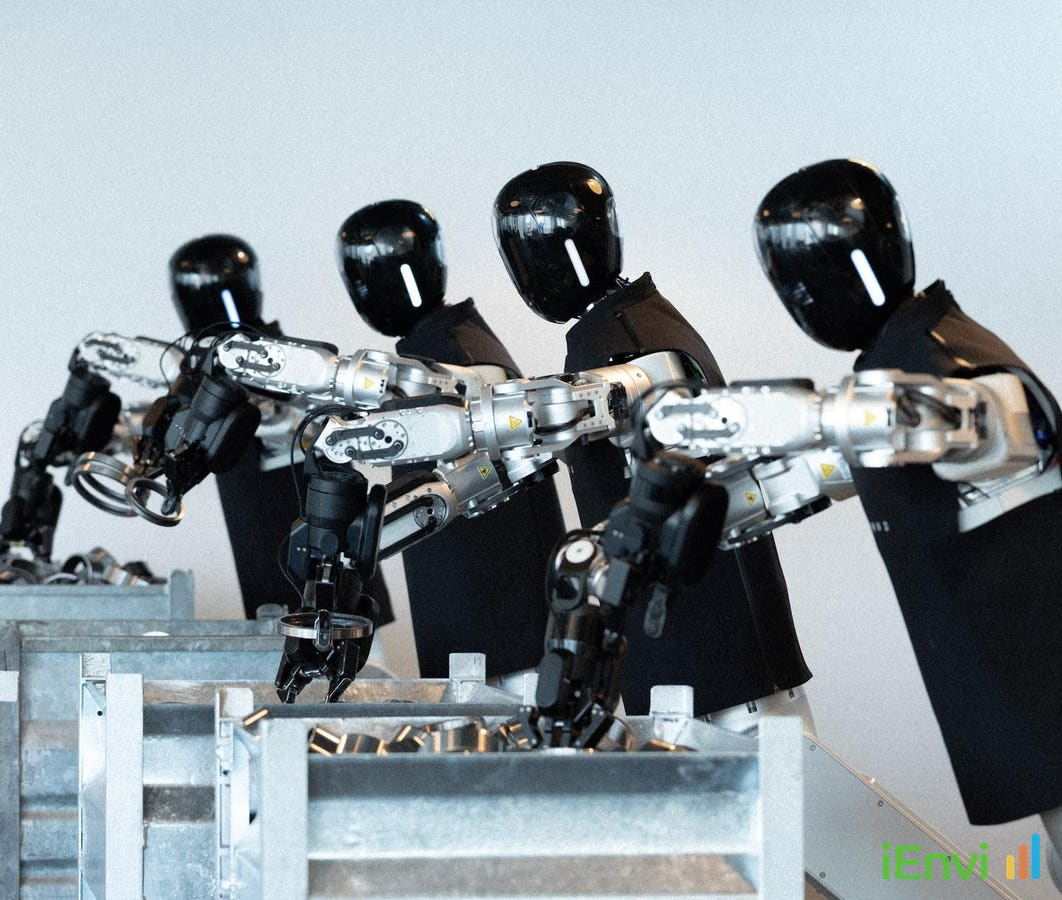
Humanoid raises USD $152 million Series A, becoming Europe’s first humanoid robotics unicorn
London-based robotics startup Humanoid raised USD $152 million (approximately AUD $233 million at current exchange rates) in a Series A funding round announced on 21 July 2026, achieving a post-money valuation of USD $1.35 billion (approximately AUD $2.07 billion). The round was led by Silicon Valley venture firm Prime Movers Lab, with strategic participation from German industrial heavyweights Bosch and Schaeffler, the Arnault family investment vehicle Aglaé Ventures (affiliated with LVMH), and Taiwan’s Fubon Financial Holding Venture Capital. The raise brings Humanoid’s total capital secured to USD $270 million across just two years of operation, formally establishing the company as Europe’s first pure-play humanoid robotics unicorn.
The significance of this funding round extends well beyond the headline valuation. Until now, the narrative around physical artificial intelligence, the convergence of robotics and large-scale AI models capable of reasoning and physical manipulation, has been dominated by United States players such as Tesla Optimus, Figure AI, and Agility Robotics, as well as a rapidly growing cohort of Chinese manufacturers including Unitree, Agibot, and UBtech. Humanoid’s Series A signals that European industrial capital is prepared to commit at a scale competitive with those markets, and that the continent’s established manufacturing ecosystem is being repositioned as a strategic asset rather than a legacy constraint.
For Australian businesses, government agencies, and consultants tracking automation trends in logistics, construction, and industrial site operations, this development is materially relevant. The adoption of physical AI platforms at scale in European and North American supply chains will influence procurement decisions, workforce planning, and operational risk frameworks in Australia within the medium term. Understanding the technical architecture, commercial model, and regulatory approach underpinning this particular platform provides a useful reference point for evaluating what is genuinely deployable versus what remains aspirational in the broader humanoid robotics market.
Key details of the Humanoid Series A raise and HMND 01 platform
The funding round values Humanoid at USD $1.35 billion post-money, with the total capital raised to date sitting at USD $270 million. Prime Movers Lab, which has previously participated in funding rounds for Figure AI, led the Series A. The presence of Bosch and Schaeffler as strategic investors is particularly notable because both companies are not acting solely as financial backers. Bosch will serve as Humanoid’s contract manufacturer, while Schaeffler will supply drivetrain and precision motion components. This arrangement gives the startup access to two of Europe’s most capable industrial supply chains without requiring the capital-intensive vertical integration strategy pursued by many American competitors. Humanoid has stated a production capacity target of 100,000 units over the next five years.
The company’s primary near-term commercial platform is the HMND 01, a wheeled humanoid robot rather than a bipedal walking design. This is a deliberate engineering and regulatory choice. Wheeled locomotion delivers substantially better energy efficiency than bipedal ambulation over flat industrial surfaces, provides greater payload stability during transport tasks, and, critically, avoids the CE safety certification process applicable to walking robots operating on European factory floors. Bipedal humanoid robots in industrial environments require extensive dynamic stability testing and certification under European machinery safety directives, a process that can add months or years to a commercial deployment timeline. By adopting wheels for the HMND 01, Humanoid has compressed the path from proof-of-concept to revenue-generating deployment.
The HMND 01 runs on Humanoid’s proprietary KinetIQ AI platform, described as a four-layer system that integrates vision-language models (VLMs) with advanced reinforcement learning. VLMs allow the robot to interpret high-level natural language instructions and map them to physical actions, while the reinforcement learning layer manages the deterministic control required for precise manipulation. The system is also designed for multi-robot fleet coordination, meaning a single operator can oversee a network of units working in parallel across a facility. In March 2026, Humanoid conducted a proof-of-concept deployment at a Bosch logistics facility, where HMND 01 units autonomously sorted, lifted, and moved boxes of five different dimensions and weights from conveyor belts to transport trolleys, without human intervention. The company plans to deploy its first Beta units to commercial customer sites in the fourth quarter of 2026.
Humanoid has reported 34,000 pre-orders valued at nearly USD $2.5 billion, though the company itself characterises these as unverified. Schaeffler has made a confirmed commitment to deploy more than 1,000 units across its manufacturing facilities, representing a significant anchor customer relationship. Klaus Rosenfeld, CEO of Schaeffler, was quoted directly on the milestone: “Humanoid robotics is rapidly moving from a visionary concept to an industrial reality. We are actively backing one of the most exciting frontiers in technology.” The combination of a strategic manufacturing partner doubling as an anchor customer is an unusual and defensible commercial structure that reduces early revenue risk while stress-testing the platform in a demanding real-world environment.
Australian context: physical AI, industrial automation, and professional services implications
Australia does not yet have a domestic humanoid robotics manufacturer operating at anything approaching this scale, and the country’s industrial robotics adoption rate has historically lagged comparable OECD economies.
References and related sources
- Primary source: www.forbes.com
- industryevents.com
- ground.news
- pymnts.com
- forbes.com
- NEPM Assessment of Site Contamination
How iEnvi can help
iEnvi integrates technology and data-driven approaches into environmental consulting. We monitor AI and technology developments that affect how environmental professionals deliver services to clients.
This is an iEnvi Machete news summary. Prepared by iEnvi to summarise the source article for environmental professionals tracking AI, data, and technology developments that affect consulting and project delivery.
Published: 25 Jul 2026
Need advice on this topic? Speak to an iEnvi expert at info@ienvi.com.au or 1300 043 684, or contact us online.
Need advice on this issue? iEnvi provides practical, senior-led environmental consulting across contaminated land, remediation, ecology and environmental risk.
Contaminated land advice Remediation services Discuss your site Talk to iEnvi