

OpenAI launches Presence, a managed enterprise platform for AI agent deployment and governance
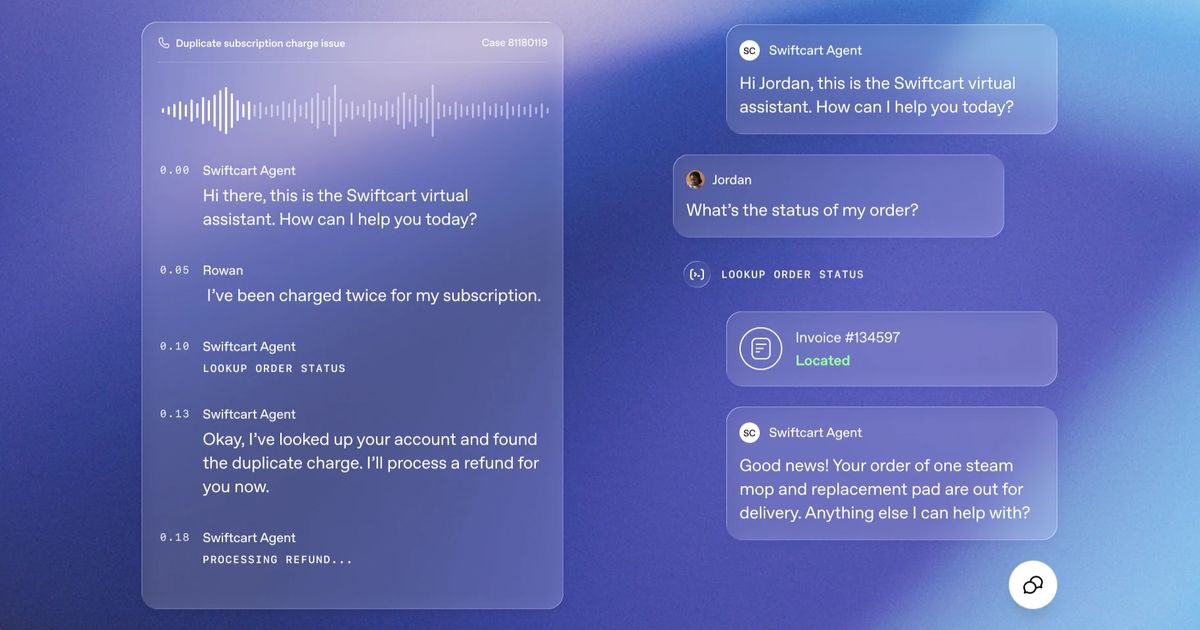
On 22 July 2026, OpenAI launched Presence, a managed enterprise platform designed to deploy, govern, and operate real-time voice and chat AI agents across customer-facing and internal business workflows. The launch marks a deliberate and significant departure from OpenAI’s established self-service API and seat-licence model, moving the company into direct, hands-on enterprise service delivery. Rather than simply providing model access, OpenAI is now embedding its own Forward Deployed Engineers alongside a select group of global systems integrators to build, integrate, and maintain autonomous agent deployments within client organisations.
The significance of this move extends well beyond OpenAI’s own commercial trajectory. Presence represents a broader industry inflection point: the competitive advantage in enterprise AI is no longer the underlying model’s raw capability, but the operational infrastructure, governance frameworks, and deployment expertise that make autonomous agents safe, auditable, and reliably useful in production environments. As OpenAI’s official launch statement put it on 22 July 2026, “the challenge for enterprises is no longer proving that AI agents can work, it’s making them reliable enough to do high-value work in production.” This framing acknowledges that frontier models from different providers have reached sufficient parity that the bottleneck has shifted entirely to deployment quality and policy governance.
For professional services firms, engineering consultancies, legal practices, and technical advisory businesses operating in Australia, this development reframes the question of AI adoption. The conversation is no longer about which AI model to use or whether to integrate a chatbot. It is about how to design, govern, and continuously evaluate autonomous agents that handle consequential, high-volume tasks within regulated and liability-sensitive workflows.
Key details of the OpenAI Presence platform and its enterprise governance architecture
Presence is architected around three core technical capabilities that distinguish it from conventional API-based AI integrations. The first is simulation batches. Before any agent configuration is pushed to a live production environment, administrators can run structured simulation batches against policy updates, testing whether the agent follows revised instructions correctly, uses integrated tools as intended, and escalates ambiguous or high-risk decisions to a human operator at the appropriate threshold. This pre-deployment testing mechanism is designed to catch behavioural drift before it reaches end users or creates liability exposure, and it addresses one of the most persistent risks in agentic AI deployments: an agent confidently executing an action that is technically within its permissions but contrary to updated organisational policy.
The second core capability is granular permissions and scoped access. Organisations using Presence define the precise boundaries of what each agent can do autonomously, which categories of action require explicit human approval before execution, and the conditions under which a seamless handoff to a human operator must occur. This three-tier permission architecture, autonomous action, human-approved action, and human-handled action, addresses a risk that has undermined earlier enterprise AI deployments where agents were given broad system access without clearly defined escalation logic. Scoped access ensures that an agent handling, for example, billing dispute resolution does not have the same data access as an agent processing insurance claims, reducing the blast radius of any misconfiguration or adversarial prompt injection.
The third capability is hybrid model integration. While Presence uses OpenAI’s proprietary models as its primary reasoning engine, the governance layer is designed to connect third-party APIs and external models for peripheral functions. This includes independent guardrails, specialised domain tools, and organisation-specific databases. The practical implication is that enterprises are not locked into a single-model architecture. They can insert specialist compliance models, proprietary data classifiers, or jurisdiction-specific rule engines alongside the core OpenAI reasoning layer, which is a meaningful concession for regulated industries where no single general-purpose model will satisfy all governance requirements.
The delivery model itself is noteworthy. Deployments are led directly by OpenAI’s Forward Deployed Engineers, a role that places OpenAI staff inside client organisations to handle integration, configuration, and ongoing system evaluation. This is a services-led, co-delivery model more typical of large enterprise software vendors or management consultancies than of an AI research laboratory. It also creates a structural dependency: organisations that build critical workflows on Presence are not simply consuming a commodity API but entering a longer-term services relationship with their model provider, with the integration complexity and switching costs that entails.
Australian business and professional services context for managed AI agent platforms
Australian professional services firms, including engineering advisory practices, legal firms, and planning consultancies, are increasingly evaluating AI tools for document-heavy, data-intensive, and compliance-critical workflows. The arrival of a managed enterprise agent platform like Presence changes the adoption calculus in several respects. Previously, the primary pathway for integrating large language models into professional workflows involved either purchasing seat licences for consumer-grade tools or commissioning custom development work through third-party integrators, with all the configuration risk, maintenance overhead, and governance uncertainty that approach entails.
References and related sources
- Primary source: venturebeat.com
- alternativeto.net
- meteoraweb.com
- renascence.io
- artificialintelligence-news.com
How iEnvi can help
iEnvi integrates technology and data-driven approaches into environmental consulting. We monitor AI and technology developments that affect how environmental professionals deliver services to clients.
This is an iEnvi Machete news summary. Prepared by iEnvi to summarise the source article for environmental professionals tracking AI, data, and technology developments that affect consulting and project delivery.
Published: 25 Jul 2026
Need advice on this topic? Speak to an iEnvi expert at info@ienvi.com.au or 1300 043 684, or contact us online.
Need advice on this issue? iEnvi provides practical, senior-led environmental consulting across contaminated land, remediation, ecology and environmental risk.
Contaminated land advice Remediation services Discuss your site Talk to iEnvi