
Humanoid secures USD $152 million Series A to become Europe’s first humanoid robotics unicorn
London-based robotics startup Humanoid has secured a USD $152 million (approximately AUD $235 million) Series A funding round at a post-money valuation of USD $1.35 billion (approximately AUD $2.08 billion), making it Europe’s first pure-play humanoid robotics unicorn. The round was led by Prime Movers Lab and included strategic investment from German industrial giants Bosch and Schaeffler, Fubon Financial Holding Venture Capital, and Aglaé Ventures, the venture arm associated with LVMH chairman Bernard Arnault. This brings Humanoid’s total funding to USD $270 million (approximately AUD $416 million) since the company was founded just two years ago.
The significance of this raise extends well beyond a headline valuation. For years, the physical AI and humanoid robotics sector has been dominated by US-based firms such as Tesla Optimus, Figure, and Apptronik, alongside a growing cluster of Chinese developers including Unitree, Agibot, and UBTECH. Humanoid’s emergence as a well-capitalised European player represents a genuine shift in the geographic distribution of advanced robotics capability. For enterprise operators in logistics, manufacturing, and industrial services, it also signals that humanoid robotic systems are transitioning from research prototypes into commercially deployable assets on a faster timeline than most industry analysts anticipated.
For Australian professional services firms, enterprise operators, and industrial facility managers, this development is directly relevant. The backing of Tier-1 manufacturing partners with established global supply chains, combined with a commercial beta deployment timeline of late 2026, means that humanoid robotics is no longer a speculative technology on a 10-year horizon. Organisations that manage complex industrial sites, warehouses, and manufacturing facilities need to begin assessing how autonomous physical AI systems will intersect with existing workforce structures, workplace health and safety obligations, and operational risk frameworks.
Key details of the Humanoid Series A raise and HMND 01 platform
The funding round was anchored by Prime Movers Lab and strategically structured to include manufacturing and deployment partners rather than purely financial investors. The inclusion of Bosch and Schaeffler is operationally significant: Humanoid has simultaneously announced a manufacturing agreement with Bosch to secure a production capacity of 100,000 units over the next five years, and a landmark commercial deployment agreement with Schaeffler to integrate thousands of HMND 01 units directly into Schaeffler’s manufacturing environments. Commercial beta rollouts at customer facilities are scheduled to begin in Q4 2026. These are not letters of intent or exploratory memoranda. They are production and deployment commitments from two of Europe’s most established industrial manufacturers.
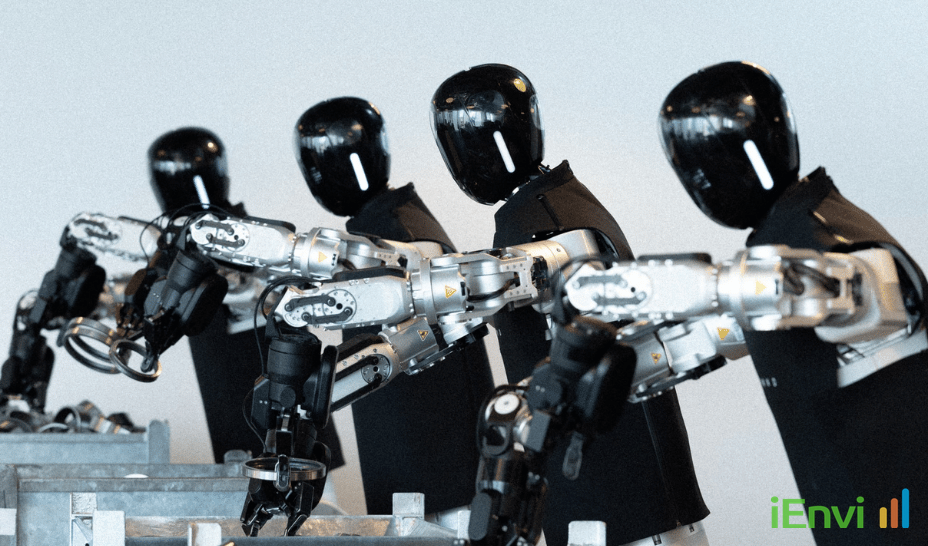
Humanoid’s flagship product, the HMND 01, uses a wheeled rather than bipedal locomotion system. This is a deliberate engineering choice that prioritises industrial practicality over the visual appeal of a walking humanoid form. Wheeled platforms eliminate the substantial energy demands associated with bipedal balance and gait, allow for longer operational cycles between charges, and navigate structured industrial floor environments, such as warehouses and production lines, with greater consistency and reliability. Critically, from a regulatory and deployment standpoint, wheeled robotic systems face a considerably simpler path to workplace health and safety certification in structured industrial environments compared to bipedal alternatives, which remain subject to ongoing stability, collision, and fall-risk concerns under most industrial safety frameworks.
The intelligence layer underpinning the HMND 01 is Humanoid’s proprietary KinetIQ framework. KinetIQ is described as a four-layer active-inference physical AI pipeline. In practical terms, this means the system is designed to perceive its physical environment through onboard sensors, interpret complex natural language instructions from human operators, plan appropriate physical responses, and execute precise manipulation tasks autonomously without requiring task-specific programming for each new operation. This architecture is what differentiates modern physical AI robots from earlier generations of industrial automation, which required rigid, pre-programmed instruction sets and could not adapt to unstructured or variable task conditions. The company has scaled to over 250 employees across offices in London, Boston, Vancouver, and San Diego, reflecting both the breadth of talent required and the genuinely global nature of the physical AI development ecosystem.
Artem Sokolov, Founder and CEO of Humanoid, described the company’s trajectory in direct terms: “In just two years, we’ve gone from an idea to becoming Europe’s first pure-play humanoid robotics unicorn, partnered with some of the world’s leading industrial companies and built one of the strongest pipelines in the industry. What we’ve accomplished in such a short time would typically take a decade.” That compression of development timelines is being enabled by advances in simulated training environments, which allow physical AI systems to accumulate the equivalent of years of real-world operational experience within controlled digital simulations before a single physical unit is deployed.
Australian context: physical AI implications for industrial operations and professional services
Australia’s industrial and resources sector operates some of the most complex and hazardous working environments in the world, spanning mining operations, chemical manufacturing, port logistics, waste processing, and large-scale infrastructure. These are precisely the environments where wheeled physical AI platforms capable of executing repetitive, physically demanding tasks stand to deliver measurable operational and safety benefits. For Australian enterprise operators and industrial facility managers, the Humanoid raise and its associated deployment commitments represent a credible signal that physical AI systems warrant inclusion in near-term operational planning, workforce strategy, and workplace health and safety risk assessments.
References and related sources
- Primary source: www.siliconrepublic.com
- eu-startups.com
- humanoidhub.ai
- forbes.com
- thehumanoid.ai
How iEnvi can help
iEnvi integrates technology and data-driven approaches into environmental consulting. We monitor AI and technology developments that affect how environmental professionals deliver services to clients.
This is an iEnvi Machete news summary. Prepared by iEnvi to summarise the source article for environmental professionals tracking AI, data, and technology developments that affect consulting and project delivery.
Published: 23 Jul 2026
Need advice on this topic? Speak to an iEnvi expert at info@ienvi.com.au or 1300 043 684, or contact us online.
Need advice on this issue? iEnvi provides practical, senior-led environmental consulting across contaminated land, remediation, ecology and environmental risk.