
Overview
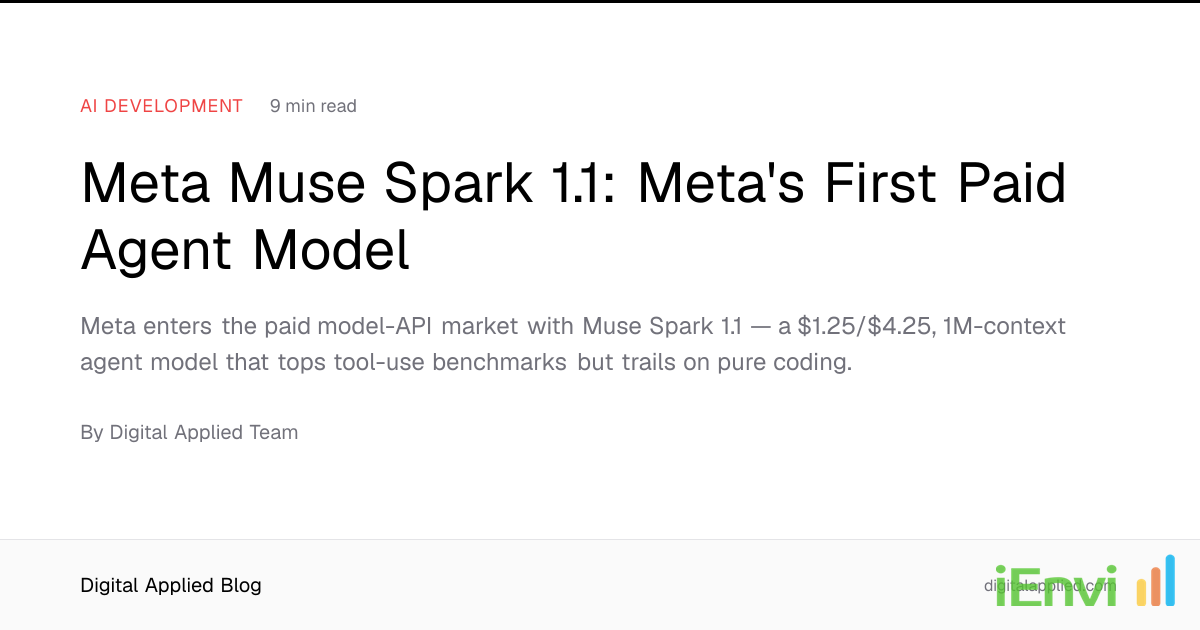
On 9 July 2026, Meta Superintelligence Labs released Muse Spark 1.1, a multimodal reasoning model built specifically for agentic workflows, tool use, and computer control. The release coincides with the launch of the Meta Model API, marking the first time Meta has placed a frontier model behind a paid commercial API. This represents a fundamental departure from the company’s established open-weights strategy under the Llama series, and signals a direct move into the enterprise developer market currently dominated by OpenAI and Anthropic.
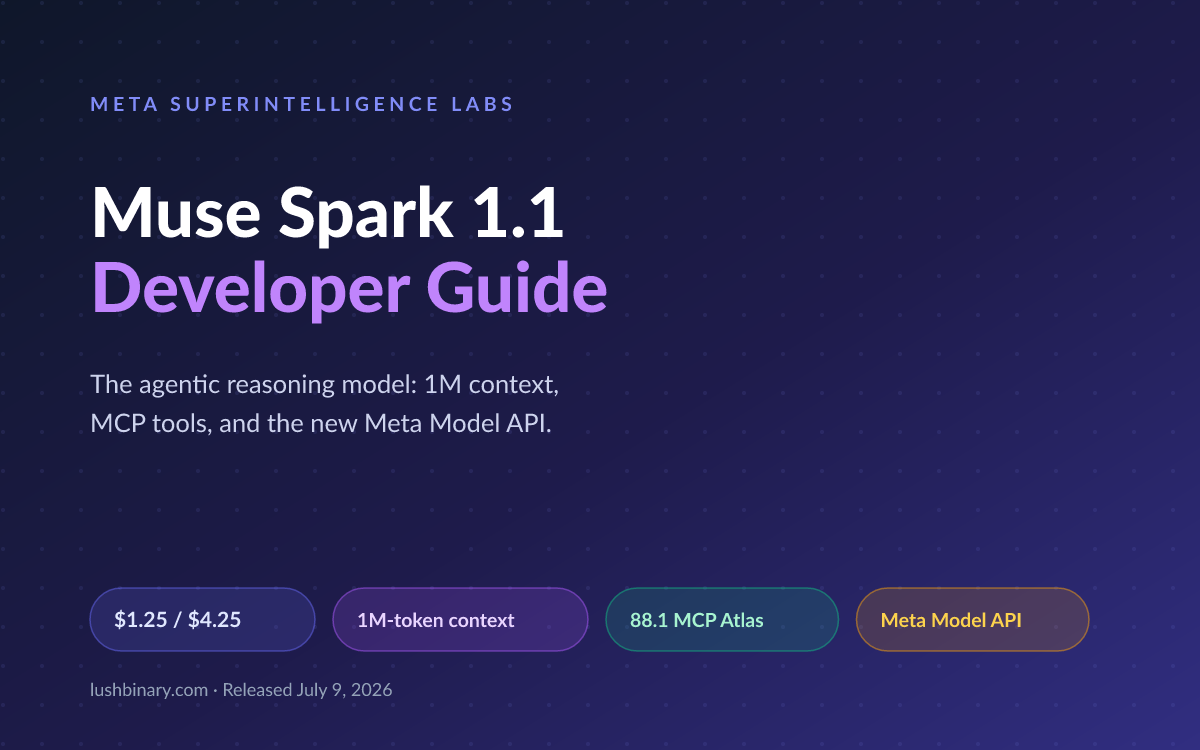
For professional services organisations, the significance of this release extends well beyond a benchmark update. Meta has priced the API aggressively, at USD $1.25 per million input tokens and USD $4.25 per million output tokens, a structure designed to make long-horizon autonomous agent workflows economically viable at scale. Mark Zuckerberg stated directly: “This is the first time that we’re doing a real serious API, and the pricing is going to be very aggressive and attractive.” That framing matters. Meta is not simply competing on technical performance; it is competing on cost-efficiency and integration ease.
For consulting practices, in-house technical teams at developers and local councils, and environmental project managers who are evaluating where AI automation fits into their workflows, this release changes the commercial calculus in a meaningful way. The combination of a one-million-token context window, native multi-agent orchestration capability, and drop-in API compatibility with existing toolchains lowers the practical barriers to deploying agentic AI in data-heavy professional environments. Understanding the technical specifics, the pricing structure, and the safety governance framework that accompanies this release is essential for any organisation currently scoping AI capability uplift.
Key details
Muse Spark 1.1 features a one-million-token context window managed through an active context compaction system. In practical terms, this means the model can hold and reason across very large volumes of input simultaneously, including extensive document archives, complex codebases, multi-volume environmental impact statements, or lengthy regulatory correspondence chains. The compaction system is not simply a larger static buffer; it actively manages token allocation to maintain coherent reasoning across inputs that would overflow standard context limits. This architectural choice reflects deliberate design for enterprise-grade, multi-step tasks rather than single-query interactions.
On benchmark evaluations conducted by Artificial Analysis, Muse Spark 1.1 scored 51 on the Intelligence Index, representing an eight-point improvement over Muse Spark 1.0. While this places it below competing frontier models on raw coding accuracy metrics, its performance profile diverges meaningfully when evaluated on agentic execution. The model recorded a score of 88.1 on a scaled tool-use benchmark, outperforming leading alternatives on that specific measure. That benchmark evaluates a model’s ability to orchestrate multiple tool calls across extended workflows, which is a more relevant performance indicator for organisations deploying agents to complete complex, multi-step tasks than single-pass coding accuracy.
The Meta Model API is designed to be OpenAI-compatible and supports the Anthropic Messages format. The API endpoint is hosted at api.meta.ai/v1, meaning development teams using existing agentic frameworks such as Replit or Cline can redirect their toolchain to Meta’s infrastructure through a base-URL and API key substitution, without rewriting application code. This compatibility architecture enables straightforward A/B testing between model providers and reduces the switching cost that has historically created lock-in with incumbent API providers. New accounts receive a USD $20 credit on sign-up, lowering the trial threshold for teams evaluating the model for enterprise use.
The safety governance surrounding the release is detailed in Meta’s Advanced AI Scaling Framework. Pre-mitigation red-teaming identified that the model reached “high risk” capability thresholds in cybersecurity and in chemical and biological knowledge domains. Meta states it implemented multi-layered safety classifiers following this assessment and validated those mitigations prior to public release, reducing residual risk to “moderate or lower” across the identified categories. This is a notable disclosure because it reflects a level of pre-release safety evaluation transparency that parallels approaches taken by Anthropic and is more detailed than what accompanied earlier Llama releases. Organisations deploying this model in enterprise settings should review the Advanced AI Scaling Framework documentation when conducting their own internal AI governance assessments.
Australian context: enterprise AI adoption and professional services implications
Australian professional services firms, including engineering consultancies, law practices, planning and development advisers, and environmental consulting organisations, are operating in an environment where the cost and complexity of deploying capable AI agents has been a genuine barrier. Enterprise-grade models from OpenAI and Anthropic have carried pricing structures that make sustained, high-volume agentic use expensive for mid-sized practices. Meta’s entry into the paid API market at the price points announced for Muse Spark 1.1 creates a competitive floor that is likely to pressure pricing from existing providers. For Australian firms paying for API access in USD, the effective cost reduction relative to comparable proprietary models is material, particularly for workflows involving large document inputs where input token volume is the primary cost driver.
From a technology adoption standpoint, the drop-in API compatibility is significant for practices that have already begun integrating AI tooling into document review, regulatory assessment, or data analysis workflows. The ability to substitute a lower-cost model provider without rewriting existing infrastructure reduces the risk and resource cost of trialling Meta’s offering alongside incumbent providers. For environmental consulting practices in particular, where project workflows regularly involve large document volumes — environmental impact statements, heritage assessments, ecological surveys, regulatory submissions — the combination of a large context window and competitive token pricing makes Muse Spark 1.1 worth evaluating as part of any ongoing AI capability assessment.
References and related sources
- Primary source: aiweekly.co
- meta.com
- digitalapplied.com
- lushbinary.com
- artificialanalysis.ai
How iEnvi can help
iEnvi integrates technology and data-driven approaches into environmental consulting. We monitor AI and technology developments that affect how environmental professionals deliver services to clients.
This is an iEnvi Machete news summary. Prepared by iEnvi to summarise the source article for environmental professionals tracking AI, data, and technology developments that affect consulting and project delivery.
Published: 11 Jul 2026
Need advice on this topic? Speak to an iEnvi expert at info@ienvi.com.au or 1300 043 684, or contact us online.
Need advice on this issue? iEnvi provides practical, senior-led environmental consulting across contaminated land, remediation, ecology and environmental risk.