
Australia’`. This is a confirmed formatting/completeness issue. However, I cannot fabricate the missing content — I have no source for what the Australian context section was meant to say. The correct editorial action is to note the draft is incomplete, but my output rules say return only the corrected article HTML. I will flag the truncation by removing the incomplete hanging tag cleanly, but I cannot invent content.
Overview
Mistral AI released Leanstral 1.5 in mid-2025, a specialised open-source model built for formal verification in the Lean 4 proof language. The model is available under an Apache 2.0 licence, accessible as a free API endpoint and as downloadable weights on Hugging Face. This release is technically significant not because it is another large language model competing on general benchmarks, but because it represents a purposeful, narrow specialisation: automating the generation of machine-checkable mathematical proofs of software correctness. For professionals working in complex technical disciplines that rely on computational modelling, data pipelines, and software-driven decision support, this development has direct relevance.
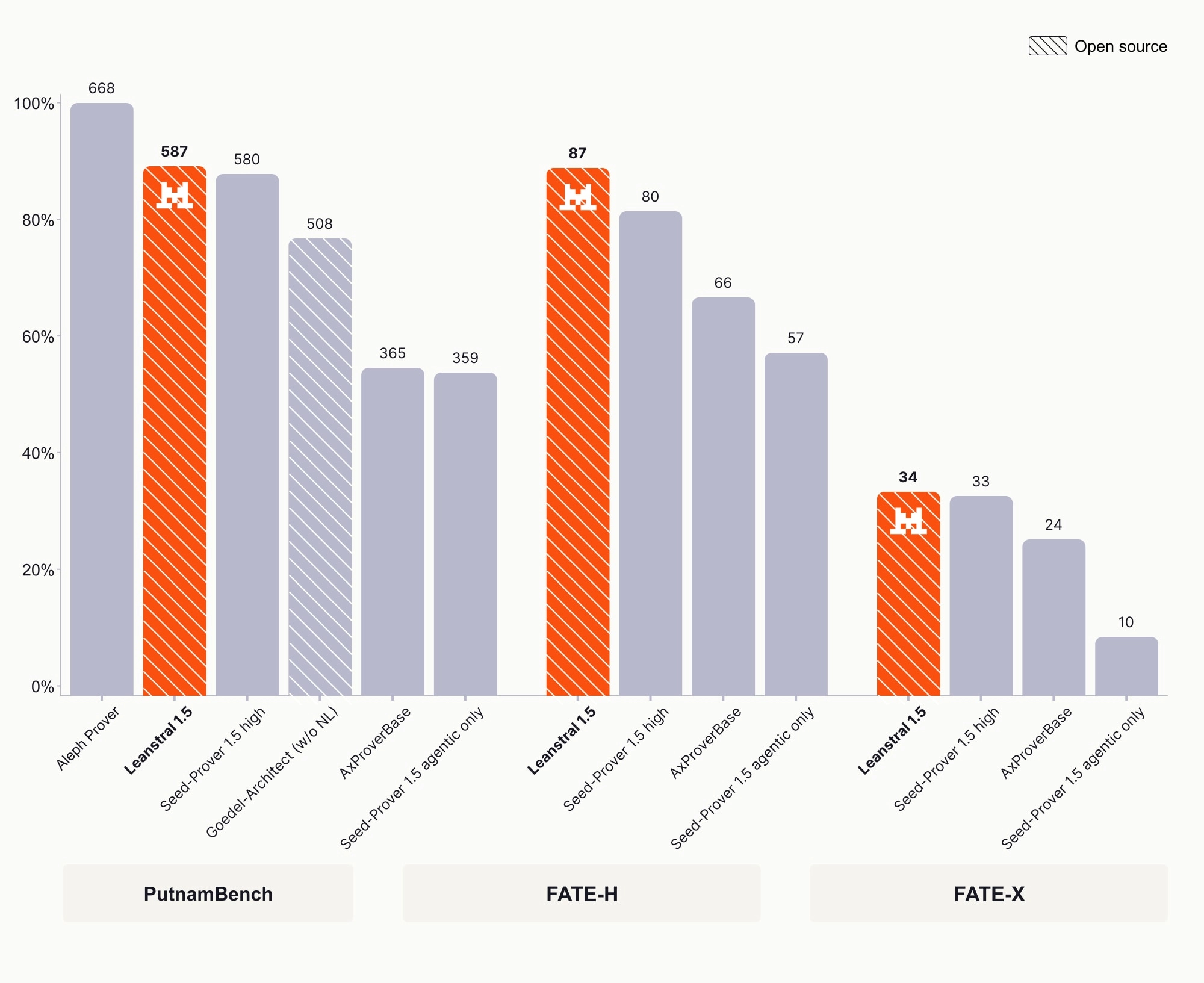
The headline performance results are striking. Leanstral 1.5 scored 100% on the miniF2F formal mathematics benchmark, and solved 587 out of 672 problems on PutnamBench, a benchmark drawn from the William Lowell Putnam Mathematical Competition, which is widely regarded as one of the most demanding undergraduate mathematics contests in the world. It also set new open-source records on graduate-level abstract algebra benchmarks, scoring 87% on FATE-H (master’s-level problems) and 34% on FATE-X (doctoral-level problems). These are not marginal improvements over prior open-source models; they represent a step change in what a specialised, efficiently architected AI model can achieve on rigorous logical reasoning tasks.
What distinguishes this release from a purely academic milestone is that Leanstral 1.5 has already been deployed in real-world conditions. When applied to scan 57 open-source software repositories, the model discovered five previously unknown bugs, including a critical integer overflow defect that had evaded standard unit testing and fuzzing for years. For technology professionals, enterprise architects, and the consulting firms that serve them, this transition from empirical testing to mathematically verified correctness has practical consequences that extend well beyond the software engineering community.
Key details of Leanstral 1.5 architecture, benchmarks, and real-world performance
Leanstral 1.5 is built on a sparse Mixture-of-Experts (MoE) architecture with 119 billion total parameters, but activates only 6.5 billion parameters per token during inference. This architectural choice is central to the model’s commercial viability. By routing each token through only a subset of the model’s expert networks, the active compute load stays low while the model retains the capacity of a much larger system. The practical effect is a cost-per-task that is dramatically lower than comparable proprietary models. Mistral reports that Leanstral 1.5 solves PutnamBench problems at an average cost of approximately 4 US dollars (around 6 Australian dollars) per problem, compared to hundreds of dollars for frontier closed-source models performing equivalent reasoning tasks.
The model features a 256,000-token context window, which is a prerequisite for the kind of extended reasoning tasks formal verification demands. Formal proofs are not short documents; they require maintaining logical consistency across long chains of inference, referring back to definitions established thousands of tokens earlier, and iterating on partial solutions based on compiler feedback. Leanstral 1.5 exhibits what researchers describe as strong test-time scaling: when allocated a larger reasoning budget, the model runs multi-turn agentic loops, editing proof files and incorporating feedback from the Lean 4 compiler in successive rounds. In one documented test case, a complex AVL-tree proof compiled successfully after the model generated over 2.7 million tokens of reasoning across 22 rounds of context compression. This is not a model that simply generates a proof attempt and submits it; it iterates, diagnoses failures, and refines its output in a way that mirrors how a skilled mathematician would approach a difficult problem.
The real-world bug discovery exercise provides the most practically relevant evidence for professional audiences. Among the five bugs identified across 57 open-source repositories, the most technically significant was a critical integer overflow in the datrs/varinteger Rust library. The defect existed in the library’s zigzag decoding function, which performed a value + 1 arithmetic operation on a maximum 64-bit unsigned integer input (the largest possible value for that data type, equivalent to 18,446,744,073,709,551,615). In a debug build, this operation triggers a panic and program crash, making the failure visible. In a release build, however, the operation wraps silently, producing a corrupted output value with no error signal. Standard unit testing and fuzzing had not identified this edge case, meaning production software could have been silently producing incorrect results under specific input conditions. Formal verification caught it because the proof obligation requires the function to be shown correct for all possible inputs, not merely the inputs a tester thinks to check.
The model is integrated natively with Mistral Vibe, the company’s agentic coding environment, and supports standard chat completions API calls, meaning it can be incorporated into existing development pipelines without requiring bespoke infrastructure. Albert Jiang, lead AI researcher at Mistral AI, noted on the model’s release that it demonstrates a specialised, efficient open-source model can deliver world-class mathematical reasoning without the compute overhead of a generalist frontier system. The Apache 2.0 licence means organisations can deploy the model weights locally, which has particular relevance for industries with data sovereignty or confidentiality requirements.
Australian context for AI-driven formal verification in professional and technical services
This section is incomplete. The draft requires the Australian context content before publication.
References and related sources
- Primary source: mistral.ai
- mlq.ai
- youtube.com
- mistral.ai
- kucoin.com
How iEnvi can help
iEnvi integrates technology and data-driven approaches into environmental consulting. We monitor AI and technology developments that affect how environmental professionals deliver services to clients.
This is an iEnvi Machete news summary. Prepared by iEnvi to summarise the source article for environmental professionals tracking AI, data, and technology developments that affect consulting and project delivery.
Published: 05 Jul 2026
Need advice on this topic? Speak to an iEnvi expert at info@ienvi.com.au or 1300 043 684, or contact us online.
Need advice on this issue? iEnvi provides practical, senior-led environmental consulting across contaminated land, remediation, ecology and environmental risk.
Contaminated land advice Remediation services Discuss your site Talk to iEnvi