
Overview
On 27 July 2024, Narrabri Shire Council’s Infrastructure Team presented a detailed update to the council’s Ordinary Council Meeting outlining the financial and logistical scale of the challenge facing the town’s water supply. The update confirmed that the Killarney Bore remains switched off due to PFAS contamination, and that bringing it back into service under the tightened Australian Drinking Water Guidelines (ADWG) June 2025 will require capital investment of between $30 million and $40 million for a permanent treatment facility, plus $12 million for an interim temporary plant. These figures represent some of the most concrete, publicly available cost benchmarks for municipal-scale PFAS water treatment in regional Australia.
The case is significant because it is not a legacy industrial site or a defence base with a clear responsible party and a dedicated remediation programme. It is a regional council water utility grappling with new health-based guideline limits that have made a previously serviceable bore unfit for supply. The ADWG June 2025 tightened the health-based guideline value for perfluorooctane sulfonate (PFOS) to 8 nanograms per litre (ng/L), a threshold the Killarney Bore currently exceeds by a factor of three. Mayor Darrell Tiemens has publicly stated that these costs should not fall on local ratepayers, and the council is actively lobbying state and federal ministers for funding assistance.
For environmental consultants, water engineers, developers, lawyers, and councils managing water supply infrastructure, this case crystallises several converging pressures: stricter health-based limits under revised national guidelines, a critical shortage of local PFAS waste disposal infrastructure, and the absence of any clear cost-sharing mechanism between local government and higher tiers of government when diffuse or historic contamination forces compliance expenditure. The Narrabri situation is unlikely to be unique. As the ADWG June 2025 limits are applied across Australia’s regional water supply network, similar forced-offline scenarios are expected at bores where PFAS has been detected at levels that were previously acceptable under older guidance.
Key details of the Killarney Bore PFAS contamination and treatment cost estimates
Water quality sampling conducted on 21 July 2024 returned the following results for the Killarney Bore. PFOS was measured at 24 ng/L, which is three times the ADWG June 2025 health-based guideline value of 8 ng/L. PFHxS was detected at 29 ng/L, sitting just below the guideline value of 30 ng/L. PFOA was recorded at 2 ng/L, well below its guideline value of 200 ng/L, and PFBS was detected at 6 ng/L against a guideline value of 1,000 ng/L. While PFOA and PFBS present no exceedance, the PFOS result alone is sufficient to preclude the bore from contributing to the drinking water supply as a standalone source under current guidelines.
The council’s current operational response is blending. The town’s drinking water supply is maintained by combining water from multiple sources so that the blended product meets the ADWG June 2025 limits. The Killarney Bore itself remains offline and is not contributing to the blend at this stage. However, the bore represents critical supply redundancy for the regional town, and the council has identified that restoring it to service requires active treatment rather than continued exclusion from supply.
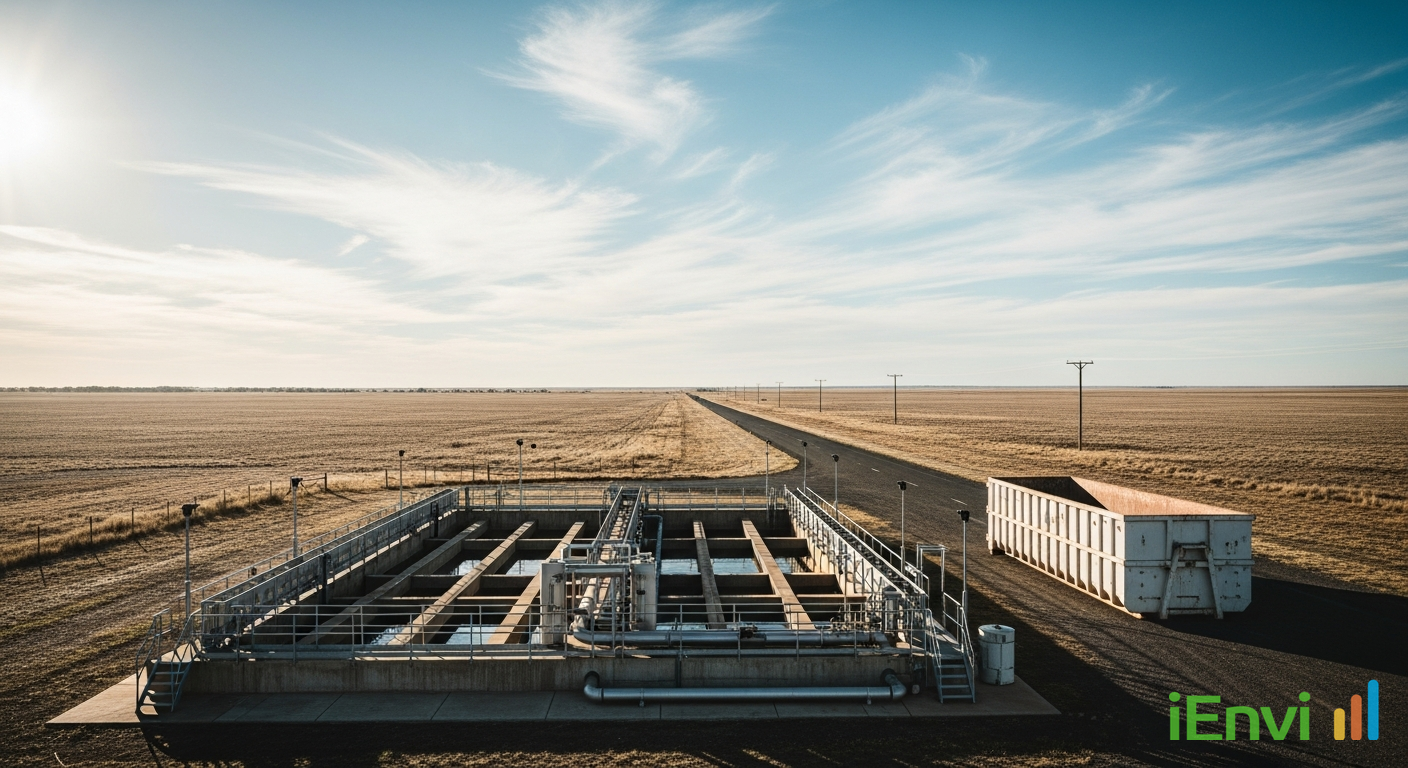
The pre-construction cost estimate for a temporary water treatment plant capable of treating at 120 litres per second (L/s) is $12 million. A permanent treatment facility designed for a peak production capacity of 6 megalitres per day (ML/day) carries a cost estimate of between $30 million and $40 million. These figures come directly from the council’s infrastructure team briefing delivered to the 27 July 2024 Ordinary Council Meeting, and they reflect the cost of granular activated carbon (GAC) or ion exchange (IX) treatment systems of the scale required to service a regional town. Both technologies are capable of reducing PFAS concentrations to below guideline values, but both generate concentrated PFAS-bearing waste media that must be managed under a separate and increasingly constrained disposal pathway.
The waste disposal bottleneck is a central element of the council’s operational challenge. Spent GAC and IX resin loaded with PFAS compounds cannot be accepted by local landfills under current restrictions governing PFAS waste classification and acceptance criteria. The council has confirmed that the concentrated waste stream from the proposed treatment plant would need to be either incinerated at a high-temperature facility capable of destroying PFAS compounds, or transported to a specialised waste facility in Queensland. Neither option is cheap, and neither is locally available. The ongoing operational cost associated with this waste management obligation adds a recurrent financial burden on top of the initial capital expenditure, compounding the affordability challenge for a regional council with a limited ratepayer base.
Australian context: ADWG June 2025, PFAS NEMP 3.0, and implications for water supply regulation
The ADWG June 2025 health-based guideline values for PFAS represent a substantial tightening relative to previous versions. The PFOS limit of 8 ng/L is particularly consequential because PFOS is the compound most frequently detected above actionable concentrations in groundwater bores near airports, defence facilities, industrial precincts, and areas where aqueous film-forming foam (AFFF) was historically used. The Narrabri case demonstrates that even where a council or water utility has not been directly implicated in PFAS use, its groundwater supply may nonetheless carry PFOS concentrations that now fail the revised health-based standard. This is a nationwide exposure for regional water authorities, many of whom operate bores that have not been comprehensively screened under the new guideline thresholds.
References and related sources
- Primary source: www.narrabri.nsw.gov.au
- nsw.gov.au
- https://www.narrabri.nsw.gov.au/Council-receives-update-on-PFAS-water-projects
- https://www.narrabri.nsw.gov.au/Latest-PFAS-Test-Results-27-July
- PFAS National Environmental Management Plan (NEMP)
- ANZG Water Quality Guidelines
- Australian Drinking Water Guidelines
How iEnvi can help
iEnvi provides specialist consulting services relevant to this topic. Our team includes CEnvP Site Contamination Specialists with experience across contaminated land, groundwater, remediation, ecology, and regulatory compliance.
- iEnvi remediation services
- iEnvi groundwater services
- iEnvi expert services and independent review services
This is an iEnvi Machete news summary. Prepared by iEnvi to summarise the source article for contaminated land, groundwater, remediation, approvals and site risk professionals.
Published: 29 Jul 2026
Need advice on this topic? Speak to an iEnvi expert at info@ienvi.com.au or 1300 043 684, or contact us online.
Need advice on this issue? iEnvi provides practical, senior-led environmental consulting across contaminated land, remediation, ecology and environmental risk.
Team credentials Environmental management plans Contaminated land advice Remediation services Talk to iEnvi