
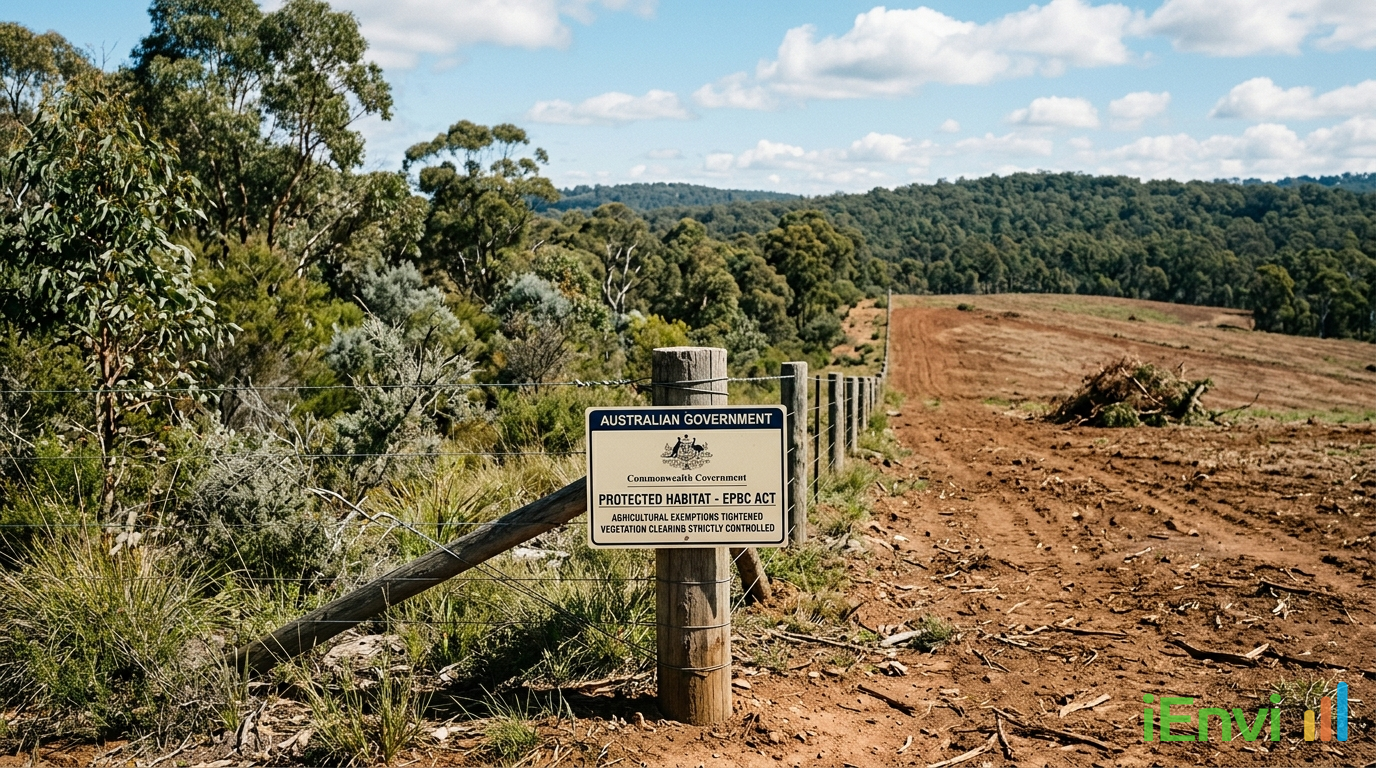
Overview of EPBC Act Land-Clearing Exemption Changes
Australia’s newly established federal regulator, the National Environmental Protection Agency (National EPA), published its first sector-specific compliance guidance on 10 August 2026, titled “Agriculture and the EPBC Act”. The guidance translates recent federal reforms to land-clearing exemptions under the Environment Protection and Biodiversity Conservation Act 1999 (EPBC Act) into operational advice for farmers, landholders, and the consultants who advise them on native vegetation and land management decisions.
The document matters well beyond the farm gate. It sets out, for the first time in plain operational language, how the reformed Section 43B continuation of use exemption now applies, how the new 50 metre riparian buffer in Great Barrier Reef catchments is to be assessed, and when self-assessment gives way to a formal referral for Matters of National Environmental Significance (MNES). For environmental consultants, property lawyers, and council planners working on regional Australia projects, this is the first authoritative statement of how the National EPA intends to enforce the reformed exemption regime in practice, not just how the amended legislation reads on paper.
Developers of rural infrastructure, renewable energy, and agribusiness projects have historically treated a property’s farming history as a low-risk starting point for clearing works. This guidance closes that assumption down. It confirms that historical agricultural use, on its own, no longer provides blanket protection from Commonwealth environmental law, and it gives practitioners a working framework for identifying where federal referral obligations now sit alongside state-based vegetation approvals.
Key Revisions to Section 43B and Riparian Buffer Rules
The core statutory change addressed in the guidance is the narrowing of the Section 43B continuation of use exemption under the EPBC Act. Under the reformed framework, landholders can no longer rely on Section 43B to clear native vegetation that has not been cleared in the past 15 years. In effect, if regrowth or remnant vegetation on a parcel has been left undisturbed for 15 years or more, clearing it is treated as a new activity requiring assessment against MNES criteria, rather than a continuation of an existing land use.
A second major change is the introduction of a 50 metre buffer zone along watercourses, wetlands, and drainage lines within the Great Barrier Reef catchment area. Clearing or land-use intensification within this buffer is no longer captured by the historical continuation of use defence, regardless of how long the surrounding paddock has been under active agricultural management. This is a specific, measurable spatial threshold that consultants can apply directly in desktop and field assessments, and it sits squarely within the National EPA’s remit given the Commonwealth’s established interest in Great Barrier Reef water quality outcomes.
The guidance also details self-assessment processes and referral triggers for MNES, giving landholders and their advisers a structured method for determining whether a proposed clearing activity, change in land-use intensity, or infrastructure works (such as firebreaks or new access tracks) requires formal referral to the National EPA. This self-assessment framework is the practical mechanism through which the 15-year regrowth rule and the 50 metre buffer are to be applied on the ground, and it forms the operational backbone of the document.
Underpinning all of this is the broader institutional reform. The National EPA was established under the Environment Protection Reform Act 2025 (Cth) as Australia’s first dedicated federal environmental regulator, and this guidance is its inaugural sector-specific publication. That sequencing signals that agriculture and regional land management, sectors with a heavy reliance on continuation of use exemptions, were identified as an early compliance priority following the 2025 reforms.
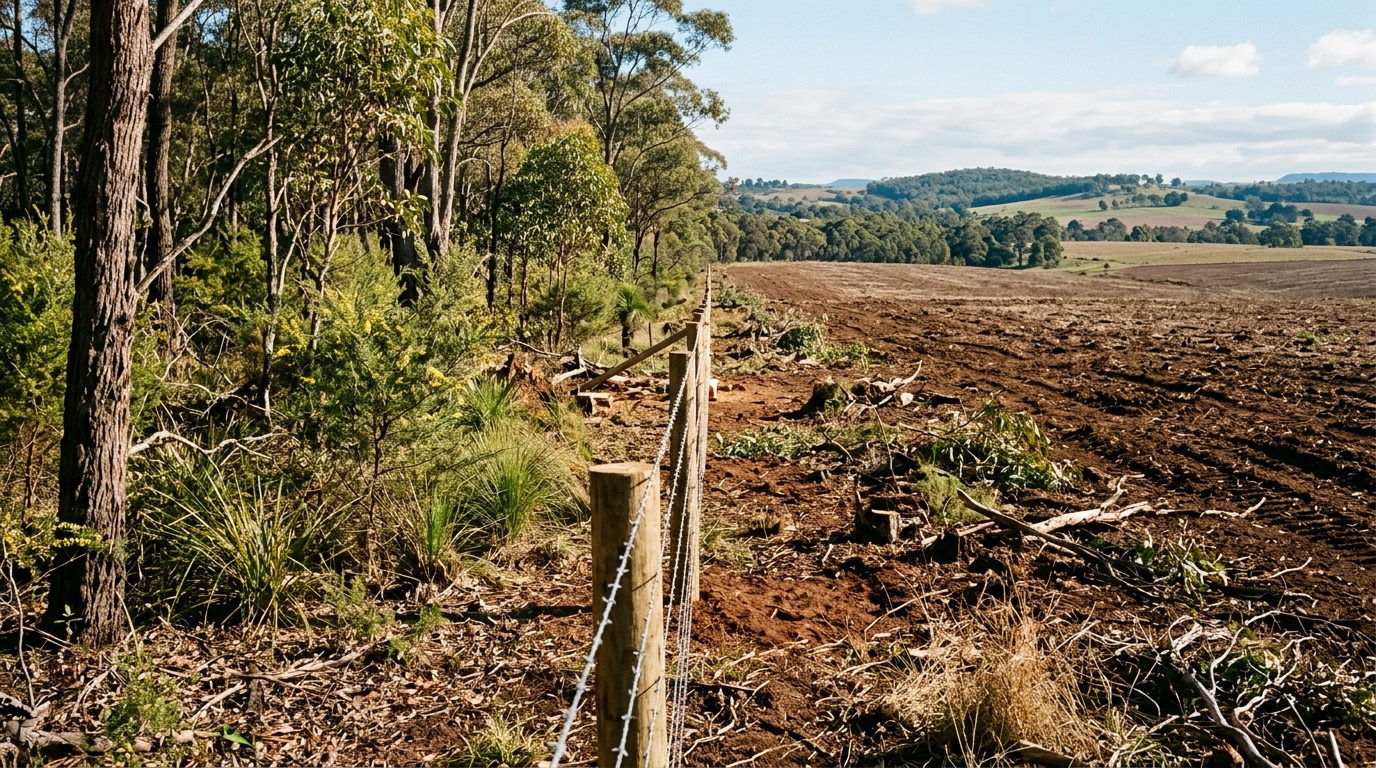
Impacts on Australian Environmental Approvals and Practitioners
For Australian environmental practitioners, this guidance sits alongside and independently of state-based native vegetation frameworks such as Queensland’s Vegetation Management Act, NSW’s Local Land Services Act native vegetation provisions, and equivalent regimes in Victoria and South Australia. A critical point the National EPA guidance makes explicit is that state-level clearing permits or development approvals provide no defence against federal EPBC Act enforcement. Consultants working on regional projects have long managed dual state and federal obligations for threatened species and ecological communities, but the removal of the blanket 15-year continuation of use protection materially expands the pool of clearing activities that now require fresh MNES assessment.
This is particularly relevant for practitioners preparing referral matrices, ecological due diligence reports, or pre-acquisition land reviews for clients in regional Queensland, NSW, and northern Victoria, where agricultural land is frequently repurposed for renewable energy generation, transmission infrastructure, or intensive agribusiness expansion. Where a due diligence assessment previously concluded that a site’s farming history removed the need for a federal referral, that conclusion can no longer be assumed to hold, particularly where regrowth vegetation has been undisturbed for 15 years or more or where works fall within 50 metres of a watercourse in a Great Barrier Reef catchment.
The guidance does not amend state vegetation management codes, ANZG water quality guidelines, or NEPM 2013 contaminated land assessment frameworks, and nothing in the source material extends the reforms to soil or groundwater contamination matters. Its relevance is confined to native vegetation clearing and MNES referral triggers under the EPBC Act, and practitioners should treat it as a distinct compliance stream from contaminated land obligations, which continue to operate under their existing frameworks unchanged.
References and related sources
- Primary source: nationalepa.gov.au
- https://nationalepa.gov.au/about-us/news-and-media/new-guide-help-farmers-comply
- EPBC Act
How iEnvi can help
iEnvi provides specialist consulting services relevant to this topic. Our team includes CEnvP Site Contamination Specialists with experience across contaminated land, groundwater, remediation, ecology, and regulatory compliance.
- iEnvi due diligence services
- iEnvi remediation and validation services
- iEnvi expert services and independent review services
This is an iEnvi Machete news summary. Prepared by iEnvi to summarise the source article for contaminated land, groundwater, remediation, approvals and site risk professionals.
Published: 11 Aug 2026
Need advice on this topic? Speak to an iEnvi expert at info@ienvi.com.au or 1300 043 684, or contact us online.
Need advice on this issue? iEnvi provides practical, senior-led environmental consulting across contaminated land, remediation, ecology and environmental risk.
Team credentials Contaminated land services Remediation services Groundwater services Talk to iEnvi